On this page
Most NEET questions on d- and f-block elements need two quick checks: the ion's d (or f) electron count, and how many electrons a redox partner moves. These 8 original single-correct questions train both, easy to hard.
Every question stays inside Unit 11, d- and f-Block Elements, of the NMC's NEET (UG)-2026 syllabus, which lists colour, magnetic properties, interstitial compounds, K2Cr2O7 and KMnO4, lanthanoids and actinoids. Each fact matches Unit 4 of NCERT Class 12 Chemistry Part I, Reprint 2026-27.
How should you use this d- and f-block practice set?
Time yourself. NEET (UG)-2026 had 180 compulsory questions in 180 minutes, with +4 for a correct answer and −1 for a wrong one, according to the NTA information bulletin. Aim for about a minute each.
Before you look at the options, write the ion's dⁿ count, or the balanced half-reaction, in the margin.
Read the trap line even when you are right.
Log each miss with its rule and retry it after three days.
If the chapter is still new to you, read our guide on how to prepare d- and f-Block Elements for NEET first.
Easy: can you count d electrons?
Q1 (easy). Aquated Ti3+ is purple, but aquated Ti4+ is colourless. Which statement explains the difference?
(A) Ti4+ is 3d1, and one d electron cannot absorb visible light (B) Ti4+ is 3d0, so no d-d transition is possible (C) Ti4+ is 3d10, a completely filled d subshell (D) Ti4+ keeps its 4s2 electrons, which absorb only ultraviolet light
Answer: (B). Titanium is 3d2 4s2; losing four electrons leaves 3d0, and colour in these ions needs a d-d transition. NCERT's table of aquated ions lists Ti4+, Sc3+ (both d0) and Zn2+ (d10) as colourless. Trap: (A) describes Ti3+, which is 3d1 and is the purple one.
Q2 (easy). Which pair of ions has the same spin-only magnetic moment?
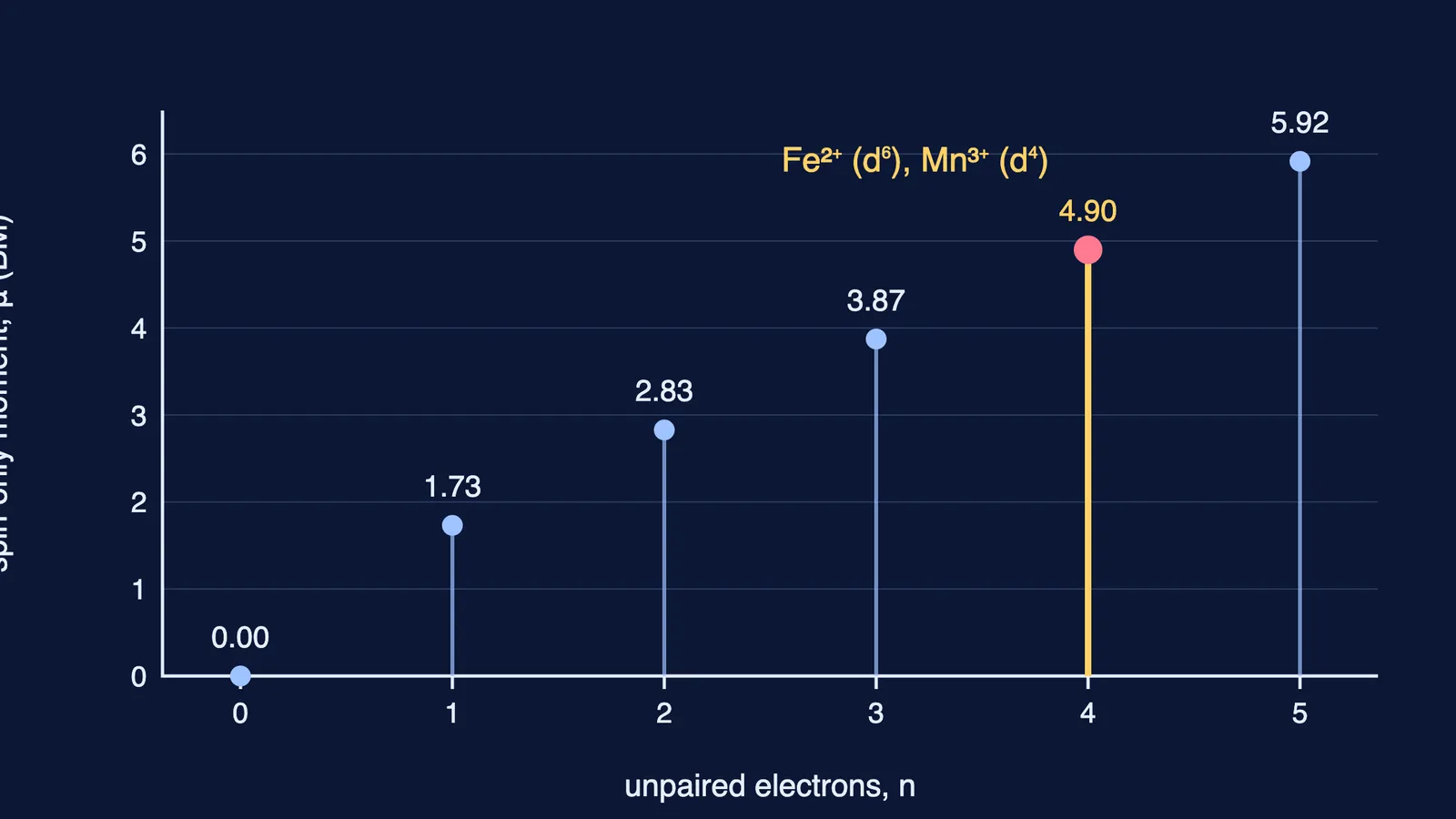
(A) Fe2+ and Mn3+ (B) Fe2+ and Co2+ (C) Cr3+ and Mn2+ (D) Ti3+ and V3+
Answer: (A). Fe2+ is 3d6 and Mn3+ is 3d4. Both have four unpaired electrons, so μ = √(4 × 6) = 4.90 BM for each. Trap: (B) assumes the same charge gives the same moment; Co2+ is 3d7 with three unpaired electrons, 3.87 BM.
Q3 (easy). Small atoms such as H, C or N trapped in a metal lattice give interstitial compounds like TiC and Fe3H. Which property do these compounds NOT have?
(A) Melting points higher than the pure metal (B) Great hardness (C) Metallic conductivity (D) Greater chemical reactivity than the metal
Answer: (D). NCERT lists four features: high melting points, great hardness, retained metallic conductivity and chemical inertness. They are inert, not more reactive. Trap: (C) assumes a non-metal inside the lattice kills conduction; it does not.
Medium: can you link configuration to redox behaviour?
Q4 (medium). X2+ and Y3+ are both d4 ions of the first transition series. X2+ is reducing and Y3+ is oxidising in water. Identify X and Y.
(A) X = Mn, Y = Cr (B) X = Cr, Y = Mn (C) X = Fe, Y = Mn (D) X = Cr, Y = Fe
Answer: (B). Only Cr2+ and Mn3+ are d4. Cr2+ loses an electron to reach Cr3+, d3 with a half-filled t2g level; Mn3+ gains one to reach the extra-stable d5 Mn2+, as NCERT explains. Trap: (A) swaps the roles, but Mn2+ is d5 and Cr3+ is d3.
Q5 (medium). Excess KI is added to an acidified solution containing 0.020 mol K2Cr2O7. What mass of I2 (254 g mol⁻¹) is liberated?
(A) 5.08 g (B) 7.62 g (C) 15.2 g (D) 30.5 g
Answer: (C). Cr2O7²⁻ + 14H⁺ + 6I⁻ → 2Cr³⁺ + 3I2 + 7H2O. Each dichromate takes 6 electrons, which frees 3 I2, so 0.060 mol × 254 = 15.2 g. Trap: (D) counts 6 mol of I2 instead of 6 mol of I⁻; two iodides make one I2.
Q6 (medium). In the preparation of KMnO4, 0.45 mol of K2MnO4 disproportionates in acidic solution. How many moles of KMnO4 form?
(A) 0.15 (B) 0.225 (C) 0.30 (D) 0.45
Answer: (C). The NCERT equation is 3MnO4²⁻ + 4H⁺ → 2MnO4⁻ + MnO2 + 2H2O. Two of every three manganate ions rise from +6 to +7 and one falls to +4, so 0.45 × 2/3 = 0.30 mol. Trap: (D) forgets this is disproportionation; a third of the manganese ends up as MnO2.
Hard: can you handle the medium and the f-block?
Q7 (hard). In neutral or faintly alkaline solution, KMnO4 oxidises iodide to iodate. How many moles of KMnO4 are needed for 0.030 mol of KI?
(A) 0.006 (B) 0.010 (C) 0.036 (D) 0.060
Answer: (D). Here permanganate stops at MnO2 (+7 to +4, 3 electrons), while I⁻ goes to IO3⁻ (−1 to +5, 6 electrons). So each iodide needs two permanganate ions, matching NCERT's 2MnO4⁻ + H2O + I⁻ → 2MnO2 + 2OH⁻ + IO3⁻, and 2 × 0.030 = 0.060 mol. Trap: (A) uses the acid reaction, where Mn goes to Mn2+ and iodide only to I2.
Q8 (hard). Which statement about f-block oxidation states is correct?
(A) Ce4+ is a strong reducing agent because its 4f subshell is half-filled (B) Eu2+ is a strong oxidising agent because gaining an electron gives 4f7 (C) Actinoids show a greater range of oxidation states, partly because their 5f, 6d and 7s levels have comparable energies (D) Uranium shows the highest oxidation state among actinoids, +7
Answer: (C). This is NCERT's reason for the actinoids' wider range. Ce4+ is 4f0 and a strong oxidant; Eu2+ is already 4f7 and a strong reductant. Trap: (D) mixes up uranium (maximum +6) with neptunium, which reaches +7.
What should you do after this set?
Sort your misses. Misses in Q1, Q2 or Q4 point to configurations; errors in Q5 to Q7 mean you calculated before writing the half-reaction.
For more problems with the reasoning shown, the Fermi Problem Library has worked problems with a step-by-step solver that explains the reasoning rather than printing an answer.
Next, try the coordination compounds NEET practice questions, which reuse these d-electron counts, and revise electron bookkeeping with Redox Reactions and Electrochemistry for NEET.