On this page
Three original case passages, easy to hard, each with four sub-questions and worked answers. Every fact is checked against Unit 4 of NCERT Class 12 Chemistry Part I, Reprint 2026-27, and the chapter is Unit 4 of the CBSE Chemistry syllabus for 2026-27, worth 7 of the 70 theory marks.
The CBSE 2026-27 Chemistry sample paper has Section D with 2 case-based questions carrying 4 marks each. For the whole chapter, see our guide to d and f block elements for the Class 12 board exam.
Case 1: Which ion is in each bottle?
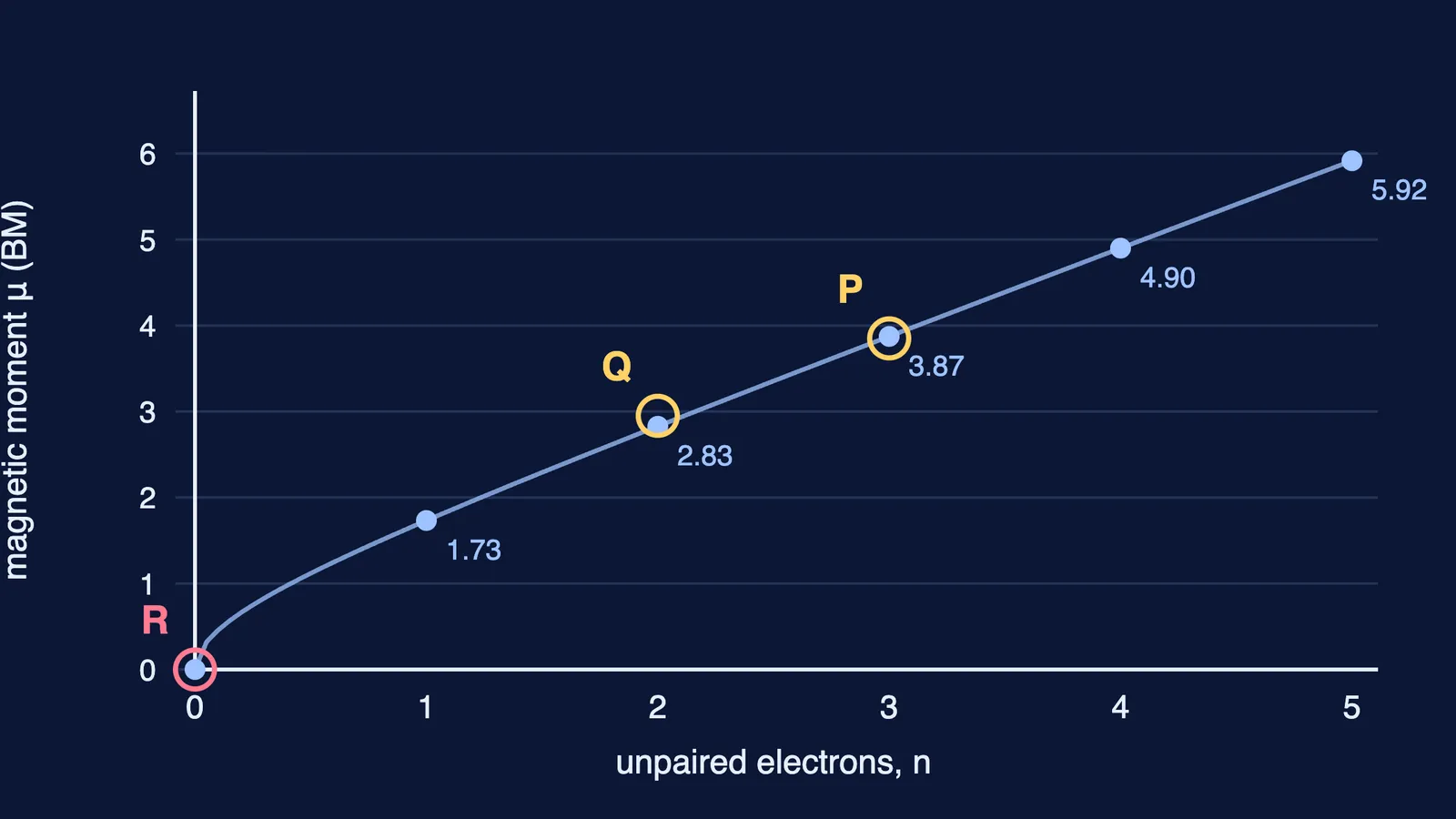
A chemistry club finds three unlabelled bottles of dilute sulphate solutions. Bottle P is violet, bottle Q is green and bottle R is colourless. Their teacher says the metal ions are Cr³⁺, Ni²⁺ and Zn²⁺, in some order. Using a magnetic balance, the students measure magnetic moments of 3.85 BM for P, 2.95 BM for Q and 0 BM for R. They compare each with the spin-only formula, μ = √(n(n + 2)) BM.
(i) Which ion is in bottle R?
(ii) How many unpaired electrons does the ion in bottle P have?
(iii) Which ion has the same spin-only magnetic moment as the ion in bottle Q? (a) V³⁺ (b) Mn²⁺ (c) Cu²⁺ (d) Fe³⁺
(iv) A classmate says Q must be Fe²⁺ because Fe²⁺ solutions are also green. Use the magnetic data to show why Q is Ni²⁺. (2 marks)
Answers.
(i) Zn²⁺. It is 3d¹⁰, so it has no unpaired electrons (μ = 0) and no d-d transition, which is why its solution is colourless.
(ii) Three. Cr³⁺ is 3d³, and √(3 × 5) = 3.87 BM, which matches the measured 3.85 BM.
(iii) (a) V³⁺. Ni²⁺ (3d⁸) and V³⁺ (3d²) both have two unpaired electrons, so both give √(2 × 4) = 2.83 BM.
(iv) Fe²⁺ is 3d⁶ with four unpaired electrons, so μ = √(4 × 6) = 4.90 BM. Ni²⁺ is 3d⁸ with two, so μ = 2.83 BM. The measured 2.95 BM is close to 2.83 and far from 4.90, so Q is Ni²⁺. Colour alone cannot separate two green ions.
Case 2: How much iron is in the tablet?
A quality-control chemist checks a batch of iron tablets whose label claims 100 mg of iron as iron(II) sulphate. She dissolves one tablet in dilute sulphuric acid and titrates it with 0.0200 M potassium permanganate. The titre is 17.40 mL. The reaction is 5Fe²⁺ + MnO₄⁻ + 8H⁺ → Mn²⁺ + 4H₂O + 5Fe³⁺. (Fe = 55.85 g mol⁻¹)
(i) What is the oxidation state of manganese before and after the reaction?
(ii) Why is the tablet dissolved in sulphuric acid and not hydrochloric acid?
(iii) What tells the chemist she has reached the end point? (a) a brown precipitate forms (b) the first lasting faint pink colour appears (c) the solution turns green (d) gas bubbles stop
(iv) Calculate the mass of iron in the tablet and the percentage of the label claim. (2 marks)
Answers.
(i) +7 in MnO₄⁻ and +2 in Mn²⁺.
(ii) NCERT notes that permanganate titrations in hydrochloric acid are unsatisfactory because the acid is oxidised to chlorine. That uses extra permanganate and inflates the iron result.
(iii) (b). Once Fe²⁺ is used up, one extra drop of MnO₄⁻ stays unreacted and its colour shows.
(iv) Moles of MnO₄⁻ = 0.0200 × 0.01740 = 3.48 × 10⁻⁴ mol. Moles of Fe²⁺ = 5 × 3.48 × 10⁻⁴ = 1.74 × 10⁻³ mol. Mass = 1.74 × 10⁻³ × 55.85 = 0.0972 g = 97.2 mg, which is 97.2% of the 100 mg claim.
Case 3: What yield of dichromate does chromite give?
A chemical plant turns chromite ore into potassium dichromate for the leather industry. One batch uses 500 kg of ore that contains 44.8% FeCr₂O₄ by mass. The ore is fused with sodium carbonate in air: 4FeCr₂O₄ + 8Na₂CO₃ + 7O₂ → 8Na₂CrO₄ + 2Fe₂O₃ + 8CO₂. The yellow sodium chromate solution is acidified to give sodium dichromate, and potassium chloride is then added so that orange crystals of K₂Cr₂O₇ form. It collects 250 kg of K₂Cr₂O₇. (FeCr₂O₄ = 223.83 g mol⁻¹; K₂Cr₂O₇ = 294.18 g mol⁻¹)
(i) What is the oxidation state of chromium in FeCr₂O₄ and in Na₂CrO₄?
(ii) Why does the plant add KCl instead of simply crystallising sodium dichromate?
(iii) What is the shape of the dichromate ion? (a) one tetrahedron (b) two tetrahedra sharing one corner (c) two octahedra sharing an edge (d) square planar
(iv) Find the theoretical mass of K₂Cr₂O₇ from this batch and the percentage yield. (2 marks)
Answers.
(i) In FeCr₂O₄, iron is +2, so 2 + 2x − 8 = 0 gives x = +3. In Na₂CrO₄, 2 + x − 8 = 0 gives x = +6.
(ii) Sodium dichromate is more soluble in water than potassium dichromate, so the less soluble K₂Cr₂O₇ crystallises out.
(iii) (b). NCERT describes it as two tetrahedra sharing one corner, with a Cr–O–Cr angle of 126°.
(iv) FeCr₂O₄ in the batch = 0.448 × 500 = 224 kg, or 224,000 ÷ 223.83 = 1000.7 mol. Each FeCr₂O₄ gives 2 CrO₄²⁻, and 2 CrO₄²⁻ give one Cr₂O₇²⁻, so the mole ratio FeCr₂O₄ : K₂Cr₂O₇ is 1 : 1. Theoretical mass = 1000.7 × 294.18 g = 294.4 kg. Yield = 250 ÷ 294.4 × 100 = 84.9%.
How to attack case-study questions on d- and f-block elements?
Write the configuration first. For any ion, write the 3dⁿ count before reading the options; colour and magnetic moment follow from it.
Use measured data to decide. When two ions share a colour, match the measured value to the nearest spin-only value: 1.73, 2.83, 3.87, 4.90 or 5.92 BM.
Count electrons for redox ratios. Find the change in oxidation state of each species before you balance or calculate.
Track chromium and manganese through each step. Write the oxidation state under every formula; traps hide where it changes or, as in chromate to dichromate, does not.
If your method breaks down on stoichiometry steps like Case 3, the Fermi Problem Library has worked problems with a step-by-step solver that explains the reasoning rather than printing an answer. For more practice on this chapter, try our assertion-reason questions on d- and f-block elements, and for timing across subjects, see our advice on answering case-based questions in board exams.