On this page
Key terms of Unit 10, Biomolecules, from the NCERT Class 12 Chemistry textbook (Reprint 2026-27), grouped by topic. For the chapter plan, see our Biomolecules Class 12 board exam guide.
The CBSE Class XII Chemistry syllabus for 2026-27 lists six topics: carbohydrates, proteins, enzymes, vitamins, nucleic acids and hormones.
How are carbohydrates classified?
Carbohydrate: an optically active compound with several –OH groups plus an aldehyde or ketone group, or one that gives such units on hydrolysis. Don't confuse with: the formula Cx(H2O)y; acetic acid fits it but is not a carbohydrate.
Monosaccharide: a sugar that cannot be hydrolysed into a simpler one, such as glucose or ribose.
Oligosaccharide and disaccharide: carbohydrates giving two to ten monosaccharide units on hydrolysis; a disaccharide gives exactly two. Example: sucrose, maltose.
Polysaccharide: gives a large number of monosaccharide units on hydrolysis; not sweet, so called a non-sugar. Example: starch, cellulose, glycogen.
Aldose and ketose: a monosaccharide with an aldehyde group is an aldose; with a keto group, a ketose. Example: glucose (aldohexose), fructose (ketohexose).
Reducing sugar: a sugar that gives a positive Tollens' or Fehling's test, thanks to a free aldehyde or ketone group. Example: glucose, maltose, lactose. Don't confuse with: non-reducing sugar, such as sucrose, where both reducing groups are used in the bond between the units.
Which terms describe the structure of glucose and its relatives?
D and L configuration: compares a sugar with glyceraldehyde. If the –OH on the lowest asymmetric carbon is on the right, as in D-(+)-glyceraldehyde, the sugar is D. Don't confuse with: (+) and (–), the direction of optical rotation. Fructose is D-(–)-fructose.
Pyranose and furanose: the six-membered ring form (glucose, closed through the –OH at C-5) and the five-membered ring form (fructose).
Anomeric carbon and anomers: C-1 of ring-form glucose is the anomeric carbon; the α and β forms, differing only in the –OH position there, are anomers.
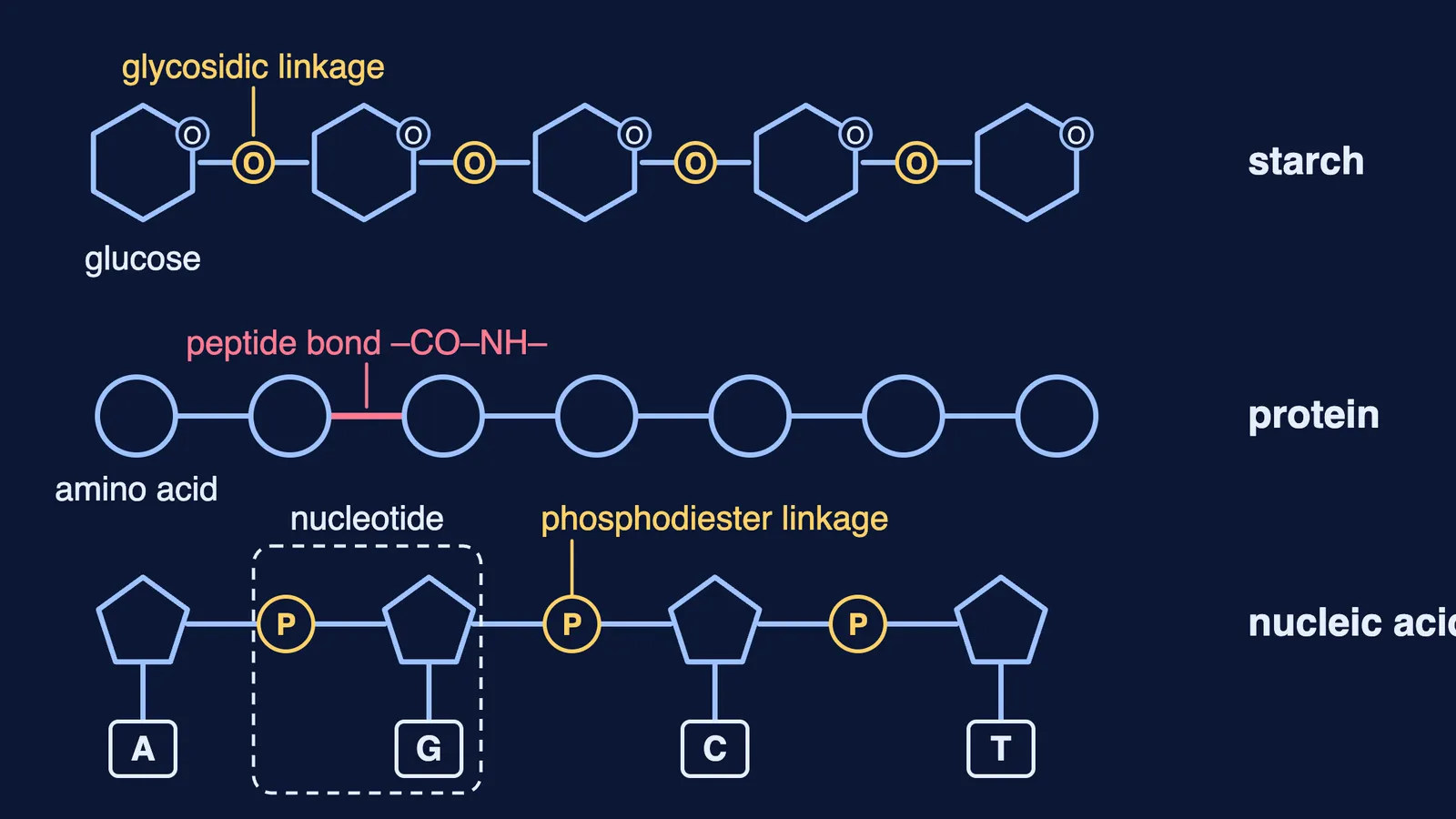
Glycosidic linkage: the oxygen bridge joining two monosaccharide units.
Invert sugar: the glucose-fructose mixture from hydrolysing sucrose. Rotation flips from (+) to (–) because fructose's –92.4° outweighs glucose's +52.5° (NCERT, section 10.1.3).
Amylose and amylopectin: the two parts of starch, both α-D-glucose. Amylose is unbranched, water-soluble and about 15-20% of starch; amylopectin is branched through C1–C6 links, insoluble and about 80-85% (NCERT, section 10.1.4).
Cellulose: a straight-chain polymer of β-D-glucose, the main material of plant cell walls. Don't confuse with: starch, built from α-glucose.
Glycogen: animals' storage carbohydrate, in liver, muscles and brain. Like amylopectin (hence "animal starch") but more branched.
What holds a protein together?
α-Amino acid: an amino acid whose amino group is on the carbon next to the carboxyl group.
Essential amino acids: ones the body cannot make, so they must come from food; the body makes non-essential ones.
Zwitter ion: the dipolar form of an amino acid in water, carrying –COO⁻ and –NH3⁺. It explains why amino acids react with both acids and bases (amphoteric behaviour).
Peptide bond: the amide link –CO–NH– formed when the carboxyl group of one amino acid joins the amino group of another, losing water. Example: glycine and alanine give glycylalanine.
Polypeptide and protein: over ten amino acids make a polypeptide; over a hundred residues with molecular mass above 10,000 u make a protein, though insulin, with 51 amino acids, also counts (NCERT, section 10.2.3).
Fibrous and globular proteins: fibrous ones have parallel chains held by hydrogen and disulphide bonds and are usually insoluble (keratin, myosin). Globular ones coil into a sphere and usually dissolve (insulin, albumins).
Primary structure: the sequence of amino acids.
Secondary structure: regular folding held by hydrogen bonds between –NH– and C=O groups, as an α-helix (a right-handed coil) or a β-pleated sheet (stretched chains side by side).
Tertiary and quaternary structure: tertiary is the overall folding of a chain; quaternary is the arrangement of two or more chains (sub-units).
Denaturation: loss of biological activity when heat or a pH change disturbs a protein's hydrogen bonds. Secondary and tertiary structures go; primary stays. Example: boiled egg white. Don't confuse with: hydrolysis, which breaks peptide bonds.
Enzymes, vitamins and hormones
Enzyme: a biocatalyst, almost always a globular protein, specific to one reaction and substrate; it lowers activation energy. Names usually end in -ase. Example: maltase, which splits maltose.
Vitamin: an organic compound needed in small amounts in the diet for specific functions; lacking one causes a specific disease. Example: lack of vitamin C causes scurvy.
Fat-soluble and water-soluble vitamins: A, D, E and K dissolve in fat and are stored in the liver and fat tissue. B-group and C dissolve in water and leave in urine, so you need them regularly; B12 is the stored exception.
Hormone: a messenger between cells, made by an endocrine gland and carried in the blood. Types: steroids (estrogens), polypeptides (insulin), amino acid derivatives (thyroxine).
What is the difference between a nucleoside and a nucleotide?
Nucleoside: a base attached to the 1′ carbon of a pentose sugar.
Nucleotide: a nucleoside with phosphoric acid at the sugar's 5′ carbon. Nucleic acids (DNA, RNA) are long chains of nucleotides. Don't confuse with: nucleoside, which has no phosphate.
Phosphodiester linkage: the phosphate bridge joining the 5′ and 3′ carbons of sugars in neighbouring nucleotides.
DNA versus RNA: DNA has 2-deoxyribose and bases A, G, C, T; RNA has ribose and uracil instead of thymine.
Double helix and complementary strands: DNA's two chains twist round each other, held by hydrogen bonds between fixed pairs, A with T and C with G. The strands are complementary, not identical.
mRNA, rRNA and tRNA: the three kinds of RNA; they build proteins from the message stored in DNA.
How to learn these terms
Make a three-row table: building block, bond, polymer (glucose, glycosidic, starch; amino acid, peptide, protein; nucleotide, phosphodiester, DNA).
Say the sugar pairs aloud: α-glucose builds starch, β-glucose builds cellulose; sucrose is non-reducing, maltose and lactose are reducing.
Draw a folded chain and mark what denaturation breaks (hydrogen bonds) and leaves (peptide bonds).
Test yourself with our Biomolecules assertion-reason questions for Class 12 Chemistry and Biomolecules case study questions.
If a term stays fuzzy, try the Fermi Concept Library, where each concept in chemistry has its own lesson.