On this page
What does a Biomolecules case-study question look like?
A case-study question sets graded questions on a short real-world passage. The CBSE 2026-27 Chemistry sample paper has 2 case-based questions carrying 4 marks each, in Section D, split into three parts. Our cases add a fourth part.
The cases and numbers below are our own; every fact follows NCERT Chemistry Part II, Unit 10, Reprint 2026-27. For the chapter plan, read our Biomolecules Class 12 board exam guide; for the general method, see how to handle case-based questions in board exams.
Case 1: Why does invert syrup turn light to the left?
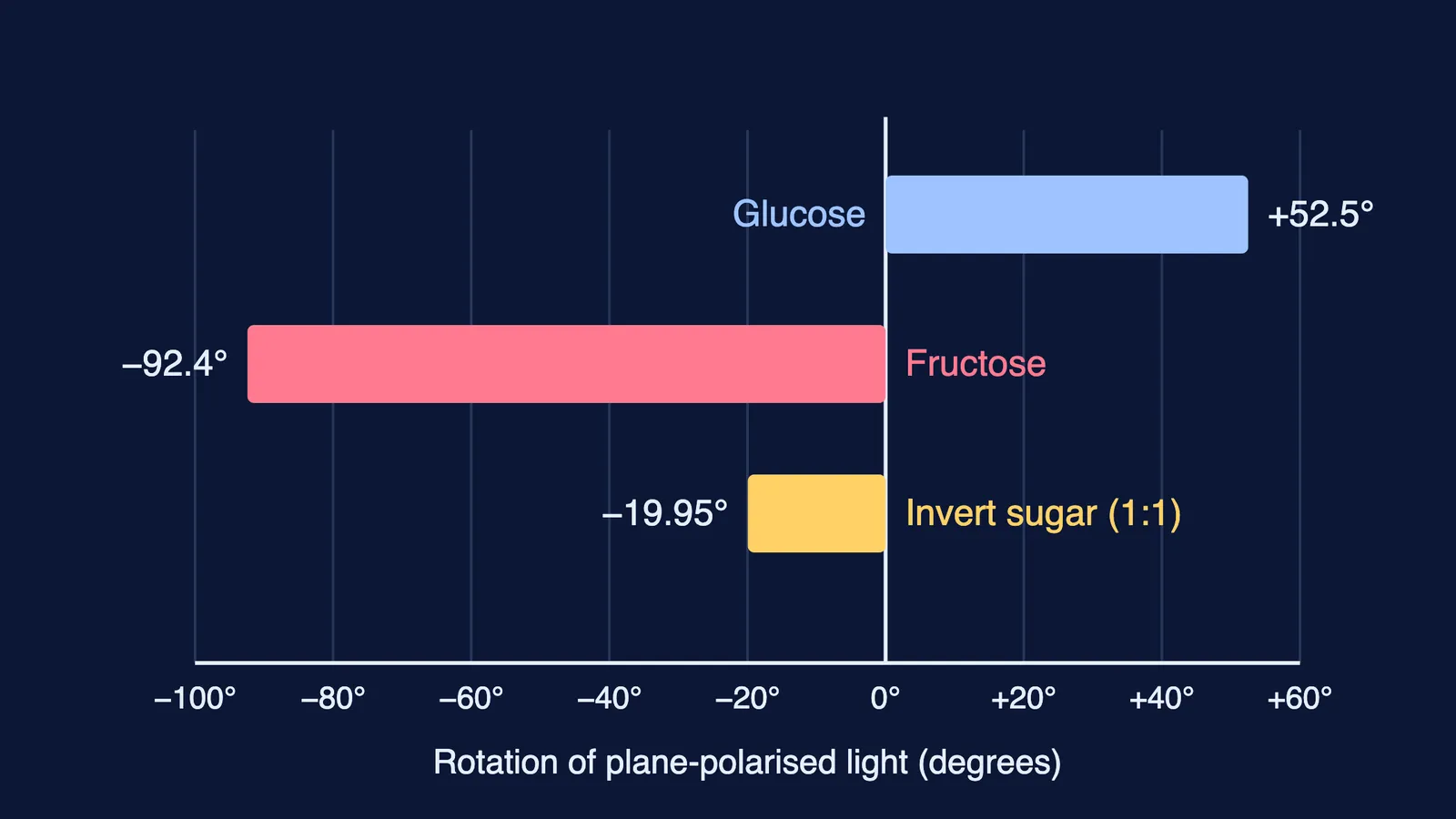
A mithai shop in Indore makes invert syrup for its gulab jamun. The cook boils 513 g of sucrose (C₁₂H₂₂O₁₁, molar mass 342 g mol⁻¹) in water with a little dilute acid. Riya tests samples in her school lab. Before boiling, the sugar solution does not reduce Tollens' reagent and rotates plane-polarised light to the right. After boiling, the syrup gives a silver mirror with Tollens' reagent and rotates light to the left. NCERT gives the rotations of glucose (+52.5°) and fructose (−92.4°). Take glucose and fructose as 180 g mol⁻¹ and water as 18 g mol⁻¹.
(i) Hydrolysis of sucrose gives: (a) two molecules of glucose (b) glucose and galactose (c) glucose and fructose in equal amounts (d) fructose only.
(ii) Why did the solution not reduce Tollens' reagent before boiling?
(iii) What mass of glucose, of fructose and of water is involved when all 513 g of sucrose is hydrolysed?
(iv) Why does the syrup rotate light to the left, and roughly by how much on the same scale? (2 marks)
Answers.
(i) (c). D-(+)-glucose and D-(−)-fructose, one each.
(ii) Sucrose's glycosidic linkage joins C1 of α-D-glucose to C2 of β-D-fructose, using both reducing groups, so sucrose is non-reducing. The freed monosaccharides are reducing sugars.
(iii) Moles of sucrose = 513 ÷ 342 = 1.5 mol. Glucose = 1.5 × 180 = 270 g, fructose = 270 g, water used = 1.5 × 18 = 27 g.
(iv) The mixture has equal moles, and so equal masses, of glucose and fructose. Their rotations average to (+52.5 − 92.4) ÷ 2 = −19.95°, about −20°. Fructose's laevorotation outweighs glucose's dextrorotation, so the sign flips from + to −, hence the name invert sugar.
Case 2: What happens to a lab peptide when it is heated?
A biotech start-up in Hyderabad makes short peptides. Its main product, Peptide P, is a single chain of 14 amino acids that coils into an α-helix and binds a target molecule. A cheaper test product is the tetrapeptide Gly-Ala-Val-Gly. Its raw material glycine is a high-melting solid that behaves like a salt. In a storage trial, one batch of Peptide P sat in a hot delivery van for six hours. It then stopped binding its target, though its amino acid sequence was unchanged. Molar masses: glycine 75, alanine 89, valine 117, water 18 g mol⁻¹.
(i) How many peptide bonds does Peptide P contain? (a) 12 (b) 13 (c) 14 (d) 15
(ii) Name the dipolar form in which glycine exists in water, and say why amino acids behave like salts.
(iii) Calculate the molar mass of Gly-Ala-Val-Gly.
(iv) Explain what happened to the batch in the van and why the sequence stayed the same. (2 marks)
Answers.
(i) (b). 14 amino acids form 14 − 1 = 13 peptide bonds.
(ii) A zwitter ion. The carboxyl group loses a proton and the amino group gains one, so one molecule carries both charges, like a salt.
(iii) A tetrapeptide has 3 peptide bonds, each releasing one water. Molar mass = (75 + 89 + 117 + 75) − 3 × 18 = 356 − 54 = 302 g mol⁻¹.
(iv) Heat disturbed the hydrogen bonds holding the α-helix, which uncoiled: the peptide was denatured and lost its biological activity. Denaturation destroys secondary and tertiary structure but leaves the primary structure, the amino acid sequence, intact.
Case 3: How does a forensic lab read DNA base data?
A state forensic laboratory receives an unidentified blood sample from a road accident and extracts a double-stranded DNA fragment of 150 base pairs, to compare with the family's samples. Analysis shows that 28% of the bases in the fragment are guanine. The same week, a trainee hydrolyses an RNA sample from a cell culture and records 31% adenine and 18% uracil. She flags the RNA as contaminated, because in DNA the amount of adenine always equals that of thymine.
(i) The sugar present in DNA is: (a) β-D-ribose (b) β-D-2-deoxyribose (c) α-D-glucose (d) β-D-fructose
(ii) How many phosphodiester linkages does one strand of the fragment contain, and which sugar carbons do they join?
(iii) Find the number of each base (A, T, G, C) in the fragment.
(iv) Is the trainee right to flag the RNA sample? Explain. (2 marks)
Answers.
(i) (b). RNA has β-D-ribose instead.
(ii) One strand has 150 nucleotides joined in a line, so 150 − 1 = 149 phosphodiester linkages, each between the 5′ and 3′ carbons of the pentose sugars.
(iii) 150 base pairs = 300 nucleotides. G = 0.28 × 300 = 84, and C = 84 because cytosine pairs with guanine. A + T = 300 − 168 = 132, so A = T = 66 (22% each).
(iv) No. A = T and G = C hold in DNA because its two complementary strands pair adenine with thymine and cytosine with guanine. RNA is single-stranded (with uracil, not thymine), so its base quantities follow no fixed relation; 31% A and 18% U are normal.
How to attack case-study questions in Biomolecules
Turn each clue into a structural fact: "reduces Tollens'" means a free aldehyde or ketone group; "same sequence after heating" means the primary structure survived.
For sugar numbers, write the balanced hydrolysis equation first.
Use the n − 1 rule: n amino acids form n − 1 peptide bonds; one DNA strand of n nucleotides has n − 1 phosphodiester linkages.
Apply base-pairing ratios only to double-stranded DNA; base pairs × 2 = nucleotides.
Keep NCERT's words exact: D and L describe configuration, + and − describe rotation; denaturation is not hydrolysis.
If a step keeps tripping you, the Fermi Problem Library has worked problems with a step-by-step solver that explains the reasoning rather than printing an answer.