On this page
How many marks is Biomolecules in Class 12 Chemistry 2026-27?
Biomolecules carries 7 of the 70 theory marks in the CBSE Class XII Chemistry curriculum for 2026-27. The curriculum also notes no chapter-wise weightage is provided, so 7 is a syllabus share, not a promise.
Your text is NCERT Chemistry Part II, Unit 10, Reprint 2026-27, covering carbohydrates, proteins, enzymes, vitamins, nucleic acids and hormones. For entrance-exam practice, see our Biomolecules guide for JEE Main; this post is about board answers.
Which Biomolecules topics come up in board answers?
Learn these as NCERT states them:
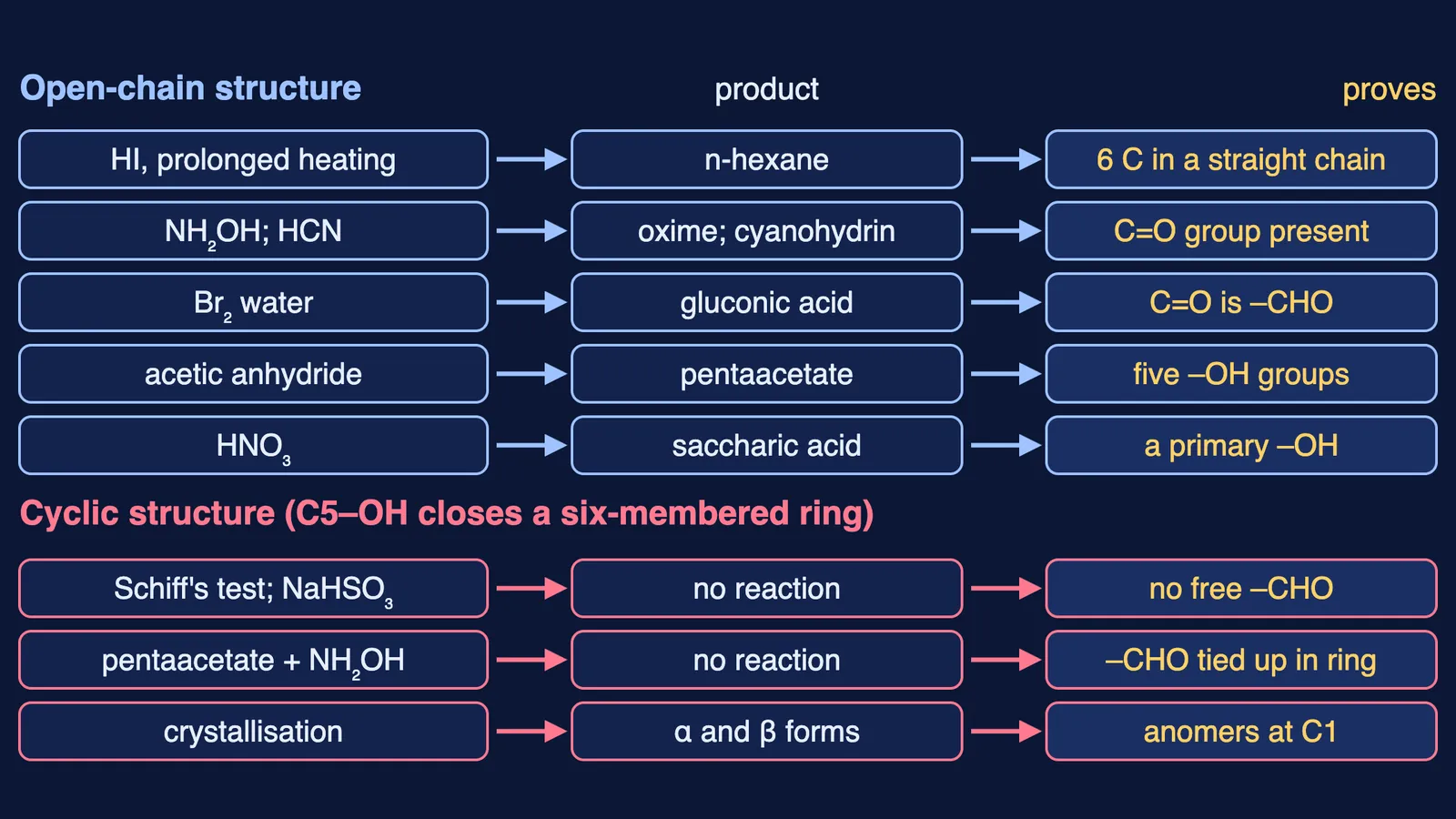
Glucose structure evidence. Five reactions fix the open chain (see the chart above). Three facts it cannot explain point to a six-membered cyclic hemiacetal.
Anomers. The α and β forms differ only in the –OH at C1, the anomeric carbon.
Reducing vs non-reducing sugars. Reducing sugars reduce Fehling's and Tollens' reagents; every monosaccharide does. Sucrose is non-reducing because its bond joins C1 of α-D-glucose to C2 of β-D-fructose, using both reducing groups. Maltose and lactose keep a free group.
Glycosidic linkages. Maltose: α-D-glucose C1 to C4. Lactose: β-D-galactose C1 to glucose C4. Amylose: unbranched C1–C4. Amylopectin: C1–C4 with C1–C6 branches. Cellulose: β-D-glucose, C1–C4. See why some rice is sticky for these in your kitchen.
Protein structure and denaturation. Primary is the amino-acid sequence; secondary is the α-helix or β-pleated sheet, held by hydrogen bonds between C=O and –NH–; tertiary is overall folding (fibrous or globular); quaternary is the arrangement of sub-units. Heat or a pH change breaks hydrogen bonds, destroying secondary and tertiary structure but not primary (boiled egg white, curdled milk).
Vitamins and deficiencies. A, D, E, K are fat-soluble and stored; B-group and C are water-soluble and excreted, so needed regularly (B12 is stored). Diseases: A, night blindness and xerophthalmia; B1, beri beri; B12, pernicious anaemia; C, scurvy; D, rickets and osteomalacia; K, longer blood clotting time.
DNA vs RNA. DNA has β-D-2-deoxyribose and bases A, G, C, T; RNA has β-D-ribose and A, G, C, U. DNA is a double helix (A pairs with T, C with G); RNA is single-stranded, as mRNA, rRNA and tRNA.
How do you set out 2-, 3- and 5-mark answers?
The 2026-27 sample paper puts 2-mark questions in Section B, 3-mark in Section C, 4-mark case studies in Section D and 5-mark long answers in Section E. Write one point per mark: a fact with its reason. The marking scheme for Question 19 gives 1 mark for completing the bases in a DNA strand and 1 for saying lemon juice lowers pH, breaks hydrogen bonds and denatures casein. For 3 marks, give three labelled parts, each naming reagent and product. For 5 marks, add structures and a closing inference.
The same question, twice:
2-mark version: give two facts the open-chain structure of glucose cannot explain.
Despite its –CHO group, glucose gives no Schiff's test and no addition product with NaHSO₃.
Glucose pentaacetate does not react with hydroxylamine, so no free –CHO is present.
5-mark version: which reactions show glucose's open-chain nature, and which show its cyclic nature?
Open chain, as reagent, product, inference: HI on prolonged heating gives n-hexane (straight six-carbon chain); hydroxylamine gives an oxime and HCN a cyanohydrin (carbonyl group); bromine water gives gluconic acid (aldehyde); acetic anhydride gives a pentaacetate (five –OH groups); nitric acid gives saccharic acid (primary –OH).
Cyclic: the Schiff's and NaHSO₃ results, the unreactive pentaacetate, and two crystalline forms, α (m.p. 419 K) and β (m.p. 423 K).
Conclusion: the C5 –OH adds to –CHO, forming a six-membered cyclic hemiacetal. α and β are anomers at C1, in equilibrium with the open chain. Draw both Haworth structures.
Part 2 reuses the 2-mark answer; the conclusion is what answers "show".
What are the assertion-reason and case-study traps?
Assertion-reason items in the sample paper use four fixed options, from "both true, R explains A" to "A false, R true". Traps here:
"Sucrose is reducing because it contains glucose": the assertion is false.
"Denaturation destroys primary structure": false; only secondary and tertiary go.
D and L give configuration relative to glyceraldehyde, not rotation: D-(–)-fructose is laevorotatory.
Case study Question 30 gives a water-soluble plant sugar that turns Benedict's reagent brick-red and gives only one kind of monosaccharide on hydrolysis. The marking scheme answer is maltose: reducing, so not sucrose; it hydrolyses, so not glucose or fructose; one kind of monosaccharide only, so not lactose. The trap is writing "glucose" after the first clue; let each clue eliminate a candidate.
A six-day Biomolecules revision plan
Reducing sugars and glucose evidence; redraw the chart from memory.
Cyclic glucose, anomers, Haworth structures, D/L.
Sugars table: units, linkage, reducing or not.
Peptide bond, structure levels, denaturation.
Vitamins, enzymes, hormones, DNA vs RNA.
Sample paper Questions 7, 19 and 30, timed, marked with the scheme; then NCERT exercises.
If an idea will not stick, the Fermi Concept Library covers every concept in physics, chemistry, biology, mathematics and computing, each with its own lesson and its place in the map.