On this page
Six assertion-reason items and four Statement I / Statement II pairs follow on Biomolecules, Unit 10 of NCERT Class 12 Chemistry Part II (reprint 2026-27). Each block runs easy to hard, and every statement was checked against that chapter. The CBSE Class XII Chemistry sample question paper for 2026-27 uses this assertion-reason format, with the same four options, for questions 13 to 16 of Section A.
How do you answer assertion-reason questions on Biomolecules?
Use these keys throughout.
Assertion-reason:
(A) Both A and R are true and R is the correct explanation of A.
(B) Both A and R are true but R is NOT the correct explanation of A.
(C) A is true but R is false.
(D) A is false but R is true.
Statement pairs:
(A) Both statements are correct.
(B) Both statements are incorrect.
(C) Statement I is correct, Statement II is incorrect.
(D) Statement I is incorrect, Statement II is correct.
Judge A alone, then R alone. Only if both are true, ask: "Is R the reason NCERT gives for A?" Many false lines here swap one detail, such as alpha for beta or C4 for C1, so underline those first.
Shaky on the basic facts? Read our Biomolecules Class 12 board exam guide, with answers and traps first.
Assertion-reason questions on Biomolecules
Q1 (easy). Assertion (A): Prolonged heating of glucose with HI gives n-hexane. Reason (R): The six carbon atoms of glucose are joined in a straight chain.
Answer: (A). Both are true: NCERT cites n-hexane formation as evidence that the chain is unbranched. Trap: thinking HI only tells you about the -CHO group.
Q2 (easy). Assertion (A): Sucrose does not reduce Fehling's solution. Reason (R): Hydrolysis of sucrose gives one molecule of glucose and one of fructose.
Answer: (B). Both are true, but R does not explain A. Sucrose is non-reducing because the glycosidic bond joins C1 of glucose to C2 of fructose, so both reducing groups are tied up. Trap: maltose also gives two monosaccharide units, and it is a reducing sugar.
Q3 (medium). Assertion (A): Glucose pentaacetate does not react with hydroxylamine. Reason (R): Glucose has five -OH groups, each on a different carbon atom.
Answer: (B). Both are true, but R explains why a pentaacetate forms, not why it ignores hydroxylamine. The real reason: no free -CHO group, because glucose exists as a cyclic hemiacetal. Trap: picking (A) because both lines are about the pentaacetate.
Q4 (medium). Assertion (A): Vitamin C must be supplied regularly in the diet. Reason (R): Water-soluble vitamins are stored in the liver and adipose tissue.
Answer: (C). A is true. R is false: NCERT says fat-soluble vitamins (A, D, E, K) are stored there; water-soluble ones are excreted in urine and, except B12, cannot be stored. Trap: pinning "stored in liver" on the wrong group.
Q5 (medium). Assertion (A): Glycine is optically active. Reason (R): The name glycine comes from the Greek word for sweet, because the compound tastes sweet.
Answer: (D). A is false: glycine is the one natural alpha-amino acid that is not optically active, because its alpha carbon carries two H atoms and is not asymmetric. R is true. Trap: applying "alpha-amino acids are chiral" to all twenty.
Q6 (hard). Assertion (A): When an egg is boiled, the egg white coagulates, yet the amino acid sequence of its proteins does not change. Reason (R): Denaturation disturbs hydrogen bonds, destroying secondary and tertiary structure while the primary structure stays intact.
Answer: (A). Both are true, and R explains A: coagulation of egg white is NCERT's own example of denaturation, which leaves the sequence untouched. Trap: assuming that a protein which loses its activity must also lose its sequence.
Statement I and Statement II questions on Biomolecules
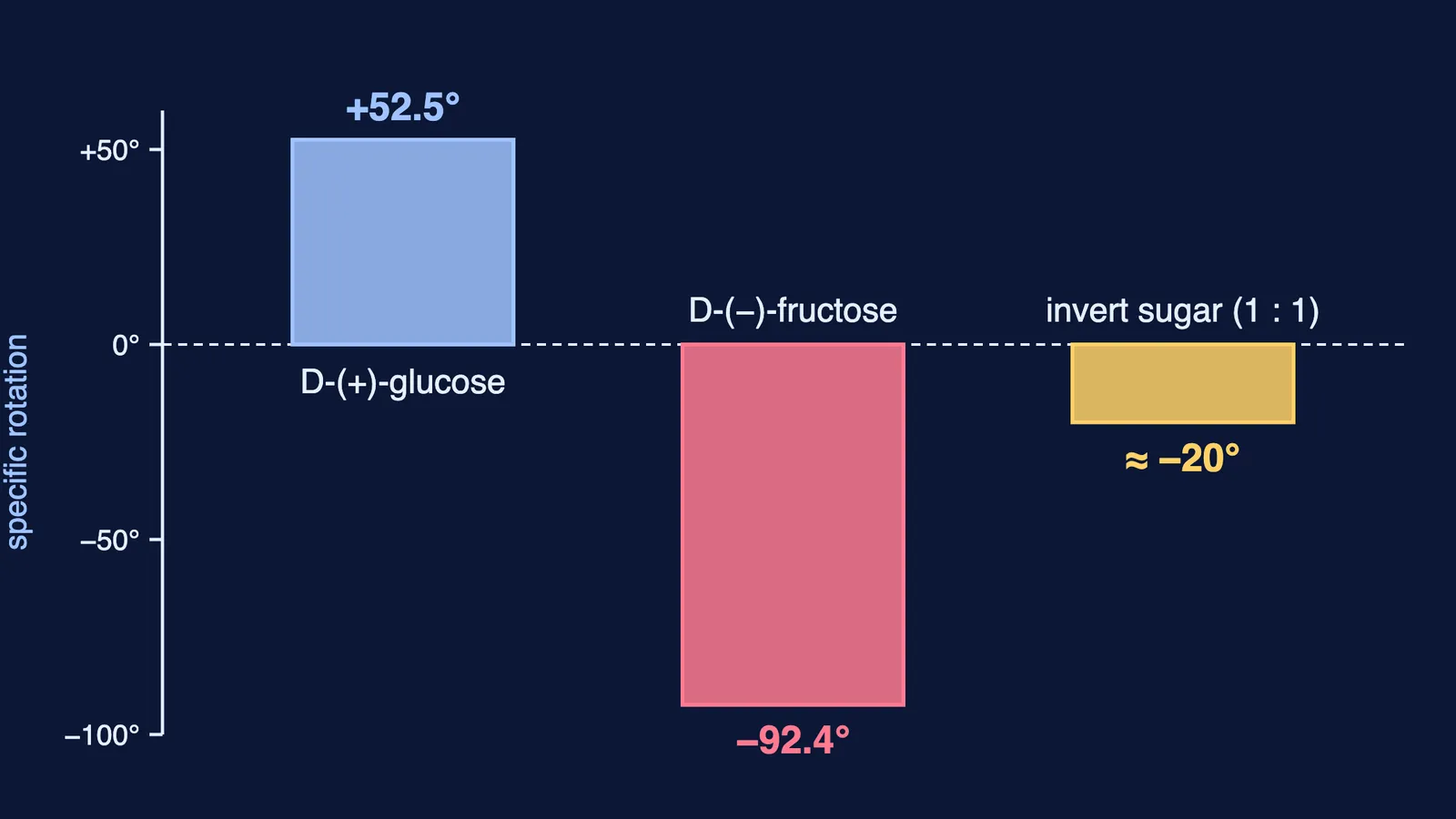
Q7 (medium). Statement I: Invert sugar is laevorotatory because the laevorotation of fructose (-92.4°) is larger than the dextrorotation of glucose (+52.5°). Statement II: Hydrolysis of sucrose gives fructose and glucose in a 2:1 molar ratio.
Answer: (C). Statement I matches NCERT. Statement II is wrong: sucrose gives an equimolar mixture. With equal amounts, the mixture's specific rotation is the average, (52.5 - 92.4) / 2 ≈ -20° (checked in Python). Trap: thinking fructose must be in excess for the sign to flip.
Q8 (medium). Statement I: Amylose is the water-insoluble component of starch and makes up about 80-85% of it. Statement II: In amylopectin, the chain grows through C1-C4 glycosidic links and branches through C1-C6 links.
Answer: (D). Statement I describes amylopectin; NCERT says amylose is water-soluble and about 15-20% of starch. Statement II is correct. Trap: swapping the two look-alike names.
Q9 (hard). Statement I: Adenine pairs with thymine and cytosine with guanine, which is why the two strands of DNA are complementary rather than identical. Statement II: A nucleoside becomes a nucleotide when phosphoric acid is linked at the 5' position of its sugar.
Answer: (A). Both match NCERT section 10.5.2: hydrogen bonds form only between specific base pairs, and the 5'-phosphate is what turns a nucleoside into a nucleotide. Trap: reading "complementary" as "identical".
Q10 (hard). Statement I: Maltose is a non-reducing sugar because C1 of one glucose unit is bonded to C4 of the other. Statement II: In lactose, the glycosidic bond joins C1 of beta-D-galactose to C1 of beta-D-glucose.
Answer: (B). Both are incorrect. Maltose is reducing, because C1 of the second glucose unit can give a free aldehyde group in solution. Lactose links C1 of galactose to C4 of glucose, leaving glucose's C1 free, so it is reducing too. Trap: assuming any glycosidic bond makes a sugar non-reducing.
How should you use this set?
Do all ten in 12 minutes with the book closed, writing T or F above each line before you pick a key.
Sort each miss: a wrong fact (reread NCERT) or a wrong link (rerun the because test).
For each sugar item, mark which carbon the glycosidic bond ties up.
Two days later, redo your misses and write a false version of each line by swapping one detail.
If a miss comes from a concept gap, such as why a cyclic hemiacetal hides the aldehyde group, the Fermi Concept Library has a lesson for every concept in chemistry. For more on the format itself, read our step-by-step assertion-reason strategy.