On this page
Coordination Compounds is Unit 5 of the NCERT Class 12 Chemistry textbook (Reprint 2026-27); the CBSE 2026-27 Chemistry curriculum covers all its sections. To turn them into written answers, use our Coordination Compounds Class 12 board exam guide.
What is a coordination compound?
Coordination compound: a metal atom or ion bonded to a fixed number of ions or molecules that each share an electron pair with it. Examples: chlorophyll (magnesium), haemoglobin (iron), vitamin B12 (cobalt).
Werner's theory: Alfred Werner's 1898 model, in which a metal in a complex shows two kinds of valence. Example: CoCl3.6NH3 gives 3 mol AgCl per mole, but CoCl3.5NH3 gives only 2.
Primary and secondary valence: primary valence ionises and is met by negative ions; secondary valence does not ionise and matches the metal's coordination number. Only primary-valence chloride precipitates.
Double salt: two salts joined in a fixed ratio that split completely into simple ions in water. Example: Mohr's salt. Don't confuse with: K4[Fe(CN)6], whose [Fe(CN)6]4- ion stays intact.
What do ligand, coordination number and coordination sphere mean?
Coordination entity: the metal plus everything bonded directly to it, such as [Co(NH3)6]3+.
Central atom or ion: the metal accepting the electron pairs, so a Lewis acid. Example: Fe3+ in [Fe(CN)6]3-.
Ligand: an ion or molecule donating an electron pair to the metal, such as Cl-, H2O or NH3.
Unidentate, didentate, polydentate: binding through one, two or several donor atoms. Example: NH3, ethane-1,2-diamine (en), and EDTA4-, which binds through six.
Chelate ligand: a ligand gripping one metal with two or more of its donor atoms together; such complexes are usually more stable than unidentate ones. Denticity is the number of donor atoms used.
Ambidentate ligand: one that has two different donor atoms but binds through one. Example: NO2- (N or O), SCN- (S or N). Don't confuse with: didentate, which uses both together.
Coordination number: the number of donor atoms bonded to the metal, counting sigma bonds only. Example: 6 in [Co(en)3]3+, as each en binds twice.
Coordination sphere: the bracketed metal-and-ligands unit; ions outside are counter ions, like K+ in K4[Fe(CN)6].
Coordination polyhedron: the shape the donor atoms make around the metal. Example: octahedral [Co(NH3)6]3+, tetrahedral [Ni(CO)4], square planar [PtCl4]2-. Not the coordination sphere, which is a group of atoms.
Oxidation number of the central atom: the charge left on the metal if every ligand leaves with its shared electron pair. Example: Cu(I) in [Cu(CN)4]3-.
Homoleptic and heteroleptic: one kind of ligand, or more than one. Example: [Co(NH3)6]3+ versus [Co(NH3)4Cl2]+.
How are coordination compounds named?
IUPAC naming: cation first; ligands alphabetically before the metal; anionic ligands end in -o (chlorido), while H2O is aqua, NH3 ammine and CO carbonyl; oxidation state in Roman numerals. Example: [Cr(NH3)3(H2O)3]Cl3 is triamminetriaquachromium(III) chloride.
-ate ending: added to the metal in an anionic complex, sometimes from the Latin name. Example: potassium hexacyanidoferrate(III).
What types of isomerism do coordination compounds show?
Stereoisomers: same bonds, different arrangement in space. Structural isomers differ in what is bonded to what.
Geometrical isomerism: cis (alike ligands side by side) and trans (opposite) forms. Example: cis- and trans-[Pt(NH3)2Cl2]. Tetrahedral complexes cannot show it.
fac and mer: three identical ligands on one octahedral face, or around its meridian. Example: [Co(NH3)3(NO2)3].
Optical isomerism: non-superimposable mirror images (enantiomers) of a chiral species, named d and l by how they rotate polarised light. Example: [Co(en)3]3+; for [PtCl2(en)2]2+ only the cis form.
Linkage isomerism: an ambidentate ligand bonds through a different atom. Example: red (–ONO) and yellow (–NO2) [Co(NH3)5(NO2)]Cl2.
Coordination isomerism: ligands swap between the cation and anion complexes. Example: [Co(NH3)6][Cr(CN)6] and [Cr(NH3)6][Co(CN)6].
Ionisation isomerism: a counter ion and a ligand trade places. Example: [Co(NH3)5(SO4)]Br and [Co(NH3)5Br]SO4.
Solvate (hydrate) isomerism: water (or another solvent) is either a ligand on the metal or sits loose in the lattice. Example: violet [Cr(H2O)6]Cl3 and grey-green [Cr(H2O)5Cl]Cl2.H2O. Don't confuse with: ionisation isomerism, where an ion moves.
How do VBT and crystal field theory explain bonding?
Valence bond theory (VBT): the metal's hybrid orbitals accept ligand electron pairs and fix the shape: sp3 tetrahedral, dsp2 square planar, d2sp3 or sp3d2 octahedral.
Inner and outer orbital complex: inner orbital (low spin) complexes use (n-1)d orbitals, as in diamagnetic [Co(NH3)6]3+; outer orbital (high spin) ones use nd orbitals, as in [CoF6]3- with four unpaired electrons.
Paramagnetic and diamagnetic: attracted by a magnet because of unpaired electrons, or not, because all are paired. Example: [NiCl4]2- versus [Ni(CN)4]2-.
Crystal field theory (CFT): treats the metal-ligand bond as purely electrostatic, with ligands as point charges or dipoles.
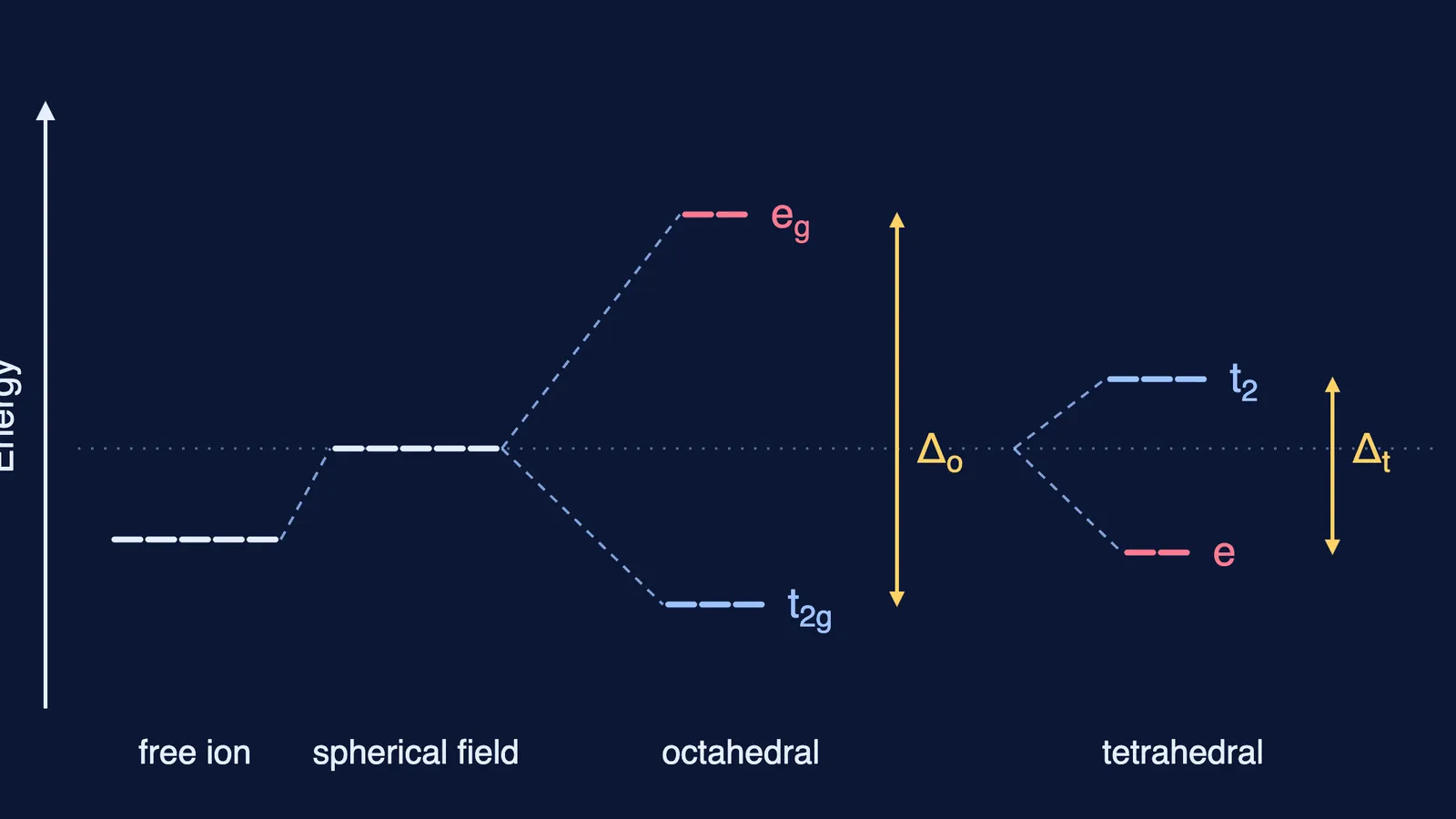
Crystal field splitting: ligands split the five equal-energy (degenerate) d orbitals. In an octahedron, the three t2g orbitals fall by 2/5 Δo and the two eg orbitals rise by 3/5 Δo.
Δo and Δt: octahedral and tetrahedral splitting energies; tetrahedral splitting is inverted and smaller, Δt = (4/9) Δo, so low spin tetrahedral complexes are rare.
Pairing energy (P): the cost of putting two electrons in one orbital. If Δo < P, a d4 ion is high spin (t2g3 eg1); if Δo > P, low spin (t2g4 eg0).
Spectrochemical series: ligands ranked by field strength from experiment, I- weakest to CO strongest. Weak field ligands give high spin complexes, strong field ligands low spin.
d-d transition: an electron jumping from t2g to eg by absorbing visible light; we see the complementary colour. Example: [Ti(H2O)6]3+ absorbs blue-green and looks violet.
Synergic bonding: in metal carbonyls, CO donates a lone pair to the metal (sigma) and the metal donates d electrons back into CO's empty π* orbital (pi); each strengthens the other. Example: [Ni(CO)4].
How to learn these terms
Learn terms in pairs: double salt vs complex, ambidentate vs didentate, ionisation vs solvate, inner vs outer orbital.
Draw both splitting diagrams from memory, labelling t2g, eg, Δo and Δt.
Name five complexes daily, checking ligand order.
Test yourself with these coordination compounds assertion-reason questions.
If a term stays vague, the Fermi Concept Library gives each chemistry concept its own lesson and its place in the map.