

On this page
Coordination compounds assertion-reason questions test whether a true reason actually explains the assertion. These 10 original items (6 assertion-reason, 4 Statement I/II pairs) run from easy to hard, and each one is built around a likely slip.
Every item stays inside Unit 12, Co-ordination Compounds, of the NMC's NEET (UG) 2026 syllabus, and every statement is checked against Unit 5 of NCERT Class 12 Chemistry Part I, Reprint 2026-27. If you have not finished the chapter, start with our guide on how to prepare Coordination Compounds for NEET.
How do you answer assertion-reason questions in coordination compounds?
Judge each statement on its own first, then ask: if R were all you knew, would A follow? Here, write the metal's oxidation state, d-electron count and the ligand's place in the spectrochemical series before reading R.
The keys are the same for every assertion-reason item below:
(A) Both A and R are true and R is the correct explanation of A.
(B) Both A and R are true but R is NOT the correct explanation of A.
(C) A is true but R is false.
(D) A is false but R is true.
Assertion-reason questions on coordination compounds
Q1 (easy). Assertion (A): EDTA⁴⁻ is a hexadentate ligand. Reason (R): A single EDTA⁴⁻ ion donates electron pairs from six atoms, two N and four O, to the same metal ion.
Answer: (A). Both are true. Denticity is the number of donor atoms a ligand uses on one metal ion, so two N plus four O is exactly why EDTA⁴⁻ is hexadentate.
Trap: picking (B) because R sounds like a mere description; here it is the definition.
Q2 (easy). Assertion (A): The oxidation state of iron in K₄[Fe(CN)₆] is +3. Reason (R): Each cyanide ligand carries a charge of −1.
Answer: (D). R is true. Four K⁺ make the complex ion −4, and six CN⁻ give −6, so Fe + (−6) = −4 and iron is +2, not +3.
Trap: remembering "+3" from [Fe(CN)₆]³⁻ and not counting the potassium ions.
Q3 (medium). Assertion (A): [Co(NH₃)₅(SCN)]²⁺ and [Co(NH₃)₅(NCS)]²⁺ are linkage isomers. Reason (R): The thiocyanate ion is an ambidentate ligand that can bind through either sulphur or nitrogen.
Answer: (A). NCERT links linkage isomerism to ambidentate ligands such as SCN⁻. The two ions differ only in the donor atom, so R is the direct cause.
Trap: calling them ionisation isomers; thiocyanate is inside the bracket in both.
Q4 (medium). Assertion (A): [Fe(CN)₆]³⁻ is paramagnetic with one unpaired electron. Reason (R): CN⁻ is a weak field ligand.
Answer: (C). A is true: NCERT gives [Fe(CN)₆]³⁻ the magnetic moment of a single unpaired electron. R is false, because CN⁻ sits near the strong-field end of the spectrochemical series, and its large splitting pairs four of iron(III)'s five d electrons.
Trap: reasoning "paramagnetic, so weak field"; low-spin d⁵ still has one unpaired electron.
Q5 (hard). Assertion (A): [Co(NH₃)₆]³⁺ is an inner orbital complex. Reason (R): The coordination number of cobalt in [Co(NH₃)₆]³⁺ is 6.
Answer: (B). Both are true, but R does not explain A: [CoF₆]³⁻ also has coordination number 6, yet NCERT calls it outer orbital (sp³d²). [Co(NH₃)₆]³⁺ is inner orbital (d²sp³) because its six 3d electrons pair up and free two 3d orbitals.
Trap: linking six ligands to d²sp³; six ligands only make it octahedral.
Q6 (hard). Assertion (A): [Ni(CO)₄] is diamagnetic. Reason (R): [Ni(CO)₄] has a tetrahedral geometry.
Answer: (B). Both are true. NCERT explains the diamagnetism by nickel's zero oxidation state with no unpaired electron. Tetrahedral [NiCl₄]²⁻ has two unpaired electrons, so the shape cannot be the reason.
Trap: treating geometry as a cause of magnetism; the electron count decides it.
Statement I and Statement II questions on coordination compounds
The keys for every statement pair:
(A) Both statements are correct.
(B) Both statements are incorrect.
(C) Statement I is correct, Statement II is incorrect.
(D) Statement I is incorrect, Statement II is correct.
Q7 (easy). Statement I: The coordination number of iron in [Fe(C₂O₄)₃]³⁻ is 3. Statement II: The oxalate ion is a didentate ligand.
Answer: (D). Statement II is true. Statement I is false: coordination number counts donor atoms bonded to the metal, so three didentate oxalates give 6.
Trap: counting ligands instead of donor atoms.
Q8 (medium). Statement I: [Pt(NH₃)₂Cl₂] exists as cis and trans isomers. Statement II: Tetrahedral complexes of the type [MA₂B₂] show cis-trans isomerism.
Answer: (C). Square planar [Pt(NH₃)₂Cl₂] has cis and trans forms. In a tetrahedron every corner is adjacent to every other, so NCERT rules out geometrical isomerism there.
Trap: assuming every four-coordinate complex behaves like platinum's.
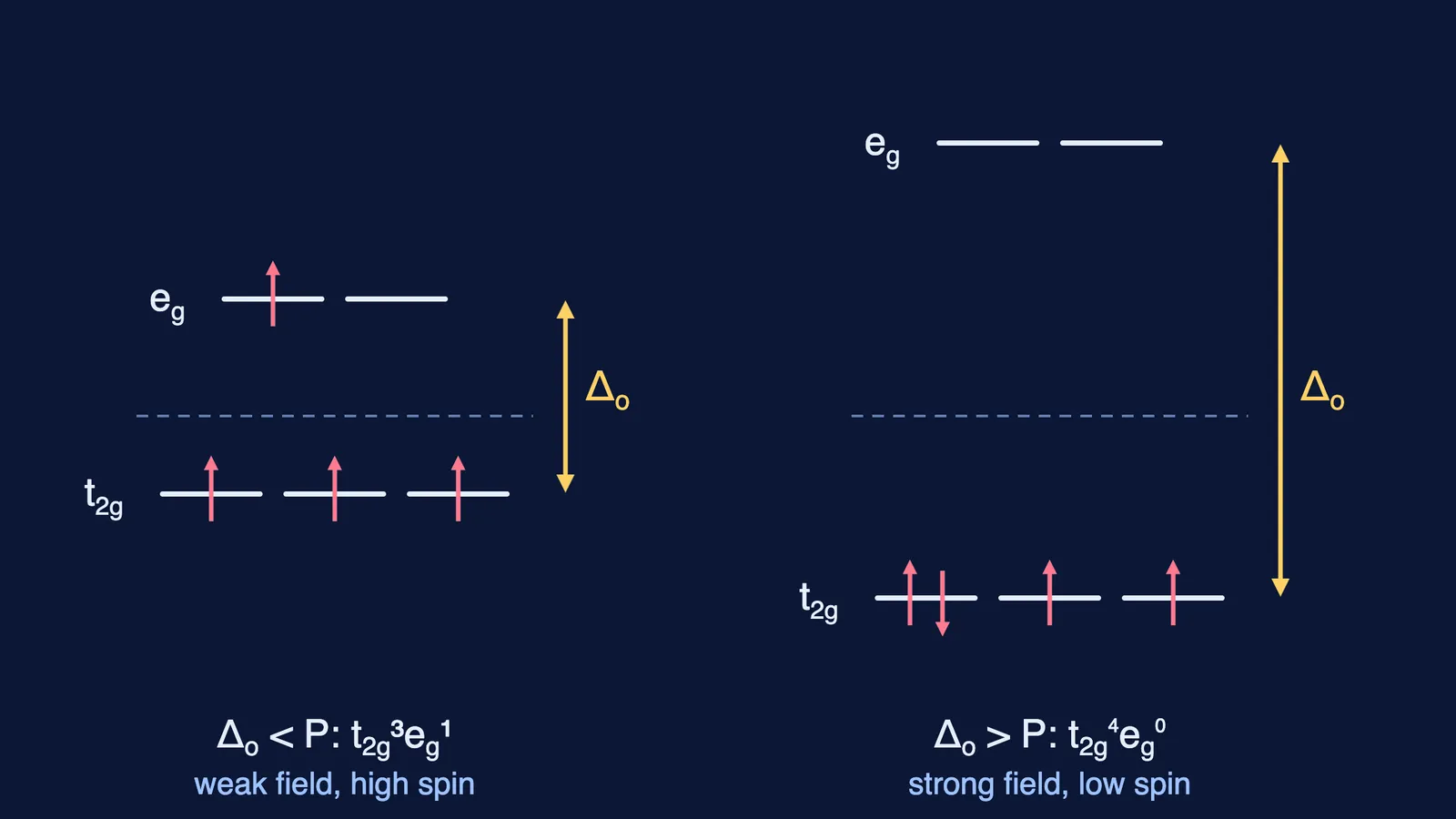
Q9 (medium). Statement I: A d⁴ ion in an octahedral field where Δo is smaller than the pairing energy P has the configuration t₂g³eg¹. Statement II: A ligand that gives a d⁴ ion this configuration is classed as a strong field ligand.
Answer: (C). Statement I matches NCERT. When Δo < P, pairing costs more than climbing the gap; ligands that cause this are weak field ligands and give high-spin complexes.
Trap: swapping which case of Δo versus P is strong field.
Q10 (hard). Statement I: With the metal, the ligands and the bond length unchanged, a tetrahedral field splits the d orbitals by about 4/9 as much as an octahedral field. Statement II: Tetrahedral complexes are rarely low spin.
Answer: (A). NCERT gives Δt = (4/9)Δo and notes that tetrahedral splitting is usually too small to force pairing. Both statements are correct.
Trap: hunting for an explanation link; in a statement pair you only judge each statement as true or false.
How should you use this set?
Cover the answers and write a key for all ten before checking.
For each miss, note whether you misjudged a statement or the link.
Redo every miss after three days, naming the swap-test complex.
If the link calls keep slipping, our assertion-reason strategy guide walks through the method, and our coordination compounds NEET practice questions drill the same ideas. When the gap is a concept, such as why CN⁻ splits d orbitals more than F⁻, the Fermi Concept Library has a lesson on every concept in chemistry, each placed in its map.


