On this page
Electrochemistry brings many new words. Our definitions are checked against the Reprint 2026-27 Electrochemistry chapter. The CBSE Class XII Chemistry curriculum 2026-27 covers cells, the Nernst equation, conductance, electrolysis, batteries, fuel cells and corrosion. For answer-writing, read our Electrochemistry Class 12 board exam guide.
What is the difference between a galvanic and an electrolytic cell?
Galvanic (voltaic) cell: turns the energy of a spontaneous redox reaction into electrical work. Example: the zinc-copper Daniell cell gives 1.1 V when both ions are at 1 mol per litre, as the NCERT chapter states.
Electrolytic cell: uses an outside voltage to drive a non-spontaneous reaction. Example: apply more than 1.1 V against a Daniell cell and zinc is deposited instead.
Half-cell (redox couple): one electrode in its electrolyte, where only oxidation or only reduction happens.
Anode and cathode: oxidation always happens at the anode, reduction at the cathode. Don't confuse the sign with the job: the galvanic anode is negative, but in an electrolytic cell the cathode is negative.
Salt bridge: joins the two electrolytes and completes the circuit inside the cell; not needed if both electrodes share one solution.
Cell notation: anode on the left, cathode on the right, a single line at each metal-solution boundary, a double line for the salt bridge. Example: Cu(s)|Cu²⁺(aq)||Ag⁺(aq)|Ag(s).
Inert electrode: platinum or gold that provides a surface and carries electrons without reacting.
How are electrode potentials measured?
Electrode potential: the potential difference between an electrode and its electrolyte, caused by charge separation at the boundary.
Standard electrode potential (E°): the electrode potential with every species at unit concentration, written as a reduction potential (IUPAC convention).
Standard hydrogen electrode (SHE): platinum with a platinum-black coating, in 1 M acid with hydrogen at 1 bar bubbling past, given a potential of zero at every temperature. One half-cell alone cannot be measured, so every E° is read against it.
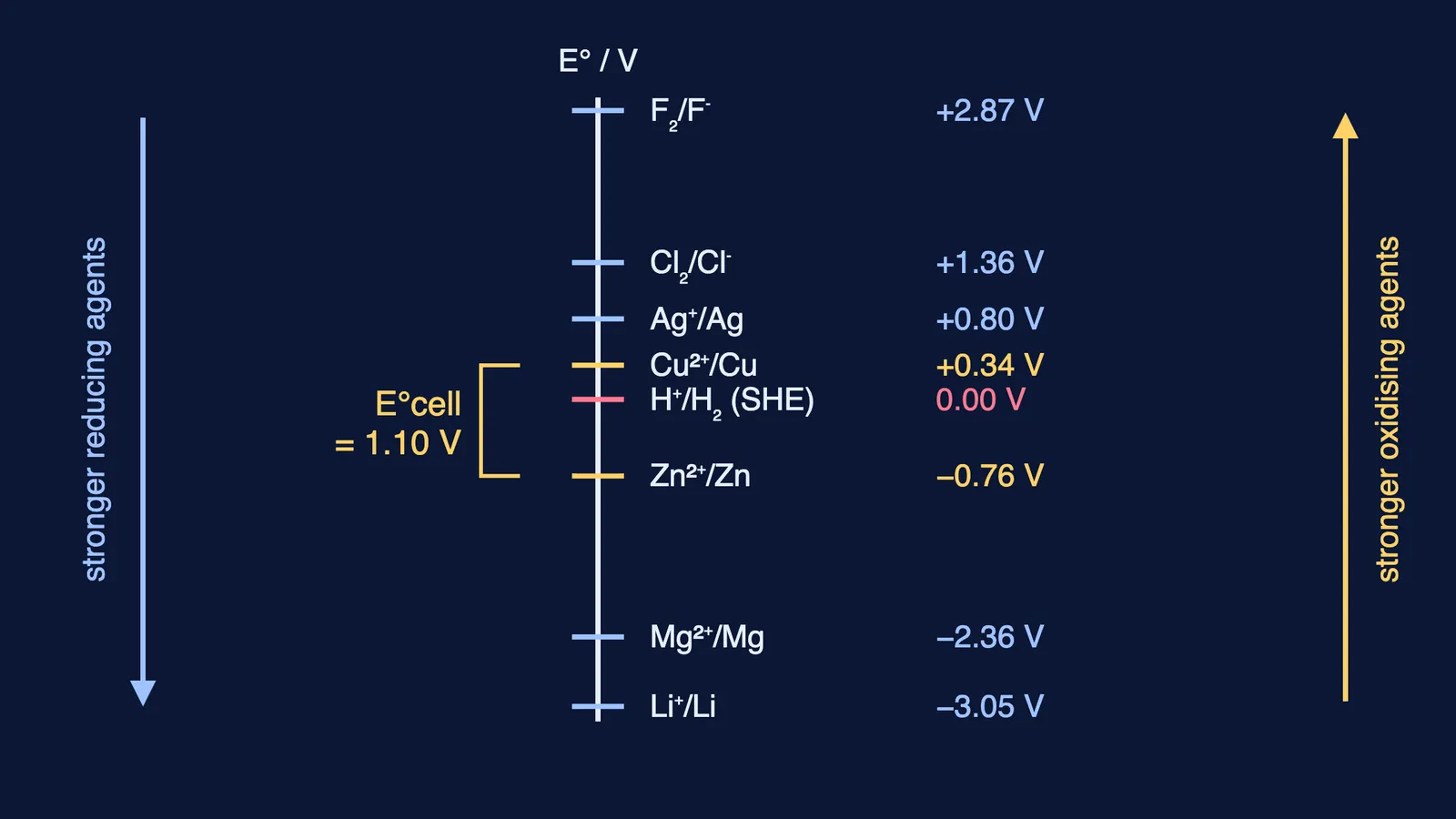
Cell potential and emf: the cathode's reduction potential minus the anode's; called emf when no current flows. Example: E°cell of the Daniell cell is 0.34 V − (−0.76 V) = 1.10 V, using NCERT's Table 2.1.
Oxidising and reducing strength from E°: higher E° means the oxidised form is reduced more readily. In NCERT's table, fluorine (2.87 V) is the strongest oxidising agent and lithium metal (−3.05 V) the strongest reducing agent in aqueous solution.
What does the Nernst equation tell you?
Nernst equation: gives an electrode's or cell's potential at any concentration; at 298 K the log term carries 0.059/n. Don't confuse E with E°, which is the unit-concentration case.
Faraday constant (F): the charge on one mole of electrons, 96487 C mol⁻¹, rounded to 96500 C mol⁻¹ for quick work, per the NCERT chapter.
Equilibrium constant from E°cell: at equilibrium E(cell) is zero, which ties E°cell to log Kc. Example: NCERT gets Kc ≈ 2 × 10³⁷ for the Daniell reaction at 298 K.
Gibbs energy of the cell reaction: ΔrG = −nFE(cell), so a positive cell potential means a spontaneous reaction. Don't confuse: E(cell) is intensive, while ΔrG is extensive and doubles when you double the equation.
How do conductivity and molar conductivity differ?
Resistivity (ρ): the resistance of a sample 1 m long with 1 m² cross-section, in ohm metre, as NCERT defines it.
Conductance (G) and conductivity (κ): conductance is 1/R of one sample, in siemens (S); conductivity is 1/ρ, a material property, in S m⁻¹.
Electronic and electrolytic conductance: electrons carry current in metals, falling as temperature rises; ions carry it in solutions, rising with temperature.
**Conductivity cell and cell constant (G*)**: two platinised platinum electrodes hold the solution, measured with AC so its composition does not change. G* = l/A, found from a KCl solution of known conductivity.
Molar conductivity (Λm): conductivity divided by concentration (κ/c).
Limiting molar conductivity (Λ°m): molar conductivity as concentration approaches zero. Don't confuse the trends: on dilution κ falls but Λm rises.
Strong and weak electrolytes: for KCl (strong), Λm rises slowly on dilution and its plot against √c is nearly straight; for acetic acid (weak) it rises steeply near zero, so Λ°m cannot be read off the graph.
Kohlrausch law of independent migration of ions: Λ°m of an electrolyte equals the sum of the limiting molar conductivities of its ions. Example: Λ°m of CaCl₂ = 119.0 + 2 × 76.3 = 271.6 S cm² mol⁻¹ from NCERT's Table 2.4.
Degree of dissociation (α): the fraction of a weak electrolyte split into ions, about Λm/Λ°m.
Which terms cover electrolysis, batteries and corrosion?
Faraday's first and second laws: published in 1833-34, per the NCERT chapter. The amount reacting at an electrode is proportional to the charge passed (Q = It); for equal charge, amounts liberated follow equivalent weights.
Overpotential: extra voltage needed for a feasible but slow electrode reaction. Example: in aqueous NaCl, chlorine rather than oxygen forms at the anode because of oxygen's overpotential.
Primary and secondary batteries: a primary battery works once (dry cell, mercury cell); a secondary one is recharged by reverse current (lead storage, nickel-cadmium).
Fuel cell: a galvanic cell fed continuously with fuel and oxygen, turning combustion energy straight into electricity. Example: the hydrogen-oxygen cell of the Apollo programme.
Corrosion and rusting: a metal oxidised at its surface; for iron, one spot acts as anode and another as cathode where oxygen is reduced, giving rust, Fe₂O₃·xH₂O.
Sacrificial electrode: a metal such as magnesium or zinc that corrodes in place of the object. Don't confuse with paint, which just keeps air out.
If a term still feels abstract, the Fermi Concept Library has every concept in chemistry, each with its own lesson and its place in the map.
How to learn these terms
Learn in pairs: galvanic and electrolytic, conductance and conductivity, κ and Λm, E and E°.
Draw the Daniell cell from memory and label anode, cathode, signs, salt bridge and electron flow.
Sketch Λm against √c for KCl and acetic acid on one axis, and say why only one extrapolates.
Rebuild a short E° ladder (F₂, Cu, SHE, Zn, Li) and read off which species oxidises which.
Turn each term into a calculation with our Electrochemistry Class 12 formulas sheet, then apply them in Electrochemistry case-study questions.