

On this page
Three new case studies on a galvanic cell, electroplating and conductance, each with four graded parts and worked answers. For the chapter summary and traps, read our Electrochemistry Class 12 board exam guide.
How are case-based questions set in CBSE Class 12 Chemistry?
The CBSE Class XII Chemistry sample question paper for 2026-27 has 2 case-based questions of 4 marks each, in Section D. Each case has two 1-mark parts and a 2-mark part with internal choice; log tables and calculators are not allowed.
Our cases have four parts each, and every number works out by hand. Constants come from the NCERT chapter Electrochemistry (Reprint 2026-27): E°(Cu²⁺/Cu) = +0.34 V, E°(Fe²⁺/Fe) = −0.44 V, 1 F ≈ 96500 C mol⁻¹, and λ°(H⁺) = 349.6 and λ°(CH₃COO⁻) = 40.9 S cm² mol⁻¹.
Case 1: An iron nail and a copper strip
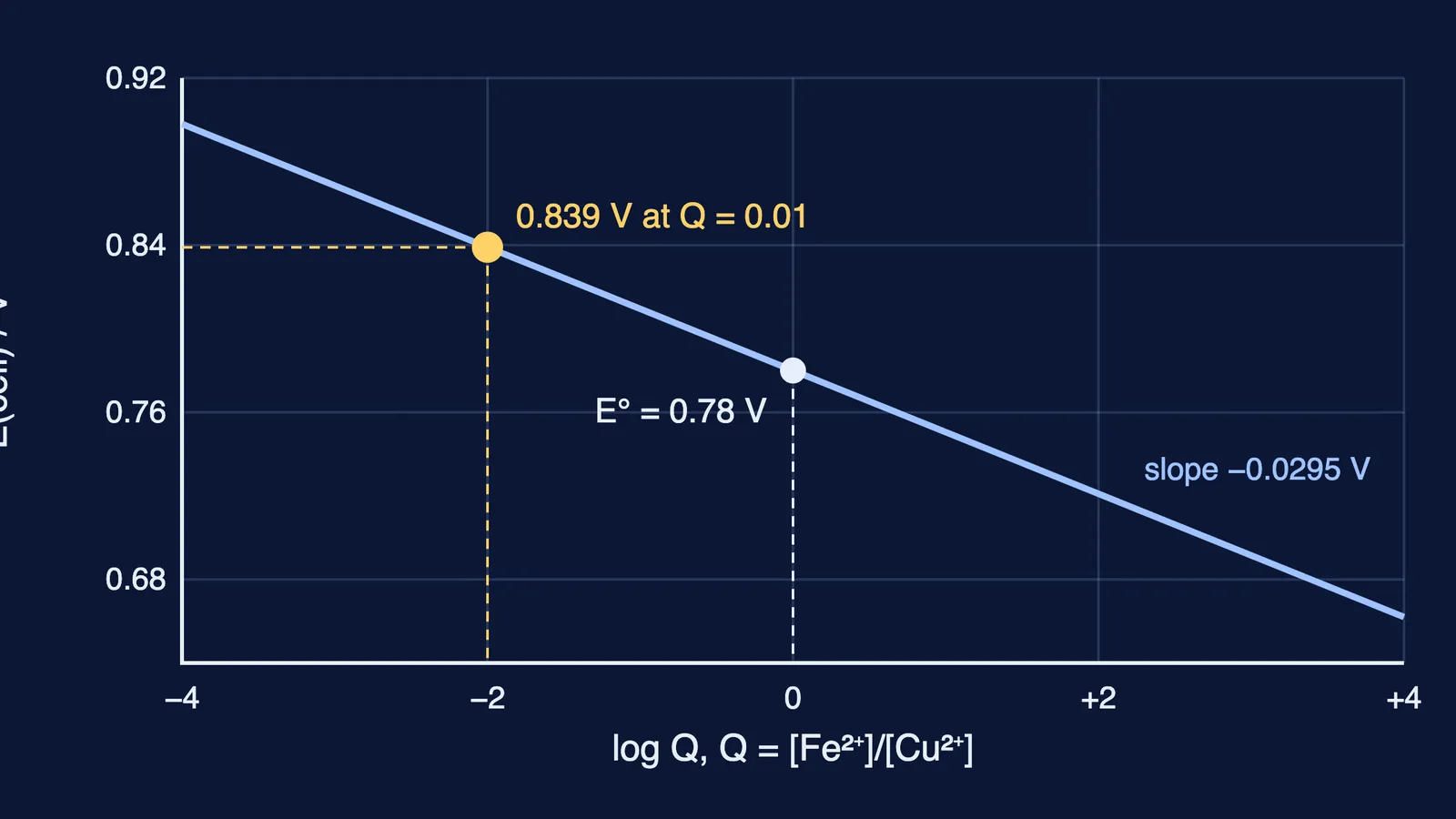
Meera, a Class 12 student in Kochi, builds a cell for her school science exhibition. She dips a cleaned iron nail into 0.001 M FeSO₄ solution in one beaker and a copper strip into 0.1 M CuSO₄ solution in another. A strip of filter paper soaked in KNO₃ solution joins the two beakers, and a wire through a voltmeter joins the nail to the copper. Her teacher gives E°(Fe²⁺/Fe) = −0.44 V and E°(Cu²⁺/Cu) = +0.34 V; take 298 K.
(i) Which electrode is the anode? (a) the copper strip (b) the iron nail (c) the filter paper (d) both
(ii) In which direction do electrons flow through the external wire?
(iii) Write the cell in standard notation and find E°(cell).
(iv) (2 marks) Calculate E(cell) for Meera's concentrations at 298 K.
Answers.
(i) (b) The iron nail. Iron has the lower reduction potential and is oxidised: Fe → Fe²⁺ + 2e⁻.
(ii) From the iron nail (anode, negative) to the copper strip (cathode, positive).
(iii) Fe(s) | Fe²⁺(aq) || Cu²⁺(aq) | Cu(s). E°(cell) = E°(right) − E°(left) = 0.34 − (−0.44) = 0.78 V.
(iv) The reaction is Fe + Cu²⁺ → Fe²⁺ + Cu, so n = 2. E(cell) = 0.78 − (0.059/2) log(0.001/0.1) = 0.78 − 0.0295 × (−2) = 0.839 V. It exceeds E° because the product ion is dilute.
Case 2: Silver plating in a Jaipur workshop
A small workshop in Jaipur silver-plates brass trays. A tray hangs in a silver salt bath facing a pure silver bar, both wired to a DC supply giving a steady 2.0 A. One batch runs for 965 seconds. To check the supply, a second cell, two copper plates in CuSO₄ solution, is connected in series, so the same charge flows through both. Take 1 F = 96500 C mol⁻¹, Ag = 108 g mol⁻¹ and Cu = 63.5 g mol⁻¹.
(i) The tray must be the: (a) anode, joined to the positive terminal (b) cathode, joined to the negative terminal (c) anode, joined to the negative terminal (d) cathode, joined to the positive terminal
(ii) Write the reaction at the silver bar.
(iii) How many faradays of charge pass in one batch?
(iv) (2 marks) Find the mass of silver on the tray and the mass of copper deposited in the series cell. Which law links the two?
Answers.
(i) (b) Silver deposits by reduction (Ag⁺ + e⁻ → Ag) at the cathode, the negative electrode in an electrolytic cell.
(ii) Ag(s) → Ag⁺(aq) + e⁻. The reactive silver bar dissolves, replacing the Ag⁺ that plates out.
(iii) Q = It = 2.0 A × 965 s = 1930 C, and 1930 ÷ 96500 = 0.02 F.
(iv) Silver needs 1 F per mole: 0.02 mol × 108 g mol⁻¹ = 2.16 g. Copper needs 2 F per mole (Cu²⁺ + 2e⁻ → Cu): 0.01 mol × 63.5 g mol⁻¹ = 0.635 g. Faraday's second law: the masses are in the ratio of the equivalent weights, 108 : 31.75.
Case 3: Checking acetic acid in a food-testing lab
A food-testing lab in Nashik checks how far acetic acid ionises before it tests vinegar samples. The analyst first calibrates her conductivity cell: filled with 0.010 M KCl, whose conductivity at 298 K is 0.00141 S cm⁻¹, the cell shows a resistance of 500 Ω. She rinses it and fills it with 0.0020 M acetic acid, and the meter reads 10,000 Ω at the same temperature. The limiting molar ionic conductivities are λ°(H⁺) = 349.6 S cm² mol⁻¹ and λ°(CH₃COO⁻) = 40.9 S cm² mol⁻¹.
(i) The SI unit of cell constant is: (a) m (b) m⁻¹ (c) S m⁻¹ (d) Ω m
(ii) Why can Λ°m for acetic acid not be found by extrapolating Λm to zero concentration?
(iii) Find the cell constant and the conductivity of the acetic acid solution.
(iv) (2 marks) Calculate Λm, Λ°m, the degree of dissociation α and Ka.
Answers.
(i) (b) m⁻¹, because G* = l/A has the dimension of length⁻¹.
(ii) For a weak electrolyte Λm rises steeply on dilution, so the curve cannot be extrapolated to zero concentration. Use Kohlrausch's law instead.
(iii) G* = κR = 0.00141 S cm⁻¹ × 500 Ω = 0.705 cm⁻¹. κ(acid) = G*/R = 0.705 ÷ 10000 = 7.05 × 10⁻⁵ S cm⁻¹.
(iv) Λm = κ × 1000/c = (7.05 × 10⁻⁵ × 1000) ÷ 0.0020 = 35.25 S cm² mol⁻¹. Λ°m = 349.6 + 40.9 = 390.5 S cm² mol⁻¹. α = 35.25 ÷ 390.5 ≈ 0.090. Ka = cα²/(1 − α) = 0.0020 × (0.090)² ÷ 0.910 ≈ 1.8 × 10⁻⁵ mol L⁻¹.
How should you attack case-study questions?
Copy the data out first, with units. The 2026-27 marking scheme gives separate half marks for the Nernst equation, the substitution and the answer.
Fix signs first. In a galvanic cell the anode is negative; in an electrolytic cell it is positive.
For Nernst, write the balanced reaction first so n and Q are right.
For conductance, keep κ in S cm⁻¹ and c in mol L⁻¹, and multiply by 1000 to get Λm in S cm² mol⁻¹.
For electrolysis, convert charge to faradays, then divide by electrons per ion.
For one-mark practice, try our assertion-reason questions on redox and electrochemistry, or see how to handle case-based questions in board exams. If one numerical step keeps going wrong, the Fermi Problem Library has worked problems with a step-by-step solver that explains the reasoning rather than printing an answer.


