

On this page
Redox Reactions and Electrochemistry is Unit 7 of Chemistry in the NMC Syllabus for NEET (UG)-2026. Every statement below was checked against NCERT Class 11 Redox Reactions and NCERT Class 12 Electrochemistry, both Reprint 2026-27.
How do you answer assertion-reason questions?
Mark each line true or false on its own. Only if both are true, ask whether R is the direct reason for A.
Use these keys for Q1 to Q6:
(A) Both A and R are true and R is the correct explanation of A.
(B) Both A and R are true but R is NOT the correct explanation of A.
(C) A is true but R is false.
(D) A is false but R is true.
More on the method: our assertion-reason question strategy.
Assertion-reason questions on redox and electrochemistry
Q1 and Q2 follow the NCERT Redox Reactions chapter; Q3 to Q6 follow the NCERT Electrochemistry chapter.
Q1 (easy). Assertion (A): In Zn(s) + Cu²⁺(aq) → Zn²⁺(aq) + Cu(s), zinc acts as the reducing agent. Reason (R): A reducing agent is a donor of electrons.
Answer: (A). Both are true and R explains A. Zinc gives two electrons to Cu²⁺, so it donates electrons and is itself oxidised.
Trap: calling zinc the oxidising agent because zinc is the one oxidised.
Q2 (easy). Assertion (A): The oxidation number of each oxygen atom in H₂O₂ is −2. Reason (R): Oxygen has an oxidation number of −2 in most of its compounds.
Answer: (D). A is false: in peroxides the two oxygen atoms are bonded to each other, and NCERT gives each one −1. R is true; peroxides are an exception.
Trap: applying the usual rule without checking for an O–O bond.
Q3 (medium). Assertion (A): The conductivity of a KCl solution decreases when it is diluted. Reason (R): The molar conductivity of a KCl solution increases when it is diluted.
Answer: (B). Both are true, but R is not the reason. Conductivity falls because there are fewer current-carrying ions per unit volume. Molar conductivity rises because it counts the whole volume that contains one mole.
Trap: thinking both quantities must move in the same direction.
Q4 (medium). Assertion (A): In a galvanic cell, the anode is the negative electrode. Reason (R): In the external circuit, electrons flow from the cathode to the anode.
Answer: (C). A is true: oxidation at the anode leaves it at a negative potential. R is false: electrons flow from the anode to the cathode; the conventional current flows the other way.
Trap: mixing up electron flow with current direction.
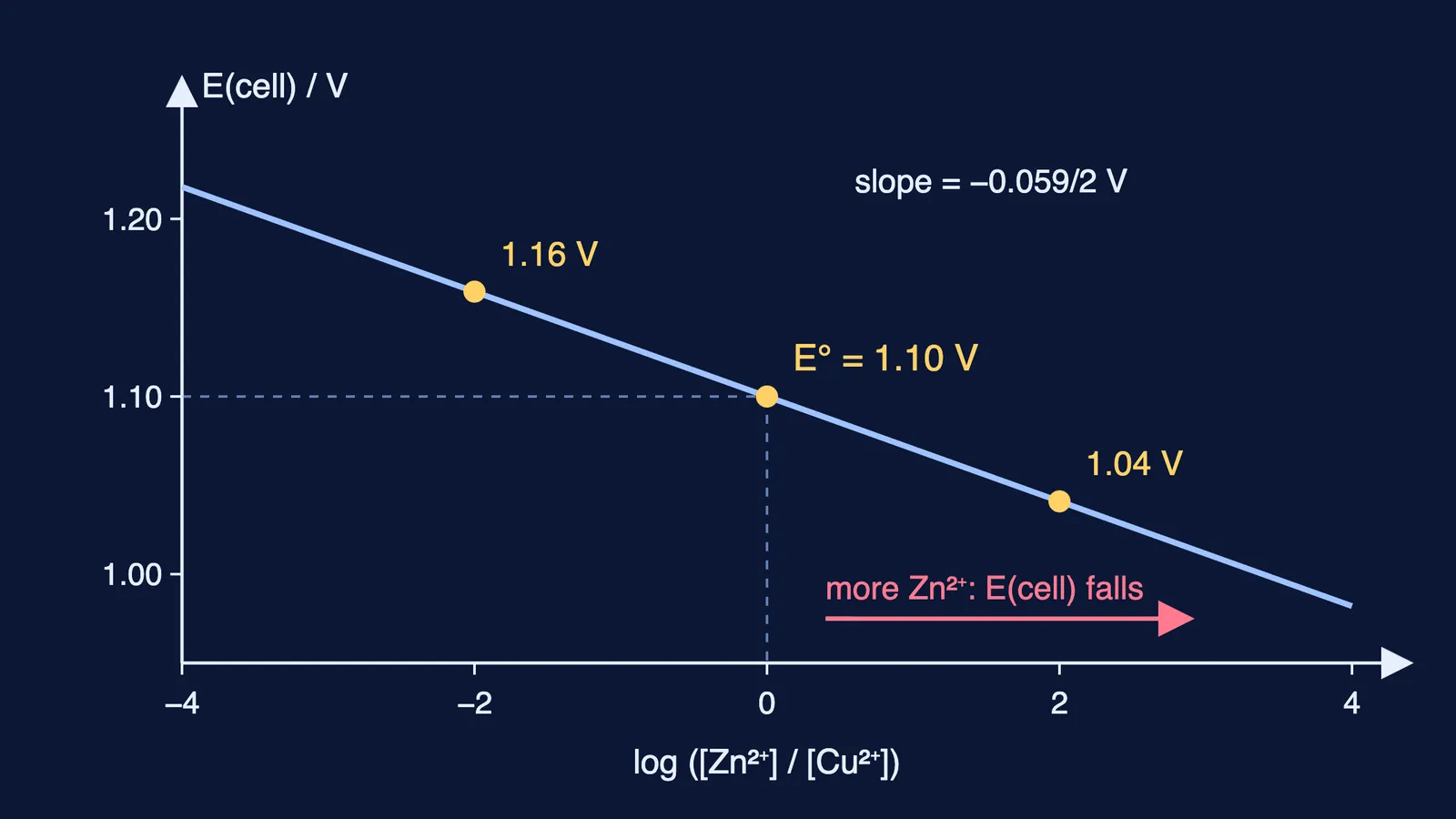
Q5 (medium). Assertion (A): In the Daniell cell at 298 K, raising [Zn²⁺] while keeping [Cu²⁺] fixed raises E(cell). Reason (R): For this cell, E(cell) = E°(cell) − (0.059/2) log([Zn²⁺]/[Cu²⁺]).
Answer: (D). A is false and R is true. Zn²⁺ sits in the numerator, so more Zn²⁺ makes the log term larger and E(cell) smaller.
Trap: reading the minus sign as a plus.
Q6 (hard). Assertion (A): Extending a plot of Λm against √c for acetic acid back to c = 0 does not give a reliable value of Λ°m. Reason (R): As acetic acid is diluted, more of it ionises, so its Λm climbs sharply at very low concentrations instead of following a straight line.
Answer: (A). Both are true and R is the cause. The steep rise near zero leaves no straight line to extrapolate, so Λ°m of a weak electrolyte comes from Kohlrausch's law instead.
Trap: borrowing the straight-line extrapolation that works for strong electrolytes like KCl.
Statement I and Statement II questions
These also follow the two NCERT chapters above. Use these keys for Q7 to Q10:
(A) Both statements are correct.
(B) Both statements are incorrect.
(C) Statement I is correct, Statement II is incorrect.
(D) Statement I is incorrect, Statement II is correct.
Q7 (medium). Statement I: The conversion of Cr₂O₇²⁻ into CrO₄²⁻ in alkaline solution is a redox reaction. Statement II: Chromium has an oxidation number of +6 in both Cr₂O₇²⁻ and CrO₄²⁻.
Answer: (D). Statement I is wrong and Statement II is correct. In Cr₂O₇²⁻, 2x − 14 = −2 gives +6; in CrO₄²⁻, x − 8 = −2 gives +6. No oxidation number changes, so this is not a redox reaction.
Trap: assuming a colour change means a redox change.
Q8 (medium). Statement I: In a dry (Leclanché) cell, the zinc container acts as the anode. Statement II: In the H₂–O₂ fuel cell, hydrogen is fed to the cathode.
Answer: (C). Statement I is correct. Statement II is wrong: hydrogen is oxidised, so it reacts at the anode; oxygen is reduced at the cathode.
Trap: linking hydrogen with the cathode because H⁺ is reduced there in electrolysis.
Q9 (hard). Statement I: A cell reaction with n = 2 and E°(cell) = 0.059 V at 298 K has Kc = 100. Statement II: A cell reaction with a positive E°(cell) has a negative ΔrG°.
Answer: (A). Both are correct. log Kc = nE°(cell)/0.059 = 2 × 0.059/0.059 = 2, so Kc = 100. And ΔrG° = −nFE°(cell) is negative whenever E°(cell) is positive.
Trap: forgetting n and getting Kc = 10.
Q10 (hard). Statement I: By Kohlrausch's law, Λ°m(CH₃COOH) = Λ°m(CH₃COONa) + Λ°m(HCl) + Λ°m(NaCl). Statement II: The average oxidation number of iron in Fe₃O₄ is +3.
Answer: (B). Both are wrong. The correct combination subtracts NaCl, which removes the extra Na⁺ and Cl⁻. In Fe₃O₄, 3x − 8 = 0 gives +8/3, an average for a mixed oxide that holds iron in two states.
Trap: assuming iron must be +3, as in Fe₂O₃.
How should you use this set?
Attempt all ten without notes, marking each line T or F before choosing a key.
For every miss, write what you misjudged: A, R, or the link.
Redo the misses after three days, then try our Redox Reactions and Electrochemistry NEET practice questions with solutions; every question there is different from these.
If conductivity and molar conductivity still blur together, the Fermi Concept Library gives every concept in chemistry its own lesson and its place in the map. For a full plan for the chapter, read Redox Reactions and Electrochemistry for NEET: how to prepare.


