On this page
This sheet follows the NCERT chapter Electrochemistry (Unit 2, Reprint 2026-27) and the topics listed for Unit 2 in the CBSE Class XII Chemistry curriculum 2026-27. NCERT uses R = 8.314 J K⁻¹ mol⁻¹ and F = 96487 C mol⁻¹ (96500 for approximate work); our examples use 96500.
Batteries, fuel cells and corrosion are in the syllabus but are learned as reactions, not formulas, so they are left out. For answer layout, see our Electrochemistry Class 12 board exam guide.
Which formulas give cell potential and the Nernst equation?
E°cell = E°right − E°left = E°cathode − E°anode, in volts (V). Both are standard reduction potentials; the anode is written on the left.
Electrode (Nernst): E(Mⁿ⁺/M) = E°(Mⁿ⁺/M) − (RT/nF) ln (1/[Mⁿ⁺]), in V. [M] for a pure solid is taken as 1. T in K, [Mⁿ⁺] in mol L⁻¹.
Cell: E(cell) = E°(cell) − (2.303RT/nF) log Q, in V, where Q comes from the balanced cell reaction (solids omitted).
At 298 K: E(cell) = E°(cell) − (0.059 V/n) log Q. Valid only at 298 K.
Worked example: Fe | Fe²⁺(0.10 M) || Ag⁺(0.010 M) | Ag at 298 K. E°(Ag⁺/Ag) = +0.80 V, E°(Fe²⁺/Fe) = −0.44 V.
E°cell = 0.80 − (−0.44) = 1.24 V.
Reaction: Fe + 2Ag⁺ → Fe²⁺ + 2Ag, so n = 2 and Q = [Fe²⁺]/[Ag⁺]² = 0.10/(0.010)² = 1000.
E(cell) = 1.24 − (0.059/2) × 3 = 1.24 − 0.0885 = 1.15 V.
Watch for: [Ag⁺] is squared because the reaction has 2Ag⁺, but E°(Ag⁺/Ag) is never doubled.
How are E°cell, ΔrG° and the equilibrium constant linked?
ΔrG = −nFE(cell), in J mol⁻¹ (1 C × 1 V = 1 J). Positive E(cell) means negative ΔrG (spontaneous).
ΔrG° = −nFE°(cell), in J mol⁻¹, all species at unit concentration.
ΔrG° = −RT ln K = −2.303RT log K, in J mol⁻¹, with T in K.
Combining them: E°(cell) = (2.303RT/nF) log Kc, in V; at 298 K, E°(cell) = (0.059 V/n) log Kc. Kc is dimensionless here.
Worked example: for Ni(s) + Cu²⁺(aq) → Ni²⁺(aq) + Cu(s), E°(Cu²⁺/Cu) = +0.34 V and E°(Ni²⁺/Ni) = −0.25 V.
E°cell = 0.34 − (−0.25) = 0.59 V; n = 2.
ΔrG° = −2 × 96500 × 0.59 = −113870 J mol⁻¹ ≈ −113.9 kJ mol⁻¹.
log Kc = (2 × 0.59)/0.059 = 20, so Kc = 1 × 10²⁰.
Watch for: ΔrG° comes out in joules; divide by 1000 for kJ mol⁻¹, keeping the sign.
What are the conductivity and molar conductivity formulas?
R = ρ (l/A), in ohm (Ω); ρ (resistivity) in Ω m or Ω cm.
Conductance G = 1/R, in siemens (S = Ω⁻¹).
Conductivity κ = 1/ρ, in S m⁻¹ or S cm⁻¹; 1 S cm⁻¹ = 100 S m⁻¹.
Cell constant G* = l/A = R × κ, in cm⁻¹ (or m⁻¹). Found using KCl of known κ.
Molar conductivity Λm = κ/c: κ in S m⁻¹ and c in mol m⁻³ give S m² mol⁻¹. With κ in S cm⁻¹ and c in mol L⁻¹: Λm = κ × 1000/c, in S cm² mol⁻¹. 1 S m² mol⁻¹ = 10⁴ S cm² mol⁻¹.
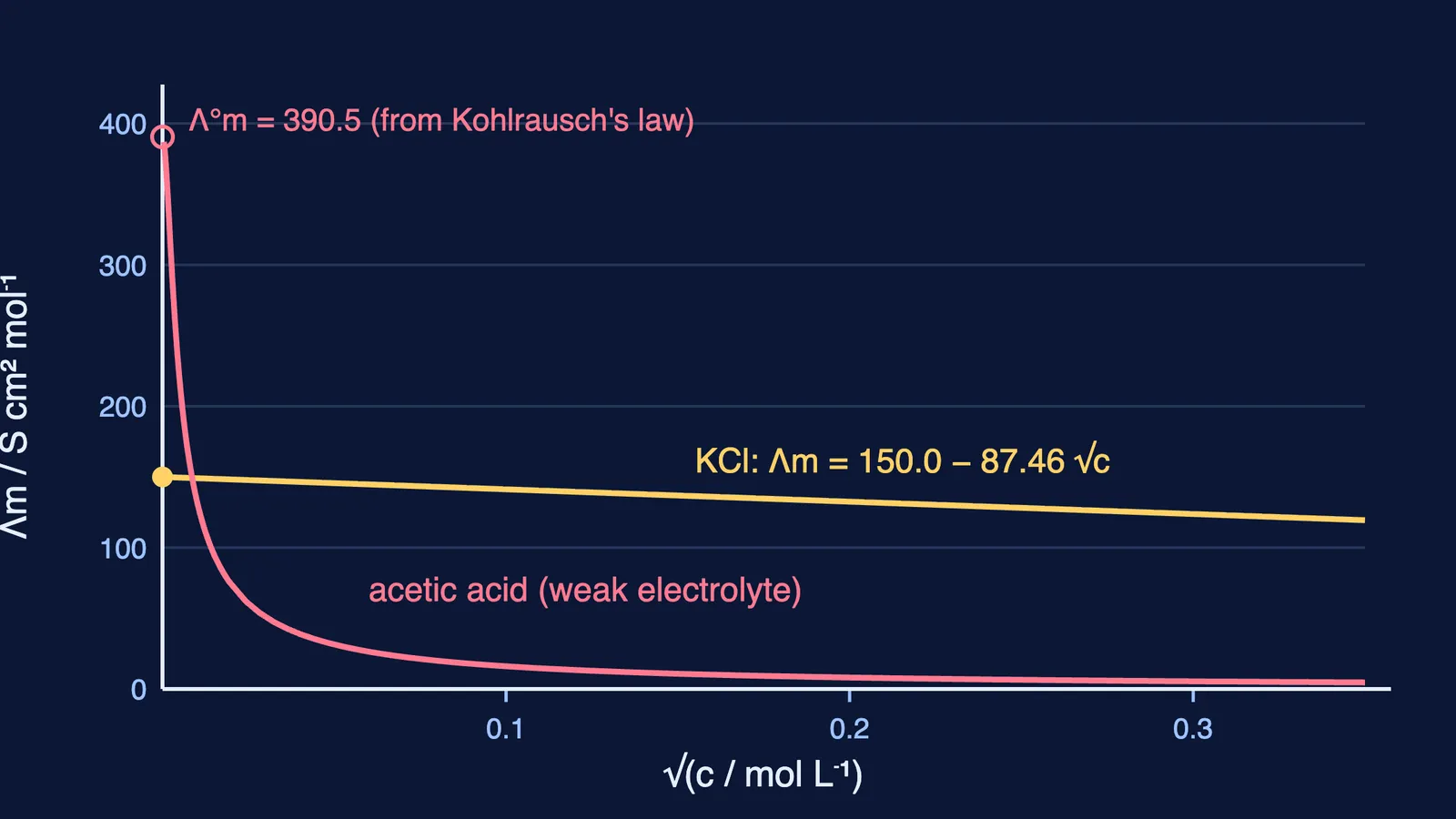
Strong electrolytes at low concentration: Λm = Λ°m − A√c, in S cm² mol⁻¹, where Λ°m is the limiting value (c → 0) and A, in S cm² mol⁻¹ (mol L⁻¹)⁻½, depends on electrolyte type, solvent and temperature.
Worked example: a cell filled with KCl solution of κ = 0.0060 S cm⁻¹ has R = 250 Ω. Filled with a 0.020 mol L⁻¹ salt solution, it reads 600 Ω.
G* = 250 × 0.0060 = 1.5 cm⁻¹.
κ = G*/R = 1.5/600 = 0.0025 S cm⁻¹.
Λm = 0.0025 × 1000/0.020 = 125 S cm² mol⁻¹ (0.0125 S m² mol⁻¹).
Watch for: the 1000 converts L to cm³. Do not use it with κ in S m⁻¹.
How does Kohlrausch's law give Λ°m and Ka for weak electrolytes?
Kohlrausch's law: Λ°m = ν₊λ°₊ + ν₋λ°₋, in S cm² mol⁻¹, with ν₊, ν₋ the ions per formula unit.
Degree of dissociation of a weak electrolyte: α ≈ Λm/Λ°m (dimensionless, approximate).
Dissociation constant: Ka = cα²/(1 − α) = cΛm²/[Λ°m(Λ°m − Λm)], in mol L⁻¹, for a 1:1 weak electrolyte at concentration c.
Worked example: 0.0020 mol L⁻¹ acetic acid has Λm = 35.0 S cm² mol⁻¹. NCERT lists λ°(H⁺) = 349.6 and λ°(CH₃COO⁻) = 40.9 S cm² mol⁻¹.
Λ°m = 349.6 + 40.9 = 390.5 S cm² mol⁻¹.
α = 35.0/390.5 = 0.0896.
Ka = 0.0020 × (0.0896)²/(1 − 0.0896) ≈ 1.76 × 10⁻⁵ mol L⁻¹.
Watch for: Na₂SO₄ has ν₊ = 2, so Λ°m = 2 × 50.1 + 160.0 = 260.2 S cm² mol⁻¹.
What are the formulas for Faraday's laws of electrolysis?
Charge: Q = It, in coulombs (C), with I in amperes (A) and t in seconds (s).
1 F (charge on one mole of electrons) = 96487 C mol⁻¹ ≈ 96500 C mol⁻¹.
Moles deposited: n(substance) = Q/(zF), in mol, where z is the number of electrons per ion reduced (2 for Cu²⁺, 3 for Al³⁺).
Mass deposited: m = (M × I × t)/(z × F), in g, with M the molar mass in g mol⁻¹. First law: m ∝ Q; second law: for the same Q, m ∝ M/z.
Worked example: a current of 3.0 A passes through NiSO₄ solution for 40 minutes (M of Ni = 58.7 g mol⁻¹).
t = 40 × 60 = 2400 s, so Q = 3.0 × 2400 = 7200 C.
Moles of Ni = 7200/(2 × 96500) = 0.0373 mol.
Mass = 0.0373 × 58.7 ≈ 2.19 g.
Watch for: convert minutes to seconds first.
How to revise this formula sheet
Write the balanced cell reaction before any Nernst step; n and Q come from it.
Carry units through each line.
Practise the chain E°cell → ΔrG° → log Kc and check the signs agree.
Test yourself on data-based questions with our electrochemistry Class 12 case-study questions. When a numerical goes wrong and you cannot see where, the Fermi Problem Library has worked problems with a step-by-step solver that explains the reasoning rather than printing an answer.