On this page
These are the key terms of Chapter 11 of the rationalised NCERT Class 10 Science textbook, Electricity (2026-27 reprint). All of them sit in Unit IV of the CBSE 2026-27 Class X Science syllabus. For the chapter plan, see our Electricity Class 10 guide.
What are electric charge, current and a circuit?
Definitions follow NCERT Chapter 11.
Electric charge (Q): the property that makes particles push or pull on each other; its SI unit is the coulomb (C). One electron carries 1.6 × 10⁻¹⁹ C of negative charge.
Electric current (I): how much charge crosses a section of a wire each second, so I = Q/t. Don't confuse with: charge, which is the amount, not the rate.
Ampere (A): the unit of current; 1 A means 1 coulomb passing per second. Example: 1 mA = 10⁻³ A.
Direction of current: by convention, the direction positive charges would move, from the positive terminal through the outside circuit to the negative terminal. Don't confuse with: electron flow, which in a metal wire runs the opposite way.
Electric circuit: a continuous, closed path for current. Example: a torch, where the switch closes the path between cell and bulb.
Circuit diagram: a drawing of a circuit using standard symbols for the cell, battery, key, bulb, resistor, rheostat, ammeter and voltmeter.
Ammeter: measures current and is always joined in series. Don't confuse with: voltmeter.
What is potential difference?
Potential difference (V): the work needed for each coulomb of charge carried between two points, so V = W/Q.
Volt (V): the unit of potential difference; 1 V means 1 joule of work moves 1 coulomb between two points.
Cell and battery: a cell keeps a potential difference across its terminals through chemical action; a battery is two or more cells combined.
Voltmeter: measures potential difference and is always joined in parallel across the two points.
What does Ohm's law say about resistance?
Ohm's law: for a metal wire kept at the same temperature, the current through it grows in direct proportion to the potential difference across it, so V = IR. Its V-I graph is a straight line through the origin.
Resistance (R): the property of a conductor that opposes the flow of charge through it; R = V/I.
Ohm (Ω): the unit of resistance; 1 Ω lets 1 A flow when 1 V is applied.
Resistor: a part of a circuit that has a noticeable resistance.
Rheostat (variable resistance): a device that changes the resistance, and so the current, without changing the cell.
Good conductor, poor conductor, insulator: for the same size, resistance goes from low to high to even higher. Example: copper, nichrome, glass.
Resistivity (ρ): a property of the material, from R = ρl/A; its unit is Ω m. Don't confuse with: resistance, which also depends on length (l) and area of cross-section (A).
Alloy: a mixture of metals that usually has higher resistivity than its metals and does not oxidise easily when hot. Example: nichrome in electric irons and toasters.
How do series and parallel combinations differ?
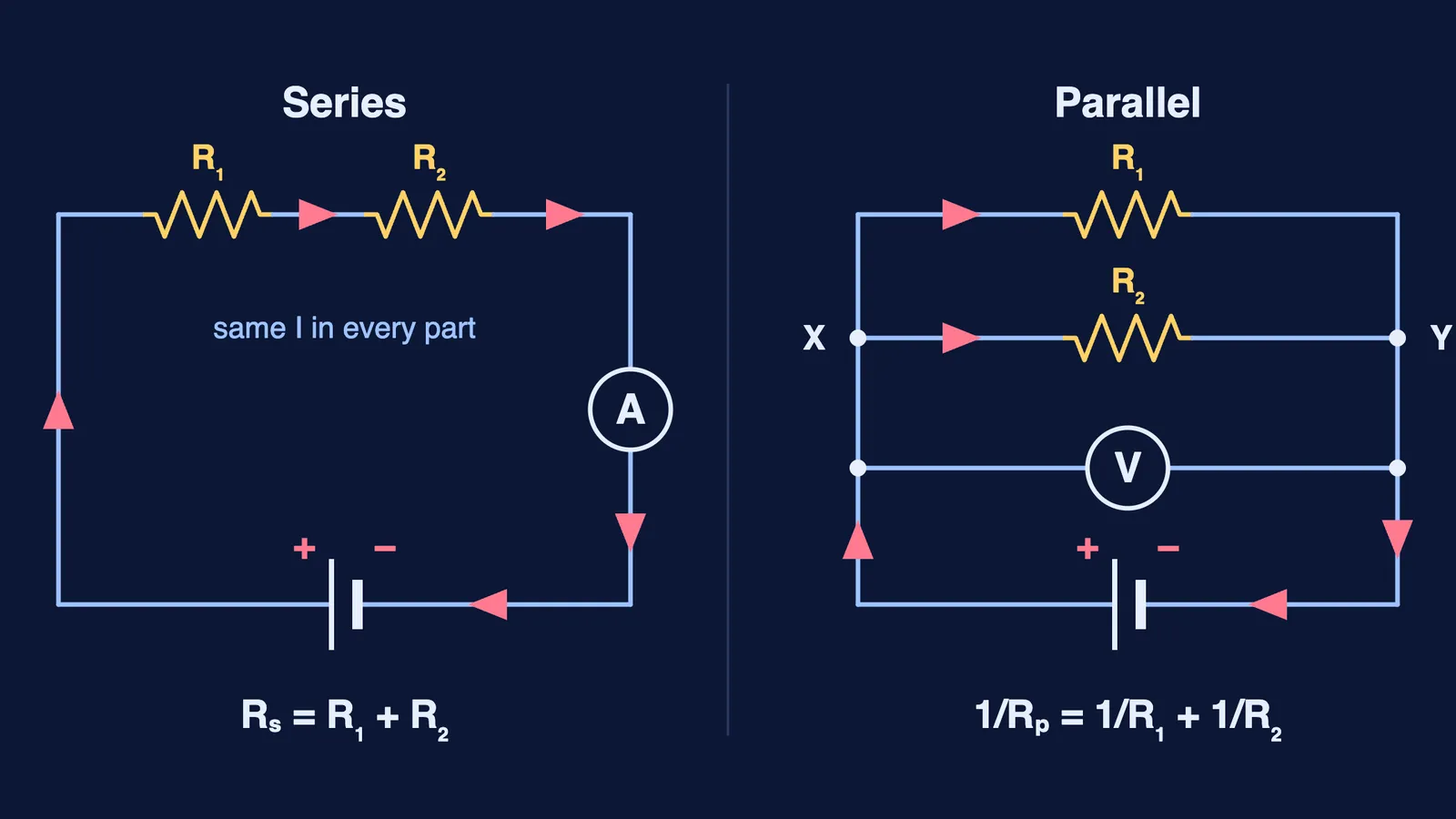
Series combination: resistors joined end to end, so the same current flows through each and the potential differences add up.
Parallel combination: resistors joined between the same two points, so each has the same potential difference and the currents add up. Example: household appliances.
Equivalent resistance: the single resistance that could replace a combination with the same current from the source. In series, Rs = R1 + R2 + R3; in parallel, 1/Rp = 1/R1 + 1/R2 + 1/R3.
Which terms cover heating and electric power?
Heating effect of electric current: in a purely resistive circuit, all the energy from the source turns into heat. Example: electric iron, toaster, kettle.
Joule's law of heating: heat produced H = I²Rt, so heat is proportional to the square of the current, to the resistance and to the time. Don't confuse with: power, which is energy per second.
Filament: the thin wire in a bulb that glows when heated. It is made of tungsten, with a melting point of 3380°C per NCERT, in a bulb filled with nitrogen and argon.
Electric fuse: a wire of suitable melting point placed in series with a device; it melts and breaks the circuit when the current is too high. Example: a 1 kW iron on 220 V draws 4.54 A, so it needs a 5 A fuse. Don't confuse with: a filament, which must not melt.
Electric power (P): the rate at which electrical energy is used, P = VI = I²R = V²/R.
Watt (W): the unit of power; 1 W = 1 V × 1 A. A kilowatt is 1000 W.
Kilowatt hour (kW h): the commercial unit of electrical energy, the "unit" on a bill; 1 kW h = 3.6 × 10⁶ J. Don't confuse with: kilowatt, which is power. Our electricity bill and kWh walkthrough puts this to work.
How to learn these terms
Write each quantity with its symbol, formula and unit in one line: Q (C), I = Q/t (A), V = W/Q (V), R = V/I (Ω), P = VI (W).
Draw one series and one parallel circuit and mark where current is the same and where potential difference is the same.
Keep the look-alike pairs together: resistance and resistivity, kW and kW h, fuse and filament, current and charge, ammeter and voltmeter. If a definition still feels shaky, the Fermi Concept Library gives each physics concept its own lesson and its place in the map.
When these feel solid, move on to magnetic effects of electric current, the next chapter.