On this page
Haloalkanes and Haloarenes is Unit 6 of CBSE Class 12 Chemistry, full of look-alike words. Below, each term is in our own words, checked against the 2026-27 reprint of the NCERT chapter and the unit list in the CBSE Chemistry curriculum for 2026-27. For answers, see our Haloalkanes and Haloarenes Class 12 board exam answer guide.
How are haloalkanes and haloarenes classified?
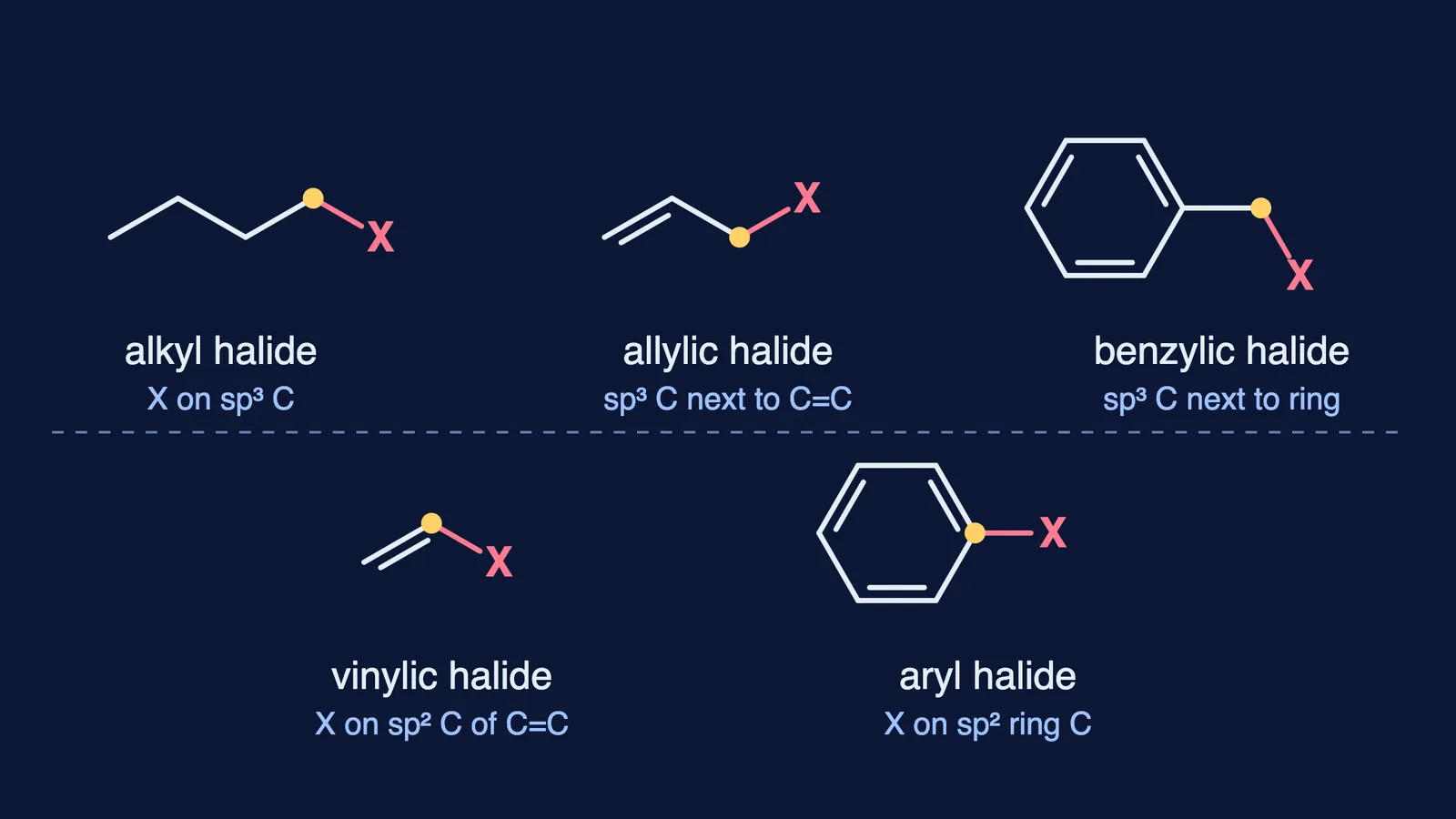
Haloalkane (alkyl halide): the halogen sits on an sp3 carbon of an alkyl group. Example: bromoethane, CH3CH2Br.
Haloarene (aryl halide): the halogen is bonded straight to an sp2 carbon of an aromatic ring. Example: chlorobenzene. Don't confuse with: a benzylic halide, where the halogen is on an sp3 carbon attached to the ring, not on the ring itself.
Primary, secondary and tertiary halides (1°, 2°, 3°): classed by how many carbons are bonded to the carbon carrying the halogen. Example: (CH3)3CBr is 3°.
Allylic halide: the halogen is on an sp3 carbon right next to a C=C. Example: 3-bromopropene (allyl bromide). Don't confuse with: a vinylic halide, where the halogen is on an sp2 carbon of the C=C itself, as in chloroethene (vinyl chloride).
Benzylic halide: the halogen is on an sp3 carbon that is attached to an aromatic ring. Example: benzyl chloride, C6H5CH2Cl.
Gem-dihalide and vic-dihalide: two halogens on the same carbon (geminal) or on neighbouring carbons (vicinal). Example: CH3CHCl2, ClCH2CH2Cl.
Which name reactions make haloalkanes and haloarenes?
Thionyl chloride method: an alcohol reacts with SOCl2 to give an alkyl chloride; the gaseous by-products SO2 and HCl escape, leaving it pure.
Free radical halogenation: chlorinating or brominating an alkane; it gives a mixture of isomers, so any one product has a low yield.
Markovnikov's rule: when HX adds to an unsymmetrical alkene, the hydrogen goes mainly to the double-bond carbon that already has more hydrogens, and the halogen to the other one. Example: propene with HBr gives mainly 2-bromopropane.
Finkelstein reaction: an alkyl chloride or bromide swaps its halogen for iodine with NaI in dry acetone; NaCl or NaBr precipitates, driving it forward. Don't confuse with: the Swarts reaction, which makes alkyl fluorides by heating with a metal fluoride such as AgF or SbF3.
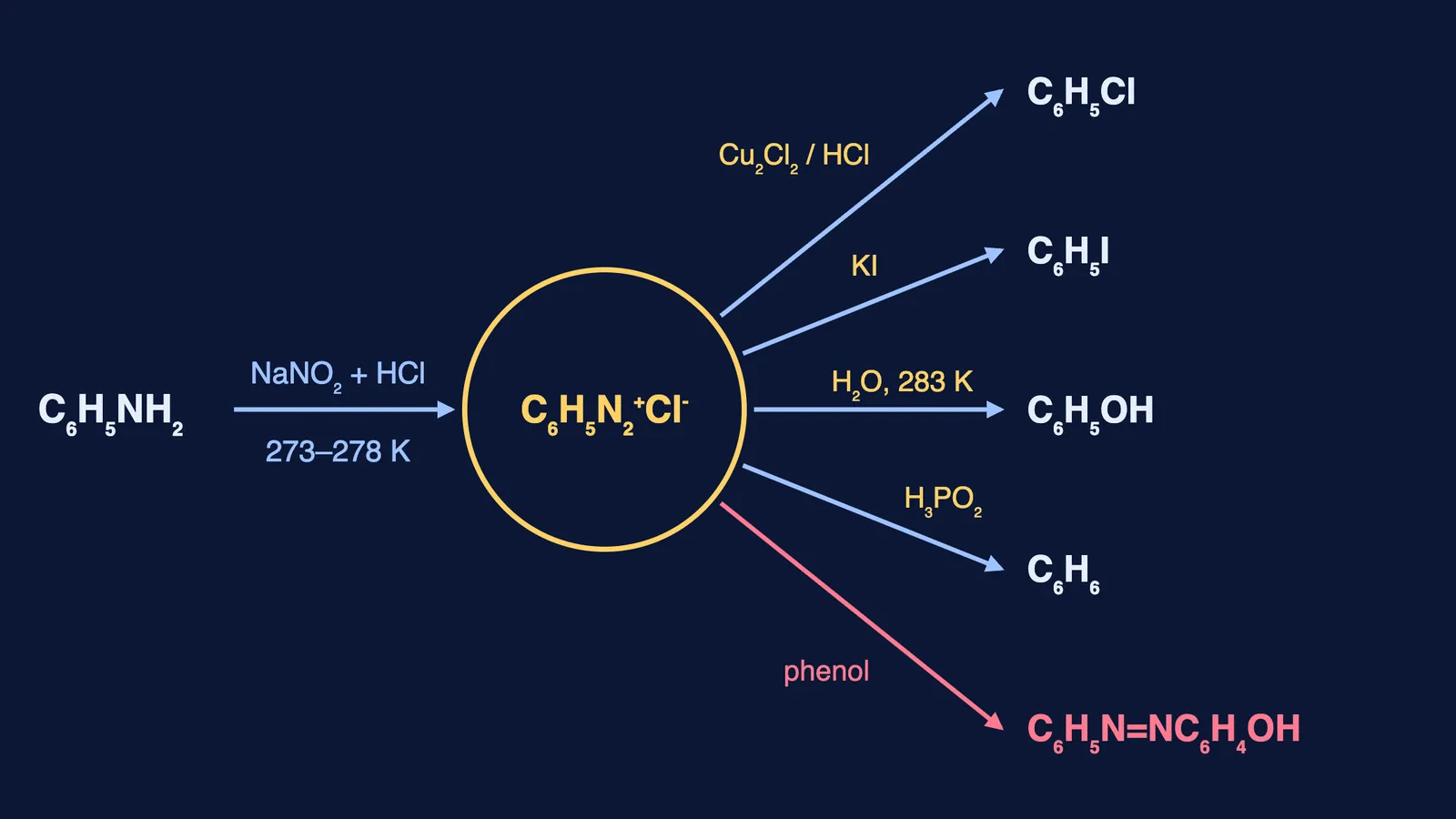
Sandmeyer's reaction: a fresh diazonium salt treated with cuprous chloride or bromide gives an aryl chloride or bromide. For an aryl iodide, shaking with KI is enough.
What do SN1, SN2 and elimination mean?
Nucleophile and leaving group: a nucleophile is an electron-rich species that attacks the slightly positive carbon; the halogen leaves as a halide ion, the leaving group. For the same alkyl group, the NCERT chapter gives reactivity as R–I > R–Br > R–Cl >> R–F.
Ambident nucleophile: a nucleophile that can attack through two different atoms. Example: cyanide gives a nitrile with KCN but mainly an isocyanide with AgCN; nitrite gives an alkyl nitrite with KNO2 and a nitroalkane with AgNO2.
SN2 (bimolecular substitution): bond-making and bond-breaking happen in one step, so the rate depends on both the halide and the nucleophile. Back-side attack means crowding slows it: methyl > 1° > 2° > 3°.
SN1 (unimolecular substitution): the halide first breaks into a carbocation (the slow step), then the nucleophile adds, so the rate depends only on the halide. Tertiary, allylic and benzylic halides react fastest because their carbocations are stable.
β-elimination (dehydrohalogenation): heating with alcoholic KOH removes H from the β-carbon and X from the α-carbon to form an alkene. The α-carbon carries X; the β-carbon is its neighbour.
Zaitsev (Saytzeff) rule: the main alkene is the one with more alkyl groups on the double-bond carbons. Example: 2-bromopentane gives mainly pent-2-ene.
What do chirality, inversion and racemisation mean?
Optical activity: rotating plane-polarised light (measured with a polarimeter). Dextrorotatory (+) means clockwise; laevorotatory (–) means anticlockwise.
Chiral and achiral: a chiral object cannot be laid exactly over its mirror image, like your two hands; an achiral one can. Example: butan-2-ol is chiral, propan-2-ol is not.
Asymmetric carbon: a carbon bonded to four different groups.
Enantiomers: a pair of non-superimposable mirror-image molecules. They share physical properties but rotate light equally in opposite directions.
Racemic mixture: an equal mix of two enantiomers, written (±) or dl, with no net rotation. Racemisation is turning one enantiomer into such a mix.
Inversion and retention of configuration: inversion flips the 3D arrangement at the carbon, like an umbrella in the wind; retention keeps it. SN2 gives inversion, SN1 gives racemisation because the flat carbocation is attacked from both sides.
Which terms cover haloarenes, metals and polyhalogen compounds?
Grignard reagent: RMgX, made from a haloalkane and magnesium in dry ether. Water destroys it.
Wurtz, Wurtz-Fittig and Fittig reactions: sodium in dry ether joins two alkyl halides into an alkane (Wurtz), an alkyl and an aryl halide into an alkylarene (Wurtz-Fittig), or two aryl halides into a biaryl (Fittig).
Partial double bond character: resonance shares halogen lone pairs with the ring, so the C–X bond in a haloarene is harder to break. The sp2 ring carbon also holds the bonding pair more tightly, so the bond is shorter: NCERT gives the C–Cl length as 169 pm in a haloarene against 177 pm in a haloalkane (chapter PDF).
Ortho-para directing: halogens slightly deactivate the ring yet steer electrophiles to ortho and para positions. A nitro group at ortho or para makes a haloarene easier to substitute by a nucleophile; at meta it has no effect; see why ortho and para nitro groups make chlorobenzene reactive.
Polyhalogen compound: an organic compound carrying two or more halogen atoms, such as dichloromethane, chloroform, iodoform, carbon tetrachloride or DDT.
Freons: methane and ethane derivatives that carry both chlorine and fluorine (CFCs). Freon 12 is CCl2F2; in the stratosphere freons start radical chain reactions that disturb the ozone balance.
If chirality feels abstract, the Fermi Concept Library has a lesson for every concept in chemistry, each with its place in the map.
How to learn these terms
Learn in pairs: allylic and vinylic, Finkelstein and Swarts, KCN and AgCN.
Draw the five halide types and write sp3 or sp2 on the carbon holding X.
Make an SN1 versus SN2 sheet: steps, rate, best substrate, stereochemistry.
Practise with the Haloalkanes and haloarenes case study questions for Class 12.