On this page
The CBSE 2026-27 Chemistry sample paper has a Section D of 2 case-based questions carrying 4 marks each. Below are three original cases on Unit 6, built from the rationalised NCERT chapter on haloalkanes and haloarenes. Each has four parts of rising difficulty and worked answers. Its cases have three parts (1, 1 and 2 marks); ours add a fourth, with (iv) as the 2-mark part. For the full chapter, start with our Haloalkanes and Haloarenes Class 12 answer guide.
Case 1: Why does NaI in dry acetone swap bromine for iodine?
Meera adds 12.3 g of 1-bromopropane (molar mass 123 g/mol) to a solution of sodium iodide in dry acetone. Within minutes the clear solution turns cloudy and a white solid settles at the bottom. She filters, distils and collects 13.6 g of 1-iodopropane (molar mass 170 g/mol). Her teacher points out that the same exchange run in a solvent that dissolves every salt involved gives a poor yield.
(i) This halogen exchange is called the: (a) Swarts reaction (b) Finkelstein reaction (c) Wurtz reaction (d) Sandmeyer reaction.
(ii) Name the white solid that settles out.
(iii) Calculate the percentage yield of 1-iodopropane.
(iv) Why does the exchange go almost to completion in dry acetone but not in a solvent that dissolves all the salts?
Answers.
(i) (b) Finkelstein reaction: an alkyl bromide or chloride with NaI in dry acetone gives the alkyl iodide.
(ii) Sodium bromide, NaBr.
(iii) Moles of 1-bromopropane = 12.3 / 123 = 0.100 mol, so the theoretical mass of 1-iodopropane = 0.100 × 170 = 17.0 g. Yield = 13.6 / 17.0 × 100 = 80%.
(iv) The exchange is reversible. In dry acetone, NaBr precipitates and leaves the solution, so by Le Chatelier's principle the equilibrium keeps shifting forward. If NaBr stays dissolved, bromide ions can attack the iodide product and the reverse reaction limits the yield.
Case 2: How do rate data separate SN1 from SN2?
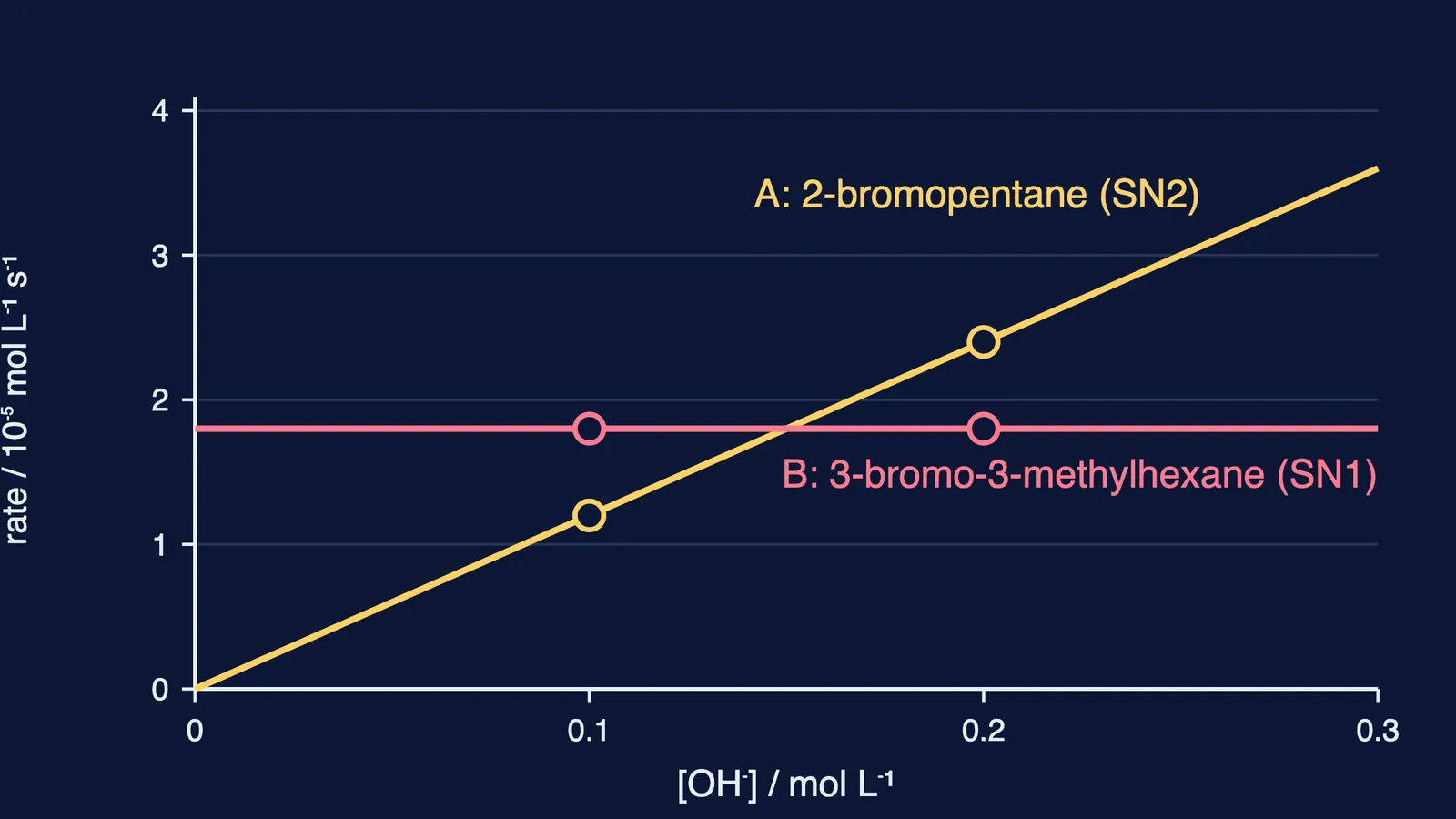
A chemist hydrolyses two optically active bromides with NaOH and records initial rates. Compound A is 2-bromopentane; compound B is 3-bromo-3-methylhexane, run in a water-ethanol mixture.
A: [A] = 0.050 M, [OH⁻] = 0.10 M, rate = 1.2 × 10⁻⁵ mol L⁻¹ s⁻¹
A: [A] = 0.050 M, [OH⁻] = 0.20 M, rate = 2.4 × 10⁻⁵ mol L⁻¹ s⁻¹
B: [B] = 0.050 M, [OH⁻] = 0.10 M or 0.20 M, rate = 1.8 × 10⁻⁵ mol L⁻¹ s⁻¹ both times
B: [B] = 0.10 M, [OH⁻] = 0.10 M, rate = 3.6 × 10⁻⁵ mol L⁻¹ s⁻¹
The rate of A is also proportional to [A].
(i) The order of the reaction of A with respect to OH⁻ is: (a) 0 (b) 1 (c) 2 (d) 3.
(ii) Which mechanism does B follow, and which step is slow?
(iii) Find the rate constant for A with units, and the rate when [A] = 0.10 M and [OH⁻] = 0.15 M.
(iv) Each hydrolysis starts from a single enantiomer. Predict whether each product is optically active, and justify.
Answers.
(i) (b) 1. Doubling [OH⁻] doubles the rate of A.
(ii) SN1. The rate depends on [B] only (first order), and the slow step is the cleavage of the C–Br bond to form a tertiary carbocation.
(iii) Rate = k[A][OH⁻]; k = 1.2 × 10⁻⁵ / (0.050 × 0.10) = 2.4 × 10⁻³ L mol⁻¹ s⁻¹. New rate = 2.4 × 10⁻³ × 0.10 × 0.15 = 3.6 × 10⁻⁵ mol L⁻¹ s⁻¹.
(iv) A reacts by SN2: OH⁻ attacks from the side opposite bromine, so pentan-2-ol forms with inverted configuration and is optically active. B reacts by SN1: the flat carbocation is attacked from both faces, so 3-methylhexan-3-ol forms as a racemic mixture and is optically inactive.
Case 3: Nitrating chlorobenzene at a dye plant
A dye plant nitrates 450 kg of chlorobenzene (molar mass 112.5 g/mol) with a mixture of concentrated nitric and sulphuric acids. The reaction is slower than the nitration of benzene in the same reactor. 90% of the chlorobenzene is converted, and analysis shows 65% of the product is 1-chloro-4-nitrobenzene and 35% is 1-chloro-2-nitrobenzene (both molar mass 157.5 g/mol). On cooling, one isomer crystallises out first. The para isomer then goes to a second reactor, where it reacts with aqueous NaOH under far milder conditions than chlorobenzene needs.
(i) In electrophilic substitution, the chlorine of chlorobenzene is: (a) activating and o, p-directing (b) deactivating and meta-directing (c) deactivating and o, p-directing (d) activating and meta-directing.
(ii) Which isomer crystallises first, and why?
(iii) Calculate the mass of 1-chloro-4-nitrobenzene formed.
(iv) Explain why the para isomer reacts with NaOH so much more easily than chlorobenzene, and predict whether 1-chloro-3-nitrobenzene would.
Answers.
(i) (c). The –I effect slows the reaction; resonance raises electron density at the ortho and para positions.
(ii) 1-chloro-4-nitrobenzene. The symmetrical para isomer packs better in the crystal lattice, so it has the higher melting point.
(iii) 450 kg / 112.5 = 4.0 kmol; 90% converted gives 3.6 kmol of nitro products; 65% of that is 2.34 kmol. Mass = 2.34 × 157.5 = 368.55 kg, about 369 kg.
(iv) Chlorobenzene resists nucleophilic substitution because resonance gives the C–Cl bond partial double-bond character. A nitro group at the para position withdraws electrons and stabilises the negative charge formed when OH⁻ attacks, so substitution is easier. At the meta position the nitro group cannot stabilise that charge by resonance, so 1-chloro-3-nitrobenzene would not show this effect.
How do you attack haloalkanes case-study questions?
Underline every reagent and solvent: NaI in dry acetone, alcoholic or aqueous KOH, AgCN or KCN each point to one answer.
Classify the carbon holding the halogen (primary, secondary, tertiary, aryl) before you decide on a mechanism.
For stereochemistry parts, write "inversion" or "racemisation" and give the reason in one clause: the backside attack or the planar carbocation.
For haloarenes, name the nitro group's position first: ortho and para help, meta does not.
If a step keeps going wrong, the Fermi Problem Library has worked problems with a step-by-step solver that explains the reasoning rather than printing an answer. For more practice, try our assertion-reason questions on haloalkanes and haloarenes, and see how to approach case-based questions in board exams.