On this page
These ten original items cover Unit 16, Organic Compounds Containing Halogens, of the NEET (UG)-2026 syllabus notified by the National Medical Commission, and Unit 6 of NCERT Class 12 Chemistry Part II. Every statement was checked against the Reprint 2026-27 text. For the chapter plan, see our guide to preparing organic compounds containing halogens for NEET.
How do you answer assertion-reason questions?
Work in three steps:
Is the Assertion true on its own?
Is the Reason true on its own?
Only if both are true: is R the textbook's own cause of A?
Our assertion-reason strategy post has more step-3 examples.
Keys for Q1 to Q6:
(A) Both A and R are true and R is the correct explanation of A.
(B) Both A and R are true but R is NOT the correct explanation of A.
(C) A is true but R is false.
(D) A is false but R is true.
Keys for Q7 to Q10:
(A) Both statements are correct.
(B) Both statements are incorrect.
(C) Statement I is correct, Statement II is incorrect.
(D) Statement I is incorrect, Statement II is correct.
Assertion-reason questions on haloalkanes and haloarenes
Answer facts come from NCERT Class 12 Chemistry, Unit 6.
Q1 (easy). Assertion (A): Haloalkanes barely dissolve in water despite their polar C–X bond. Reason (R): The attractions a haloalkane forms with water molecules are stronger than the hydrogen bonds between water molecules.
Answer: (C). A is true. R is false: the new haloalkane–water attractions are weaker than the hydrogen bonds broken in water, so less energy is released than is spent, hence the low solubility.
Trap: reading "polar C–X bond" as "dissolves well in water".
Q2 (easy). Assertion (A): Freons are extremely stable, unreactive gases. Reason (R): Freon 12 (CCl2F2) is manufactured from tetrachloromethane by the Swarts reaction.
Answer: (B). Both are true, but how a compound is made does not explain why it is stable.
Trap: picking (A) because both sentences are about freons.
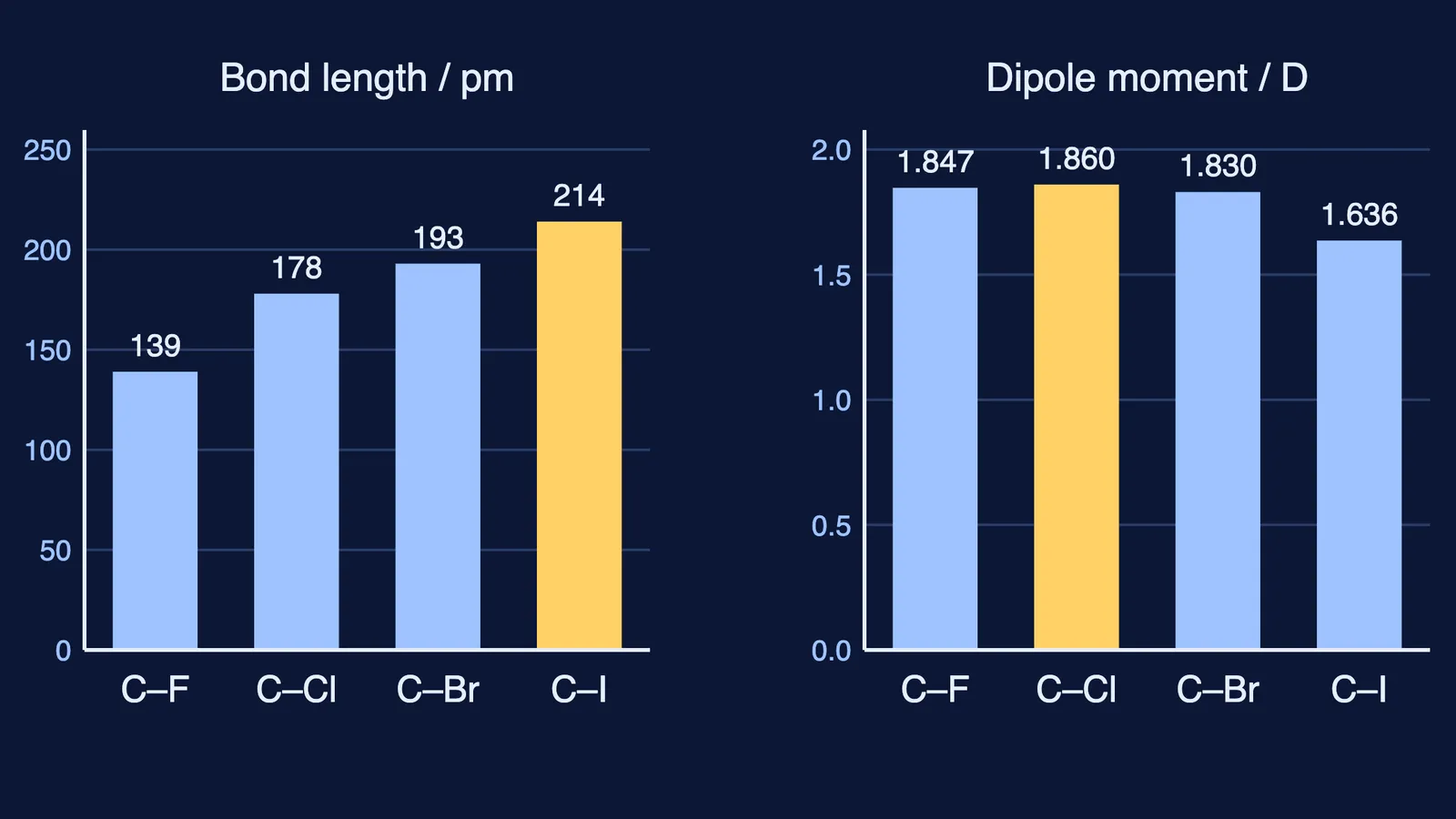
Q3 (medium). Assertion (A): Of the four methyl halides, CH3–I has the largest dipole moment. Reason (R): The C–I bond is the longest of the four carbon–halogen bonds.
Answer: (D). A is false: NCERT's Table 6.2 gives CH3–Cl the largest value (1.860 D) and CH3–I the smallest (1.636 D). R is true: C–I is 214 pm, against 139 pm for C–F. Iodine's smaller partial charge outweighs the longer bond; the diagram at the top plots both columns.
Trap: assuming a longer bond must mean a bigger dipole.
Q4 (medium). Assertion (A): Heating phenol with concentrated HCl does not give chlorobenzene, though the same reagent turns alcohols into alkyl chlorides. Reason (R): The C–O bond in phenol has partial double bond character and is harder to break than a single bond.
Answer: (A). Both are true, and R is the reason NCERT gives for why the alcohol methods cannot make aryl halides.
Trap: treating phenol as just another alcohol.
Q5 (hard). Assertion (A): SN1 hydrolysis of optically active 2-bromobutane gives an optically inactive product. Reason (R): The carbocation formed in the slow step is sp2 hybridised and planar, so the nucleophile can attack from either face.
Answer: (A). Both are true, and R is the cause: attack from both faces gives a 50:50 mixture, (±)-butan-2-ol, whose rotations cancel.
Trap: thinking "optically inactive" means no chiral product forms.
Q6 (hard). Assertion (A): 1-Chloro-4-nitrobenzene undergoes nucleophilic substitution more readily than chlorobenzene. Reason (R): A nitro group at the meta position stabilises the carbanion intermediate as well as one at the para position.
Answer: (C). A is true: a para –NO2 group stabilises the negative charge of the intermediate. R is false: in the meta isomer no resonance structure puts the charge on the carbon bearing –NO2, so NCERT reports no effect.
Trap: thinking "electron-withdrawing" helps from any position.
Statement I and Statement II questions on haloalkanes and haloarenes
Judge each statement on its own against NCERT Unit 6; there is no "because" step.
Q7 (easy). Statement I: An alkyl bromide heated with NaI in dry acetone gives an alkyl iodide, helped by NaBr precipitating out. Statement II: Alkyl fluorides are made by heating an alkyl chloride with a metallic fluoride such as SbF3.
Answer: (A). Both are correct: Statement I is the Finkelstein reaction (the precipitate drives it forward, by Le Chatelier's principle); Statement II is the Swarts reaction.
Trap: swapping the two names.
Q8 (medium). Statement I: For the same alkyl group, boiling points follow the order RF > RCl > RBr > RI. Statement II: In a Grignard reagent, the magnesium–halogen bond is essentially covalent.
Answer: (B). Both are incorrect. Boiling points run RI > RBr > RCl > RF, because larger, heavier halogens give stronger van der Waals forces. In RMgX, the C–Mg bond is covalent but highly polar, while the Mg–X bond is essentially ionic.
Trap: carrying the electronegativity order into boiling points.
Q9 (medium). Statement I: Heating 2-bromopentane with alcoholic KOH gives pent-1-ene as the major product. Statement II: In β-elimination, the hydrogen is lost from the carbon next to the one carrying the halogen.
Answer: (D). Statement I is incorrect: by Zaitsev's rule the major product is the alkene with more alkyl groups on the double-bond carbons, pent-2-ene. Statement II is correct: that neighbouring carbon is the β-carbon.
Trap: picking the terminal alkene.
Q10 (hard). Statement I: (–)-2-Bromooctane reacts with sodium hydroxide by SN2 to give octan-2-ol with the same configuration as the bromide. Statement II: Iodoform's antiseptic action comes from iodoform itself.
Answer: (B). Both are incorrect. SN2 attack comes from the side opposite the bromine, so configuration inverts, giving (+)-octan-2-ol. Iodoform's antiseptic effect comes from the free iodine it releases.
Trap: assuming a substitution keeps the shape because only one group changes.
How should you use this set?
Cover the answers and write your key for all ten, with one line on why.
Wrong on whether a statement is true? Reread the NCERT section. Wrong only between (A) and (B)? Find the textbook's own reason.
Then try our haloalkanes and haloarenes NEET practice questions with solutions.
If a trap exposes a concept gap, such as why a meta nitro group leaves chlorobenzene's reactivity unchanged, the Fermi Concept Library has a lesson for every concept in chemistry, each with its place in the map.