On this page
Below are three original Amines cases, easiest first, each with four parts (one more than the board format, for practice) and worked answers.
What do Amines case-study questions look like in CBSE Class 12?
The CBSE Chemistry sample paper for 2026-27 has 2 case-based questions of 4 marks each in Section D. Each has two 1-mark parts and one 2-mark part. Every reaction and condition here comes from NCERT Class 12 Chemistry Part II, Unit 9 Amines (Reprint 2026-27). Scenarios and numbers are our own (C = 12, H = 1, N = 14, O = 16, Na = 23).
Case 1: Which bottle holds which amine?
In a Pune school lab, bottles A, B and C each hold a dilute solution of a different amine, C₃H₉N. With Hinsberg's reagent (benzenesulphonyl chloride), A gives a solid that does not dissolve in sodium hydroxide, B gives a product that does dissolve in it, and C shows no reaction. Warmed with chloroform and ethanolic KOH, B gives a foul smell. Riya then treats a portion of B containing 0.295 g of the amine with sodium nitrite and hydrochloric acid and collects the gas.
(i) Which bottle holds a tertiary amine? (a) A (b) B (c) C (d) none of them
(ii) Write the IUPAC name of the amine in bottle A.
(iii) Bottle B could hold either of two amines. Name both, and say why B's Hinsberg product dissolves in alkali.
(iv) Name the gas and the type of organic product formed with nitrous acid, and calculate the mass of gas released. (2 marks)
Answers.
(i) (c). Tertiary amines do not react with benzenesulphonyl chloride.
(ii) N-Methylethanamine. It is the only secondary C₃H₉N amine; its sulphonamide has no N–H, so it is insoluble in alkali.
(iii) Propan-1-amine or propan-2-amine; the carbylamine (isocyanide) smell confirms a primary amine. The sulphonamide's N–H is strongly acidic because of the electron-withdrawing sulphonyl group, so it dissolves in alkali.
(iv) Primary aliphatic amines give nitrogen gas quantitatively and an alcohol. Moles of amine = 0.295 ÷ 59 = 5.00 mmol, so N₂ = 5.00 mmol × 28 g/mol = 0.140 g.
Case 2: Making aniline from nitrobenzene
A small dye-intermediate unit in Gujarat reduces 24.6 g of nitrobenzene with iron scrap and a little hydrochloric acid. The crude mixture still contains some unreacted nitrobenzene. The chemist shakes it with dilute HCl and ether, adds NaOH to the right layer, and recovers 15.8 g of pure aniline. A stored sample turns brownish within weeks.
(i) Iron scrap and HCl are preferred for this reduction because: (a) iron is a catalyst for hydrogenation (b) FeCl₂ formed is hydrolysed and releases HCl, so only a little acid is needed (c) iron removes nitrobenzene (d) HCl alone reduces the nitro group
(ii) After shaking with dilute HCl and ether, in which layer is the aniline, and in what form?
(iii) Why does the stored aniline turn brownish?
(iv) Why does adding NaOH bring the aniline back? Calculate the percentage yield. (2 marks)
Answers.
(i) (b). Only a small amount of HCl is needed to start the reaction.
(ii) In the aqueous layer, as anilinium chloride. Amine salts dissolve in water but not in ether, while nitrobenzene, which is not basic, stays in the ether.
(iii) Arylamines are usually colourless but get coloured on storage due to atmospheric oxidation.
(iv) Amine salts regenerate the parent amine when treated with a base such as NaOH. Nitrobenzene (123 g/mol): 24.6 ÷ 123 = 0.200 mol, so at most 0.200 mol of aniline (93 g/mol) = 18.6 g. Yield = 15.8 ÷ 18.6 × 100 = 84.9%.
Case 3: What went wrong in the azo dye batch?
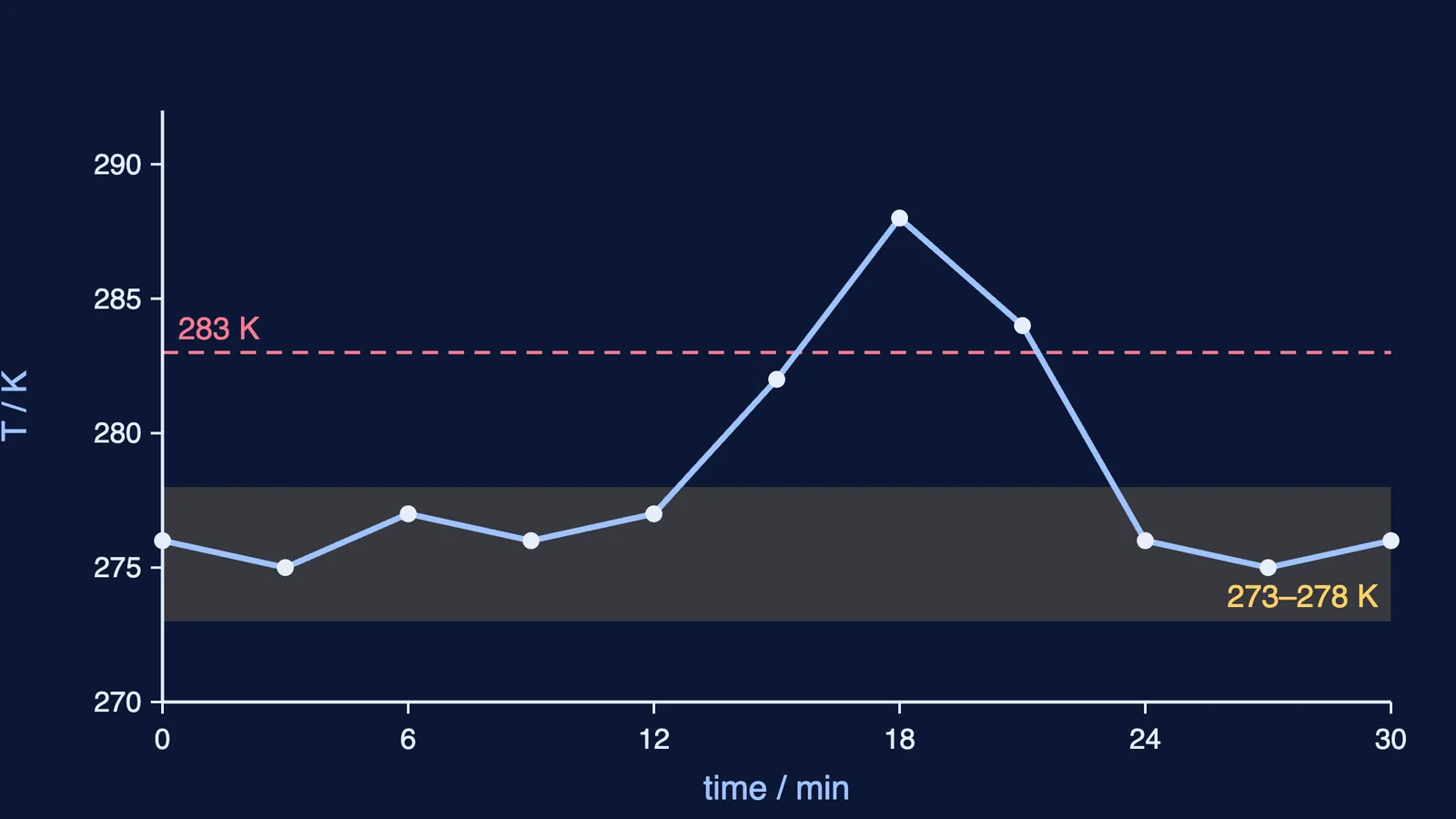
For a Surat textile-dye project, Arjun dissolves 4.65 g of aniline in 2.0 M hydrochloric acid, cools the beaker in an ice bath, and adds sodium nitrite solution slowly. His temperature log reads between 275 and 277 K for the first 12 minutes. Then the ice melts: the reading climbs to 288 K at minute 18, and only falls back to 276 K by minute 24 after fresh ice goes in. Gas bubbles appear during the warm spell. Added to phenol, the cold solution gives an orange solid, less than expected.
(i) The ice bath is needed because arenediazonium salts are stable only for a short time in solution at: (a) 273-278 K (b) 298-303 K (c) 323-333 K (d) above 373 K
(ii) Name the orange compound and the type of reaction that forms it.
(iii) What by-product and what gas formed during the warm spell, and why is the yield low?
(iv) Using C₆H₅NH₂ + NaNO₂ + 2HCl → C₆H₅N₂⁺Cl⁻ + NaCl + 2H₂O, find the minimum mass of NaNO₂ and the minimum volume of 2.0 M HCl for 4.65 g of aniline. (2 marks)
Answers.
(i) (a). So the salt is used immediately after it is made.
(ii) p-Hydroxyazobenzene, by a coupling reaction, an electrophilic substitution at the para position of phenol.
(iii) Once the temperature rises to 283 K, the diazonium salt is hydrolysed to phenol, and nitrogen gas escapes. Some diazonium salt was lost before coupling, so less dye formed.
(iv) Aniline: 4.65 ÷ 93 = 0.0500 mol. NaNO₂ (69 g/mol): 0.0500 × 69 = 3.45 g. HCl: 2 × 0.0500 = 0.100 mol, and 0.100 ÷ 2.0 M = 0.0500 L = 50 mL.
How to attack case-study questions
Turn test results into amine classes first. Hinsberg product soluble in alkali means 1°, insoluble means 2°, no reaction means 3°; a carbylamine smell means 1°.
Circle every temperature. 273-278 K means diazotisation, 283 K means phenol, and a warm spell means lost diazonium salt.
Write the balanced equation before any number. Every numerical here is one mole ratio away from the answer.
Give the reason in NCERT's words. "Atmospheric oxidation", "insoluble in organic solvents like ether" and "strongly acidic" (for the sulphonamide N–H) earn marks.
If you went wrong on a numerical, the Fermi Problem Library has worked problems with a step-by-step solver that explains the reasoning rather than printing an answer. For the full chapter, read our Amines guide for the Class 12 board exam, then see how to answer case-based questions in CBSE board exams and try the Amines assertion-reason questions.