On this page
These ten original items cover Unit 18, Organic Compounds Containing Nitrogen, of the NEET (UG)-2026 syllabus notified by the National Medical Commission, and Unit 9, Amines, of NCERT Class 12 Chemistry Part II. Every statement was checked against its Reprint 2026-27 text. For the chapter plan, see our guide to preparing Organic Compounds Containing Nitrogen for NEET.
How do you answer assertion-reason questions?
Work in three steps:
Is the Assertion true on its own?
Is the Reason true on its own?
Only if both are true: is R the textbook's own cause of A?
Our assertion-reason strategy post has more step-3 examples.
Keys for Q1 to Q6:
(A) Both A and R are true and R is the correct explanation of A.
(B) Both A and R are true but R is NOT the correct explanation of A.
(C) A is true but R is false.
(D) A is false but R is true.
Keys for Q7 to Q10:
(A) Both statements are correct.
(B) Both statements are incorrect.
(C) Statement I is correct, Statement II is incorrect.
(D) Statement I is incorrect, Statement II is correct.
Assertion-reason questions on Amines
Answer facts come from NCERT Class 12 Chemistry, Unit 9.
Q1 (easy). Assertion (A): The C–N–C bond angle in trimethylamine is less than 109.5°. Reason (R): The sp3 hybridised nitrogen in an amine carries an unshared pair of electrons.
Answer: (A). Both are true. NCERT puts the angle at 108° in trimethylamine and gives the unshared pair on nitrogen as the reason it is below the tetrahedral value.
Trap: assuming sp3 always means exactly 109.5°.
Q2 (easy). Assertion (A): Lower aliphatic amines are soluble in water. Reason (R): Amines are more polar than alcohols and form stronger intermolecular hydrogen bonds.
Answer: (C). A is true: small amines dissolve because they form hydrogen bonds with water. R is false: NCERT states the opposite, since oxygen (3.5) is more electronegative than nitrogen (3.0), alcohols are the more polar compounds.
Trap: accepting any hydrogen-bond sentence as the reason without checking its direction.
Q3 (medium). Assertion (A): Aniline can be prepared by Gabriel phthalimide synthesis using chlorobenzene. Reason (R): Aryl halides do not undergo nucleophilic substitution with the anion formed by phthalimide.
Answer: (D). A is false: Gabriel synthesis gives aliphatic primary amines only. R is true, and it is exactly why A fails.
Trap: reading "Gabriel gives primary amines" as "every primary amine, including aniline".
Q4 (medium). Assertion (A): In water, trimethylamine is a weaker base than methylamine. Reason (R): In the gas phase, the basicity order is tertiary > secondary > primary amine > NH3.
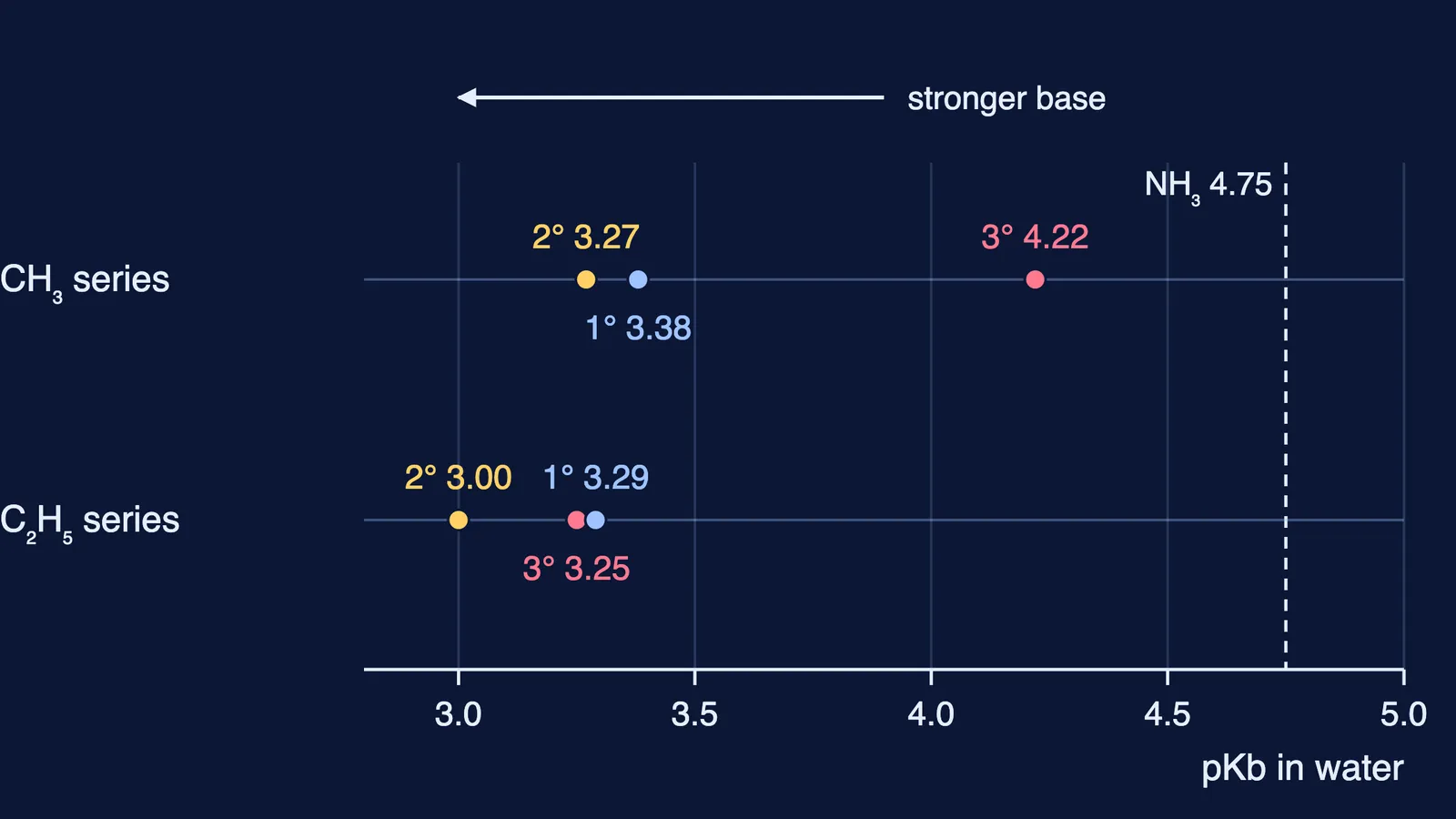
Answer: (B). Both are true: the pKb of (CH3)3N is 4.22 against 3.38 for CH3NH2, and a higher pKb means a weaker base. But R describes the gas phase, where only the +I effect counts. In water, solvation and steric hindrance of the cation decide the order, so R cannot explain A. The diagram at the top plots these values.
Trap: carrying the gas-phase order into water.
Q5 (hard). Assertion (A): Direct nitration of aniline gives a significant amount of m-nitroaniline along with the ortho and para products. Reason (R): In the strongly acidic nitrating mixture, aniline is protonated to the anilinium ion, which is meta directing.
Answer: (A). Both are true, and R is NCERT's own explanation of the meta product.
Trap: thinking that because –NH2 directs ortho and para, a meta product is impossible.
Q6 (hard). Assertion (A): Aniline does not undergo Friedel–Crafts alkylation. Reason (R): The –NH2 group is a powerful activating, ortho and para directing group.
Answer: (B). Both are true, but R would make the ring more reactive. The real cause is that aniline forms a salt with the AlCl3 catalyst; nitrogen gets a positive charge and becomes strongly deactivating.
Trap: picking (A) because both lines are about the –NH2 group on the ring.
Statement I and Statement II questions on Amines
Judge each statement on its own against NCERT Unit 9; there is no "because" step.
Q7 (easy). Statement I: Both aliphatic and aromatic primary amines give a foul-smelling isocyanide when heated with chloroform and ethanolic KOH. Statement II: Secondary amines also give the carbylamine reaction.
Answer: (C). Statement I is correct. Statement II is incorrect: secondary and tertiary amines do not show the reaction, which is why it is a test for primary amines.
Trap: forgetting that aniline, an aromatic amine, passes this test.
Q8 (medium). Statement I: Hoffmann bromamide degradation of butanamide gives butan-1-amine. Statement II: Reduction of ethanenitrile with LiAlH4 gives ethanamine.
Answer: (D). Statement I is incorrect: the amine has one carbon less than the amide, so butanamide gives propan-1-amine. Statement II is correct: nitrile reduction keeps every carbon, including the nitrile carbon.
Trap: thinking Hoffmann keeps every carbon, as nitrile reduction does.
Q9 (medium). Statement I: Benzenediazonium chloride is made by treating aniline with sodium nitrite and hydrochloric acid at 273–278 K. Statement II: Benzenediazonium fluoroborate is insoluble in water and stable at room temperature.
Answer: (A). Both are correct. Benzenediazonium chloride is used soon after it is made because it is unstable, while the fluoroborate salt is stable enough to isolate.
Trap: assuming every diazonium salt decomposes at room temperature.
Q10 (hard). Statement I: In water, the basic strength of the ethylamines follows (C2H5)3N > (C2H5)2NH > C2H5NH2. Statement II: Tertiary amines react with benzenesulphonyl chloride to give a sulphonamide that is insoluble in alkali.
Answer: (B). Both are incorrect. NCERT's aqueous order is (C2H5)2NH > (C2H5)3N > C2H5NH2 > NH3. Tertiary amines do not react with Hinsberg's reagent at all; the alkali-insoluble sulphonamide comes from a secondary amine.
Trap: assuming more ethyl groups always means a stronger base in water.
How should you use this set?
Cover the answers and write your key for all ten, with one line on why.
Wrong on whether a statement is true? Reread the NCERT section. Wrong only between (A) and (B)? Find the textbook's own reason.
Then try our Amines NEET practice questions with solutions.
If a trap exposes a concept gap, such as why solvation reverses the basicity order in water, the Fermi Concept Library has a lesson for every concept in chemistry, each with its place in the map.