On this page
These eight original NEET-style questions on amines and diazonium salts run from easy to hard. Each has one correct option, a short worked solution and a trap line naming the wrong option most students pick, and why.
How should you use this amines practice set?
Amines and diazonium salts form Unit 18 of Chemistry, Organic Compounds Containing Nitrogen, in the NMC NEET (UG)-2026 syllabus. Every fact and pKb value here follows Unit 9, Amines, of NCERT Class 12 Chemistry Part II (reprint 2026-27). In NEET-UG 2026, each correct answer earned +4 and each wrong one cost 1 mark, according to the NTA information bulletin.
Give yourself 8 minutes, one per question, and work on paper.
For every amine, write 1°, 2° or 3° and whether nitrogen sits on the ring before you look at the options.
Mark any answer you guessed, even if it turns out right.
New to the chapter? Read our guide on how to prepare amines for NEET first.
Easy: do you know the definitions cold?
Q1 (easy). 2-Methylbutan-2-amine, CH₃CH₂C(CH₃)₂NH₂, is a:
(A) tertiary amine
(B) secondary amine
(C) primary amine
(D) quaternary ammonium salt
Answer: (C). NCERT classifies amines by how many hydrogens of ammonia are replaced. Here nitrogen carries one carbon group and two hydrogens, so it is primary. Trap: (A). The nitrogen is on a tertiary carbon, but carbon classification does not decide amine class.
Q2 (easy). Potassium phthalimide is heated with a halide, and alkaline hydrolysis then gives 2-phenylethanamine, C₆H₅CH₂CH₂NH₂. The halide was:
(A) C₆H₅CH₂Cl
(B) C₆H₅CH₂CH₂Br
(C) 4-BrC₆H₄CH₂CH₃
(D) C₆H₅CH(Br)CH₃
Answer: (B). In Gabriel synthesis the phthalimide anion replaces the halogen of an alkyl halide, so –NH₂ lands on the carbon that held Br. Aryl halides such as (C) do not react, per NCERT. Trap: (D). It has the same formula, C₈H₉Br, but would put –NH₂ on the carbon next to the ring.
Q3 (easy). Which product of benzenediazonium chloride is made without any copper or copper(I) salt?
(A) Chlorobenzene
(B) Iodobenzene
(C) Benzonitrile
(D) Bromobenzene
Answer: (B). Potassium iodide alone replaces the diazonium group with iodine. Cl, Br and CN need Cu(I) (Sandmeyer), and Cl and Br can also use copper powder with the halogen acid (Gattermann). Trap: (C). KCN sounds like KI, but the cyanide route uses CuCN.
Medium: can you apply the rules to a new molecule?
Q4 (medium). 4-Methylaniline is shaken with excess bromine water at room temperature. The main product is:
(A) 2-Bromo-4-methylaniline
(B) 2,4,6-Tribromoaniline
(C) 3,5-Dibromo-4-methylaniline
(D) 2,6-Dibromo-4-methylaniline
Answer: (D). –NH₂ is a powerful ortho-para director, which is why aniline itself gives 2,4,6-tribromoaniline. Here the para position already holds CH₃, so bromine fills both free ortho positions. Trap: (A). One bromine is what you get only after taming –NH₂ by acetylation.
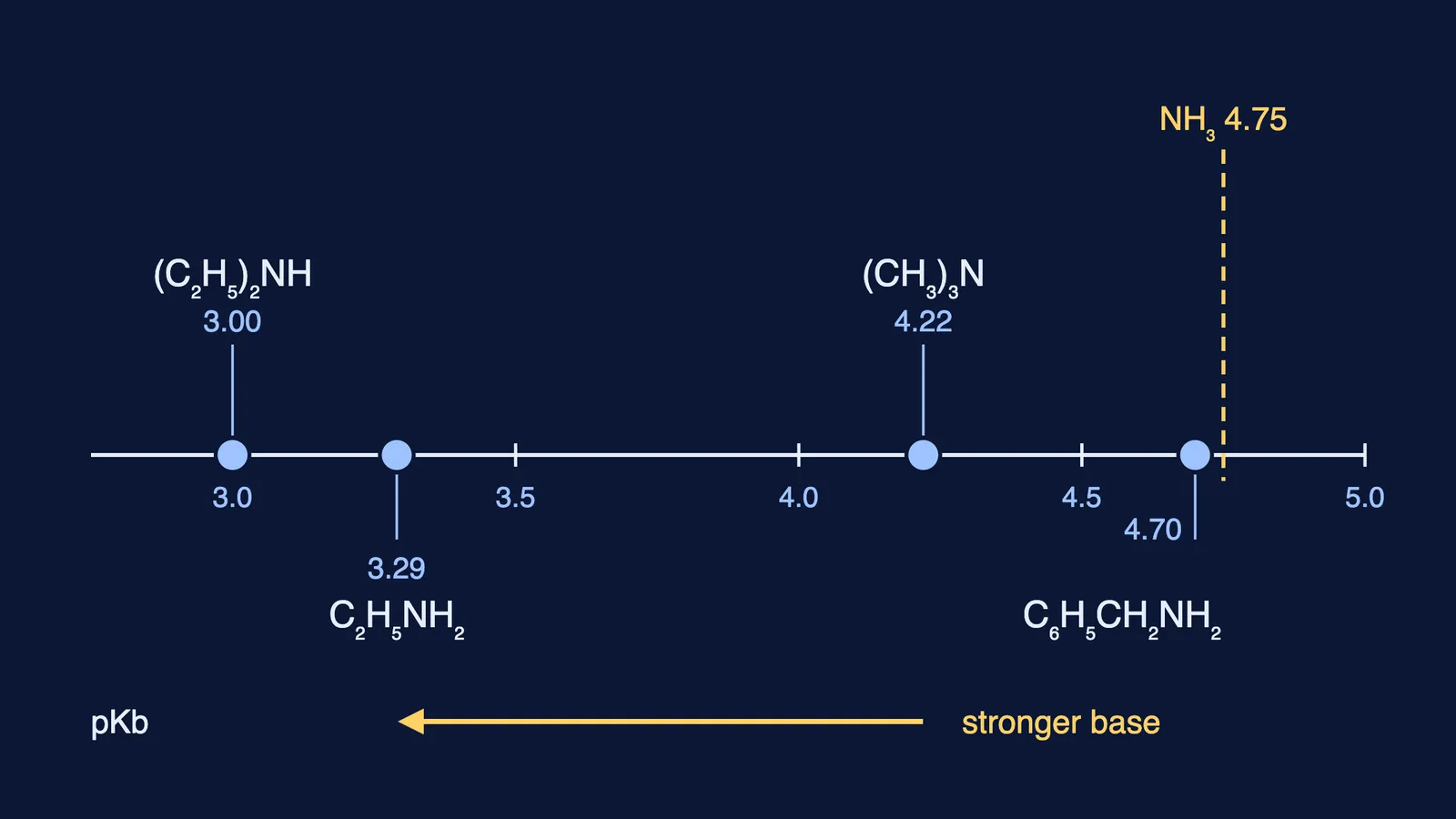
Q5 (medium). Arrange in decreasing order of basic strength in water: C₂H₅NH₂, (C₂H₅)₂NH, (CH₃)₃N, C₆H₅CH₂NH₂.
(A) (CH₃)₃N > (C₂H₅)₂NH > C₂H₅NH₂ > C₆H₅CH₂NH₂
(B) C₂H₅NH₂ > (C₂H₅)₂NH > (CH₃)₃N > C₆H₅CH₂NH₂
(C) (C₂H₅)₂NH > C₂H₅NH₂ > (CH₃)₃N > C₆H₅CH₂NH₂
(D) (C₂H₅)₂NH > (CH₃)₃N > C₂H₅NH₂ > C₆H₅CH₂NH₂
Answer: (C). In NCERT Table 9.3, the pKb values in water are 3.00, 3.29, 4.22 and 4.70. A smaller pKb means a stronger base. Trimethylamine is weaker than you might expect because its ion has only one N–H to hydrogen-bond with water, so solvation stabilises it least. Trap: (A), the gas-phase order 3° > 2° > 1°, which solvation overturns in water.
Q6 (medium). 5.76 g of hexanamide (C₆H₁₃NO, 115.18 g/mol) undergoes Hoffmann bromamide degradation with a 75% yield. The mass of amine formed is closest to:
(A) 3.27 g
(B) 3.80 g
(C) 4.32 g
(D) 4.36 g
Answer: (A). 5.76 / 115.18 = 0.0500 mol of amide. NCERT notes the amine has one carbon less, so the product is pentan-1-amine (87.17 g/mol), one mole per mole of amide: 0.0500 × 0.75 × 87.17 = 3.27 g. Trap: (B), which keeps six carbons and uses hexan-1-amine (101.19 g/mol).
Hard: can you reason through two steps?
Q7 (hard). Assertion (A): Benzenediazonium fluoroborate can be stored as a solid at room temperature. Reason (R): Benzenediazonium chloride is stable in the dry state.
(A) Both A and R are true, and R explains A
(B) Both A and R are true, but R does not explain A
(C) A is true, but R is false
(D) A is false, but R is true
Answer: (C). Per NCERT section 9.8, the fluoroborate is water-insoluble and stable at room temperature, so A is true. The chloride is stable only in cold solution and decomposes easily when dry, so R is false. Trap: (A), from assuming every diazonium salt behaves like the fluoroborate.
Q8 (hard). Aniline is diazotised with NaNO₂ and HCl at 273-278 K, and the solution is split. One half is warmed to 283 K, giving P, and made alkaline. The cold other half is added to it to give a coloured compound Q. The molar mass of Q is closest to:
(A) 170.2 g/mol
(B) 182.2 g/mol
(C) 197.2 g/mol
(D) 198.2 g/mol
Answer: (D). At 283 K the diazonium salt hydrolyses to phenol, so P is phenol. The cold diazonium salt couples with phenol at phenol's para position to give p-hydroxyazobenzene, C₁₂H₁₀N₂O, which keeps the –N=N– link: 198.2 g/mol. Trap: (C), p-aminoazobenzene, the product of coupling with aniline instead of phenol.
What should you do after checking your answers?
Put each miss in one bin: recall (Q1, Q3, Q7), applying a rule to a new molecule (Q2, Q4, Q5, Q8) or bookkeeping of carbons and moles (Q6). Practise the fullest bin first, and redo every miss in two days without the solutions.
If basicity cost you marks, read why secondary amines are the strongest bases in water. If the tests are shaky, see how the Hinsberg test sorts three amines.
When a whole conversion falls apart, the Fermi Problem Library has worked problems with a step-by-step solver that explains the reasoning rather than printing an answer.