On this page
Three original case passages on Aldehydes, Ketones and Carboxylic Acids, easiest first. Each has four parts that get harder, and worked answers follow each case. Every chemistry fact is checked against Unit 8 of NCERT Class 12 Chemistry Part II (Reprint 2026-27); the scenarios and numbers are our own.
What do CBSE case-study questions on this chapter look like?
The CBSE Chemistry sample paper for 2026-27 has 2 case-based questions in Section D, each carrying 4 marks. Its Question 29 has two 1-mark multiple-choice parts and a 2-mark part with an internal choice. Unit 8 is in the 2026-27 Chemistry syllabus with 8 of the 70 theory marks.
Our cases have four parts each. Give each case 8 minutes on paper first. For the full chapter, start with our Aldehydes, ketones and carboxylic acids Class 12 board exam guide.
Case 1: Which aldehyde fails Fehling's test?
In a Class 12 practical in Pune, Ananya is given two unlabelled colourless liquids. Bottle X has molecular formula C7H6O (molar mass 106 g/mol) and bottle Y has C2H4O (44 g/mol). She warms 2 mL of each with freshly prepared Tollens' reagent in a water bath, and both test tubes develop a bright silver mirror. She then heats fresh portions with Fehling's reagent. Y gives a reddish-brown precipitate; X shows no change. Her teacher says X is aromatic.
(i) The silver mirror tells Ananya that X and Y are both: (a) ketones (b) aldehydes (c) carboxylic acids (d) alcohols.
(ii) Name X and Y.
(iii) In Tollens' test, the aldehyde is converted into: (a) a primary alcohol (b) a carboxylate anion (c) an alkane (d) a ketone.
(iv) Which liquid undergoes aldol reaction with dilute alkali and which undergoes Cannizzaro reaction with concentrated alkali? Give a reason and name the products. (2 marks)
Answers.
(i) (b). Mild oxidising agents such as Tollens' reagent oxidise aldehydes, not ketones.
(ii) X is benzaldehyde (C6H5CHO) and Y is ethanal (CH3CHO). Aromatic aldehydes do not respond to Fehling's test.
(iii) (b). NCERT states that aldehydes are oxidised to the corresponding carboxylate anion in this alkaline test.
(iv) Ethanal has α-hydrogens, so with dilute alkali it gives the aldol 3-hydroxybutanal. Benzaldehyde has no α-hydrogen, so with concentrated alkali it disproportionates: one molecule is reduced to benzyl alcohol and another oxidised to the salt sodium benzoate.
Case 2: How strong is the acid in pickle vinegar?
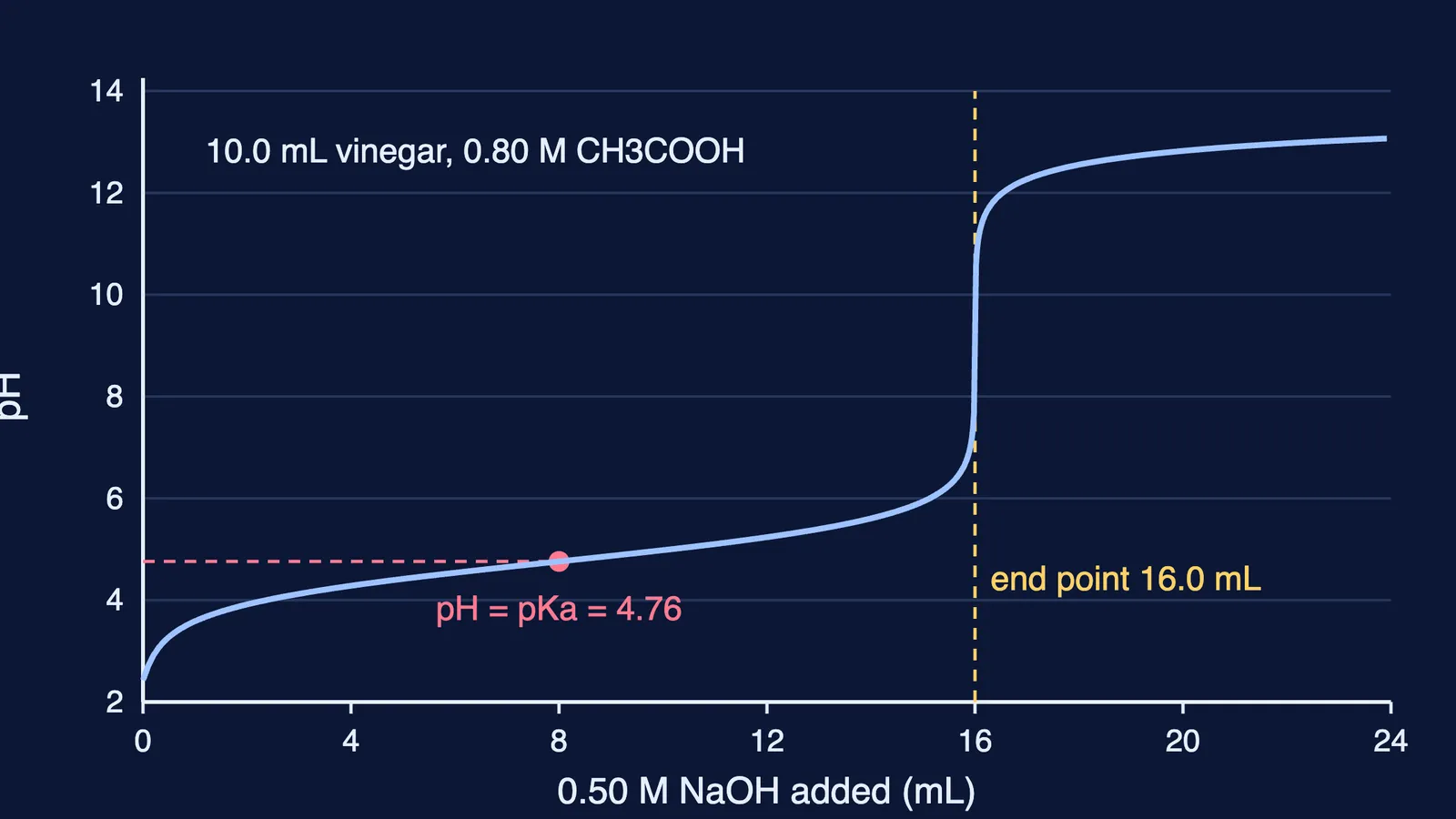
A pickle unit near Nashik checks every batch of vinegar before use. The quality chemist adds sodium hydrogencarbonate to a small sample and sees brisk effervescence. She then titrates 10.0 mL of vinegar against 0.50 M NaOH and needs 16.0 mL to reach the end point. Ethanoic acid (CH3COOH, 60 g/mol) is the only acid present.
(i) The gas given off with sodium hydrogencarbonate is: (a) H2 (b) O2 (c) CO2 (d) CH4.
(ii) Find the mass of ethanoic acid in 100 mL of this vinegar.
(iii) Ethanoic acid (pKa 4.76) is far more acidic than ethanol (pKa about 16). Give one reason.
(iv) Which is the stronger acid, benzoic acid or ethanoic acid? Explain why the phenyl group has this effect, though its resonance would suggest the opposite. (2 marks)
Answers.
(i) (c). Carboxylic acids react with hydrogencarbonates to give carbon dioxide; this is NCERT's test for a carboxyl group.
(ii) Moles of NaOH = 0.50 × 0.0160 = 0.0080 mol, and the acid reacts 1:1, so 10.0 mL holds 0.0080 mol acid (0.80 M). Mass = 0.0080 × 60 = 0.48 g in 10.0 mL, so 4.8 g per 100 mL.
(iii) The carboxylate ion is stabilised by two equivalent resonance structures that spread the negative charge over two oxygen atoms.
(iv) Benzoic acid is stronger, because its pKa (4.19) is smaller. The carboxyl carbon is attached to an sp2 carbon, which is more electronegative, and this outweighs the resonance effect.
Case 3: Which ketone is in the unlabelled solvent drum?
At a paint factory in Vapi, the label on a solvent drum has peeled off. The purchase record says the drum holds one compound of formula C4H8O (72 g/mol). With 2,4-DNP reagent the liquid gives an orange precipitate. It does not reduce Tollens' reagent. Warmed with iodine and sodium hydroxide, it gives a yellow precipitate. Reduction with zinc amalgam and concentrated hydrochloric acid gives a gas, butane. Finally, the technician treats 2.16 g of the liquid with excess sodium hypoiodite.
(i) The 2,4-DNP result shows that the compound contains: (a) a carboxyl group (b) a carbonyl group (c) a hydroxyl group (d) a C=C bond only.
(ii) Which two C4H8O carbonyl compounds does the Tollens' result rule out?
(iii) Identify the solvent and name the reduction used to make butane.
(iv) Write the haloform reaction and calculate the maximum mass of iodoform (CHI3, 394 g/mol) formed from 2.16 g. (2 marks)
Answers.
(i) (b). Aldehydes and ketones form 2,4-dinitrophenylhydrazones, which are yellow, orange or red solids.
(ii) The aldehydes butanal (CH3CH2CH2CHO) and 2-methylpropanal ((CH3)2CHCHO); both would reduce Tollens' reagent.
(iii) Butan-2-one (ethyl methyl ketone), the only C4H8O ketone; iodoform confirms its CH3CO– group. NCERT lists ethyl methyl ketone as a common industrial solvent. The reduction is Clemmensen reduction, which turns the C=O into CH2.
(iv) CH3COCH2CH3 + 3NaOI → CHI3 + CH3CH2COONa + 2NaOH. Moles of ketone = 2.16 ÷ 72 = 0.030 mol, giving 0.030 mol CHI3 = 0.030 × 394 = 11.8 g.
How to attack case-study questions
Underline every test result and translate it: silver mirror, aldehyde; yellow iodoform, CH3CO– or CH3CH(OH)–; effervescence with hydrogencarbonate, carboxyl group.
Check the alkali strength. Dilute alkali plus α-hydrogen means aldol; concentrated alkali with no α-hydrogen means Cannizzaro.
Read pKa the right way round. The smaller pKa is the stronger acid, and the reason is always about stabilising the carboxylate ion.
Show the mole step in numericals: moles, ratio, then mass, with units.
Practise the reasoning in pairs. Our assertion-reason questions on aldehydes, ketones and acids and the general method in how to answer case-based questions in board exams use the same skills.
If you keep losing marks at the same step, the Fermi Problem Library has worked problems with a step-by-step solver that explains the reasoning rather than printing an answer.