

On this page
These ten original items cover the aldehydes, ketones and carboxylic acids part of Unit 17 in the NEET (UG)-2026 syllabus notified by the National Medical Commission, and Unit 8 of NCERT Class 12 Chemistry Part II. Every statement was checked against its Reprint 2026-27 text. For the chapter plan, see our guide to preparing organic compounds containing oxygen for NEET.
How do you answer assertion-reason questions?
Work in three steps:
Is the Assertion true on its own?
Is the Reason true on its own?
Only if both are true: is R the textbook's own cause of A?
Our assertion-reason strategy post has more step-3 examples.
Keys for Q1 to Q6:
(A) Both A and R are true and R is the correct explanation of A.
(B) Both A and R are true but R is NOT the correct explanation of A.
(C) A is true but R is false.
(D) A is false but R is true.
Keys for Q7 to Q10:
(A) Both statements are correct.
(B) Both statements are incorrect.
(C) Statement I is correct, Statement II is incorrect.
(D) Statement I is incorrect, Statement II is correct.
Assertion-reason questions on aldehydes, ketones and carboxylic acids
Answer facts come from NCERT Class 12 Chemistry, Unit 8.
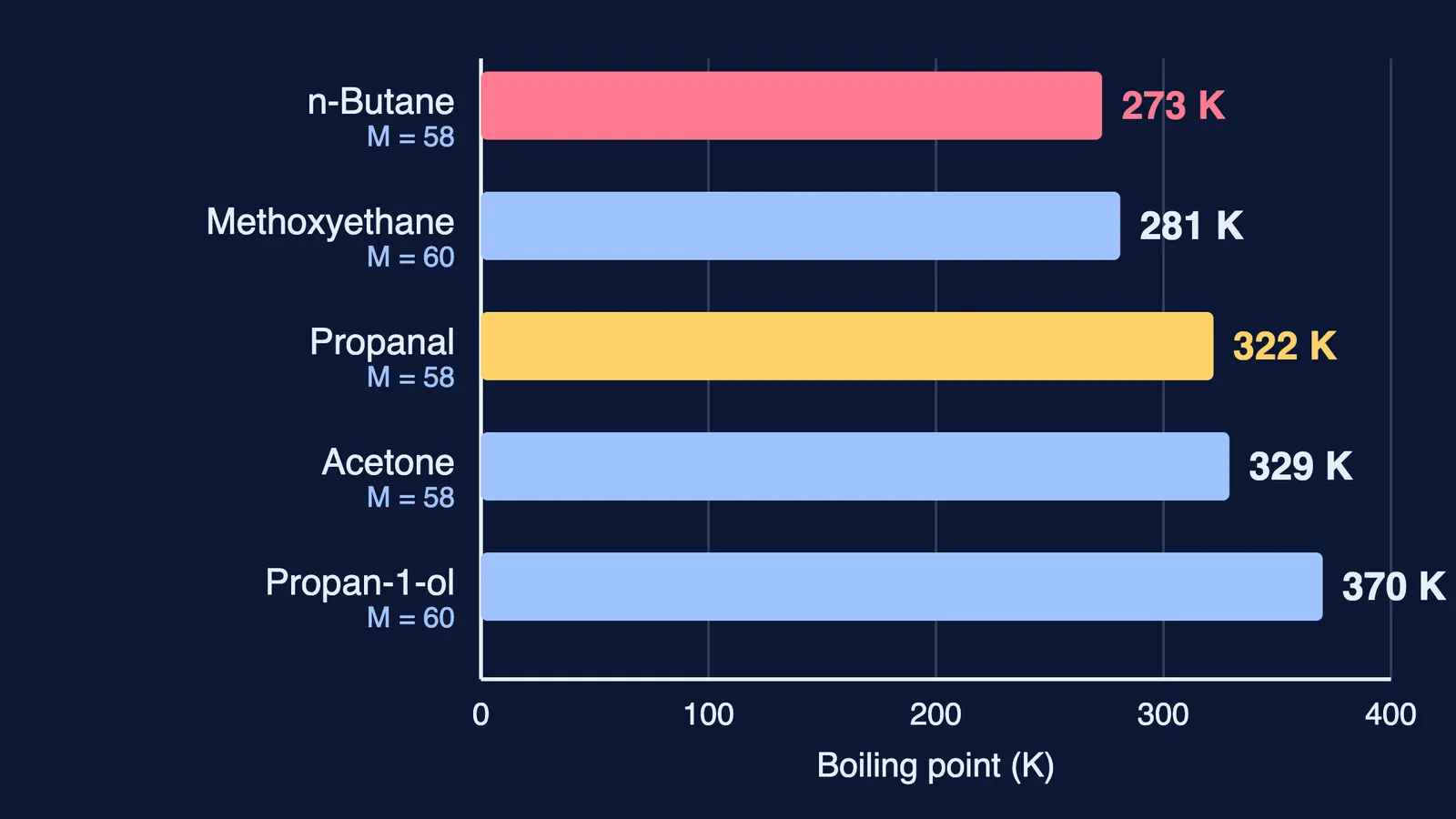
Q1 (easy). Assertion (A): Propanal boils at a higher temperature than n-butane, although both have a molar mass of 58. Reason (R): Propanal molecules attract one another through dipole-dipole interactions of the polar C=O group.
Answer: (A). Both are true, and R is the cause. NCERT lists propanal at 322 K and n-butane at 273 K, and explains the gap by weak molecular association from dipole-dipole interactions. The chart at the top shows the full series.
Trap: assuming equal molar mass means equal boiling points.
Q2 (easy). Assertion (A): Methanal undergoes the Cannizzaro reaction on heating with concentrated alkali. Reason (R): Methanal has an α-hydrogen atom.
Answer: (C). A is true. R is false: methanal has no carbon next to its carbonyl group, so it has no α-hydrogen, and NCERT limits the Cannizzaro reaction to aldehydes without one.
Trap: confusing the condition for Cannizzaro with the condition for aldol.
Q3 (medium). Assertion (A): Propanone gives a yellow precipitate when heated with iodine and sodium hydroxide. Reason (R): Propanone does not reduce Tollens' reagent.
Answer: (B). Both are true. The iodoform test works because propanone has a methyl group joined to its carbonyl carbon. Failing Tollens' only shows it is a ketone; many ketones give no iodoform.
Trap: chaining "ketone" to "iodoform positive".
Q4 (medium). Assertion (A): Propanone is miscible with water in all proportions. Reason (R): Propanone molecules form hydrogen bonds with one another.
Answer: (C). A is true: propanone mixes with water because it forms hydrogen bonds with water. R is false: propanone has no O–H, and NCERT puts its lower boiling point than alcohols down to the absence of intermolecular hydrogen bonding.
Trap: assuming bonding with water means bonding with itself.
Q5 (hard). Assertion (A): 4-Nitrobenzoic acid is a weaker acid than benzoic acid. Reason (R): An electron-withdrawing group stabilises the carboxylate anion.
Answer: (D). A is false: NCERT gives pKa 3.41 for 4-nitrobenzoic acid against 4.19 for benzoic acid, and the smaller pKa marks the stronger acid. R is true, and it is exactly why the nitro compound is stronger.
Trap: reading the larger pKa as the stronger acid.
Q6 (hard). Assertion (A): Benzoic acid is a stronger acid than phenylacetic acid, C6H5CH2COOH. Reason (R): In benzoic acid, the carboxyl carbon is bonded directly to an sp2 hybridised ring carbon, which is more electronegative than the sp3 CH2 carbon it is bonded to in phenylacetic acid.
Answer: (A). Both are true, and R is NCERT's own reason why direct attachment of a phenyl group raises acidity. In phenylacetic acid a CH2 separates the ring from the carboxyl group.
Trap: expecting the phenyl ring to donate electrons by resonance and weaken the acid.
Statement I and Statement II questions on this chapter
Judge each statement on its own against NCERT Unit 8; there is no "because" step.
Q7 (easy). Statement I: Propanone heated with zinc amalgam and concentrated hydrochloric acid gives propane. Statement II: Wolff-Kishner reduction converts the carbonyl compound to its hydrazone with hydrazine, then heats it with KOH in ethylene glycol.
Answer: (A). Both are correct. Both reductions turn C=O into CH2, one in acid and one in base.
Trap: thinking Clemmensen stops at the alcohol.
Q8 (medium). Statement I: Benzaldehyde gives a silver mirror when warmed with Tollens' reagent. Statement II: Benzaldehyde gives a reddish-brown precipitate when heated with Fehling's reagent.
Answer: (C). Statement I is correct. Statement II is incorrect: NCERT notes that aromatic aldehydes do not respond to Fehling's test.
Trap: treating Tollens' and Fehling's as interchangeable aldehyde tests.
Q9 (medium). Statement I: Propanone is more reactive than propanal towards nucleophilic addition. Statement II: In aromatic aldehydes and ketones, the carbonyl group activates the ring and directs electrophiles to the ortho and para positions.
Answer: (B). Both are incorrect. Ketones are less reactive: two alkyl groups crowd the carbonyl carbon and reduce its electrophilicity more than one does. On the ring, the carbonyl group is deactivating and meta-directing.
Trap: thinking more alkyl groups mean more reactive.
Q10 (hard). Statement I: A cross aldol reaction between ethanal and propanal in dilute alkali gives a single product. Statement II: The α-hydrogen of an aldehyde is acidic because the carbonyl group withdraws electrons and the conjugate base is resonance stabilised.
Answer: (D). Statement I is incorrect: both aldehydes have α-hydrogens, so each can act as donor or acceptor and NCERT says the mixture gives four products. Statement II is correct and is NCERT's stated reason.
Trap: forgetting the two self-condensation products.
How should you use this set?
Cover the answers and write your key for all ten, with one line on why.
Wrong on whether a statement is true? Reread the NCERT section. Wrong only between (A) and (B)? Find the textbook's own reason.
Then try our alcohols, aldehydes and acids NEET practice questions with solutions.
If a trap exposes a concept gap, such as why a phenyl ring raises acidity, the Fermi Concept Library has a lesson for every concept in chemistry, each with its place in the map.


