On this page
These eight NEET-UG Chemistry questions on organic compounds containing oxygen are new: none is copied or reworded from NCERT, the exemplar or past papers.
Which parts of the oxygen chapter does this NEET set test?
The National Medical Commission's syllabus for NEET (UG)-2026 lists Organic Compounds Containing Oxygen as Chemistry Unit 17: methods of preparation, properties, reactions and uses of alcohols, phenols, ethers, aldehydes, ketones and carboxylic acids. NEET-UG 2027 has not been notified yet, so this set follows that list. Every fact in the options matches NCERT Class 12 Chemistry Unit 7 or Unit 8, both marked Reprint 2026-27.
Need the theory first? Read the guide on how to prepare organic compounds containing oxygen for NEET, then come back.
How should you use this practice set?
Give yourself eight minutes, about one per question.
Write the structure of every compound named in the stem before reading the options.
Read each trap line, even when you got the question right.
Easy: preparation, boiling points and one simple test
Q1 (easy). 2-Methylpropene is treated with diborane and the product is oxidised with H₂O₂ in aqueous NaOH. The alcohol formed is:
(A) 2-methylpropan-2-ol
(B) 2-methylpropan-1-ol
(C) butan-1-ol
(D) 2-methylpropanal
Answer: (B). In hydroboration-oxidation, NCERT Unit 7 says boron attaches to the double-bond carbon carrying more hydrogen atoms, and –OH later replaces boron. That puts –OH on the CH₂ end: (CH₃)₂CH–CH₂OH. Trap: (A), the Markovnikov product you get from acid-catalysed hydration, not from diborane.
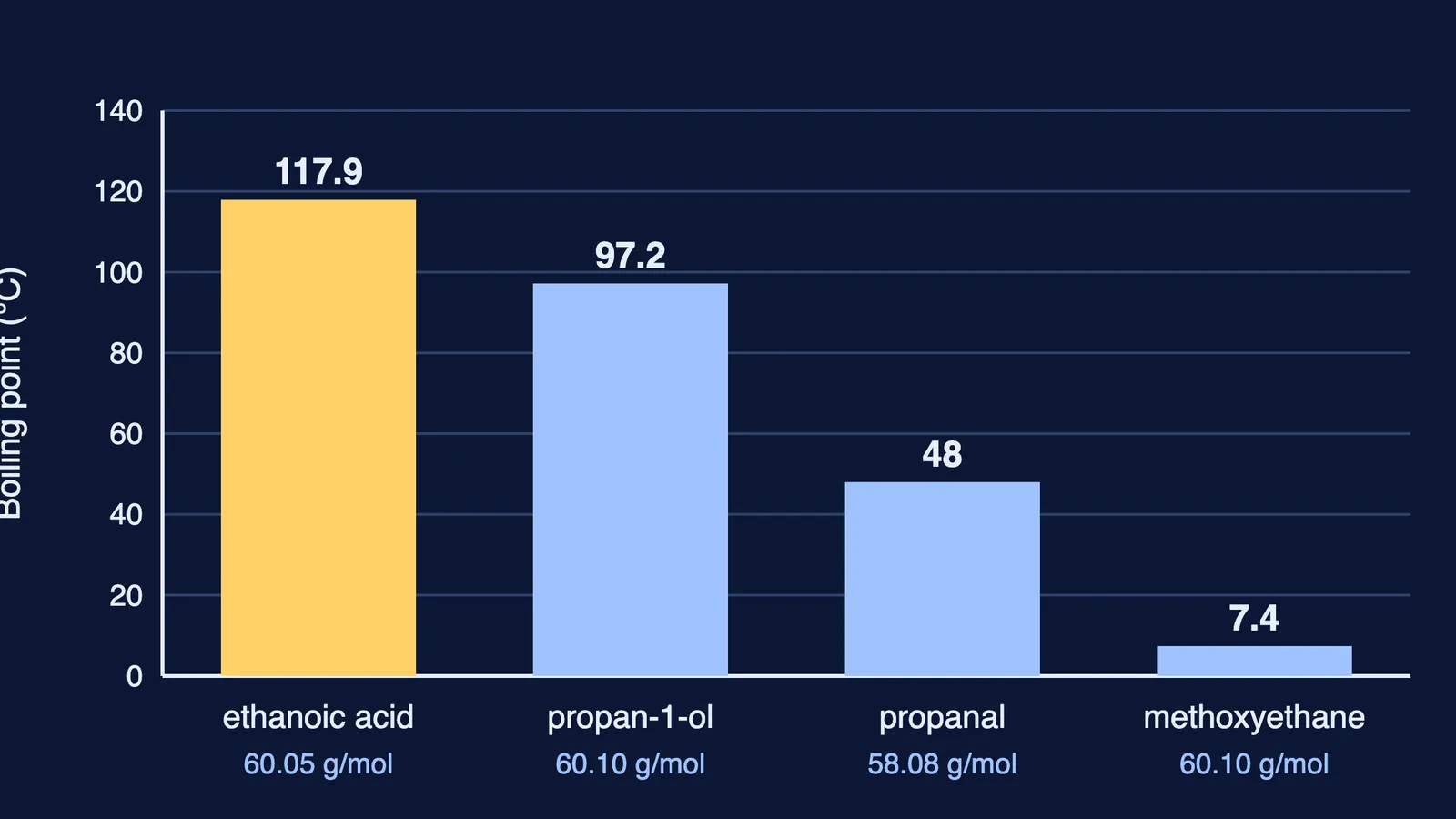
Q2 (easy). Each compound below has a molar mass of 58 to 60 g/mol. Which has the highest boiling point?
(A) propan-1-ol
(B) methoxyethane
(C) ethanoic acid
(D) propanal
Answer: (C). NCERT Unit 8 states that carboxylic acids boil higher than aldehydes, ketones and even alcohols of comparable molecular mass, because their molecules associate more extensively through intermolecular hydrogen bonding. PubChem lists ethanoic acid at 117.9 °C and propan-1-ol at 97.2 °C, with propanal at 48 °C and methoxyethane at 7.4 °C. Trap: (A). The alcohol does hydrogen-bond, just less extensively than the acid. For why the ether sits so low, see why ethers dissolve like alcohols but boil like alkanes.
Q3 (easy). Which aqueous reagent tells benzoic acid apart from phenol in a test tube?
(A) sodium hydroxide
(B) sodium hydrogencarbonate
(C) sodium metal
(D) Tollens' reagent
Answer: (B). NCERT Unit 8 notes that carboxylic acids, unlike phenols, release CO₂ from hydrogencarbonates, which is why the test detects a –COOH group. Benzoic acid (pKa 4.19) fizzes; phenol (pKa 10.0) does not. Trap: (A). Both acids dissolve in NaOH, so nothing separates them; (C) gives hydrogen with both and (D) reacts with neither.
Medium: which product, and which isomer?
Q4 (medium). Phenol is nitrated with dilute HNO₃ at 298 K and the mixture is steam-distilled. Which statement is correct?
(A) o-nitrophenol distils over, because intramolecular hydrogen bonding stops its molecules associating
(B) p-nitrophenol distils over, because it is the less polar isomer
(C) o-nitrophenol distils over, because intermolecular hydrogen bonding makes it more volatile
(D) p-nitrophenol distils over, because intramolecular hydrogen bonding lowers its boiling point
Answer: (A). In the ortho isomer the –OH and –NO₂ are close enough to hydrogen-bond within one molecule, so molecules do not stick to each other; NCERT Unit 7 calls it steam volatile. The para isomer bonds between molecules and stays behind. Trap: (C), the right isomer with the reason reversed: intermolecular bonding lowers volatility.
Q5 (medium). Which pair, followed by hydrolysis, gives 2-phenylethanol, C₆H₅CH₂CH₂OH?
(A) C₆H₅MgBr + CH₃CHO
(B) C₆H₅CH₂MgBr + HCHO
(C) C₆H₅MgBr + HCHO
(D) CH₃MgBr + C₆H₅CHO
Answer: (B). Of the carbonyl compounds, only methanal gives a primary alcohol; it adds one carbon, the CH₂OH. The Grignard reagent must therefore supply C₆H₅CH₂–. Trap: (A), which has the right eight carbons but gives the secondary alcohol C₆H₅CH(OH)CH₃, as does (D). (C) gives benzyl alcohol, one carbon short.
Q6 (medium). Arrange in decreasing acid strength: CH₃COOH, HCOOH, ClCH₂COOH, ClCH₂CH₂COOH.
(A) ClCH₂COOH > ClCH₂CH₂COOH > HCOOH > CH₃COOH
(B) ClCH₂COOH > HCOOH > ClCH₂CH₂COOH > CH₃COOH
(C) HCOOH > ClCH₂COOH > CH₃COOH > ClCH₂CH₂COOH
(D) ClCH₂COOH > HCOOH > CH₃COOH > ClCH₂CH₂COOH
Answer: (B). Chlorine's –I effect stabilises the carboxylate, but it weakens with every carbon between Cl and –COOH. Formic acid has no electron-donating alkyl group at all. NCERT's acidity series in Unit 8 places these four in exactly order (B). Trap: (A), from assuming any chlorine beats no chlorine.
Hard: can you follow two steps?
Q7 (hard). Sodium phenoxide is heated with CO₂ under pressure and acidified to give P. P is warmed with ethanoic anhydride and a trace of conc. H₂SO₄ to give Q. Q is:
(A) methyl 2-hydroxybenzoate
(B) 2-acetoxybenzoic acid
(C) phenyl ethanoate
(D) 4-acetoxybenzoic acid
Answer: (B). Kolbe's reaction puts –COOH ortho to –OH, so P is salicylic acid (2-hydroxybenzoic acid). Acetylation turns the phenolic –OH into –OCOCH₃, and NCERT Unit 7 notes that acetylating salicylic acid gives aspirin, C₉H₈O₄. Trap: (D), which assumes the para product; (A) needs methanol, which is never added. The story behind the first step is in how phenol became salicylic acid, then aspirin.
Q8 (hard). Ethanal reacts with CH₃MgBr and the adduct is hydrolysed to give X. X is warmed with iodine and NaOH, giving a yellow precipitate and a sodium salt Y. Y is:
(A) sodium methanoate
(B) sodium ethanoate
(C) sodium propanoate
(D) sodium 2-hydroxypropanoate
Answer: (B). The Grignard step gives propan-2-ol, CH₃CH(OH)CH₃, a secondary alcohol with three carbons. NCERT Unit 8 says hypoiodite first oxidises a CH₃CH(OH)– group to CH₃CO–, and then the haloform reaction removes one carbon as CHI₃, leaving the sodium salt of a two-carbon acid: CH₃COONa. Trap: (C), which keeps all three carbons and forgets the one lost as iodoform.
What should you do after checking your answers?
Put each miss in one bin: preparation routes (Q1, Q5), physical properties (Q2, Q4), acid strength (Q3, Q6) or reaction sequences (Q7, Q8). Redo the fullest bin in three days without the solutions, writing the intermediate for every step.
When you can follow a solution but could not have started it yourself, the Fermi Problem Library has worked problems with a step-by-step solver that explains the reasoning rather than printing an answer.