

On this page
Take two bottles with the same formula, C4H10O. One holds diethyl ether, the other butan-1-ol. Pour a little of each into water and they behave almost the same. Heat them and they behave nothing alike. This pair is a classic question in the alcohols, phenols and ethers chapter of Class 12 chemistry, and the explanation turns on one small difference: who can give a hydrogen bond, and who can only take one.
What do the numbers actually say?
Here is the data, all from PubChem, the US National Library of Medicine's chemistry database.
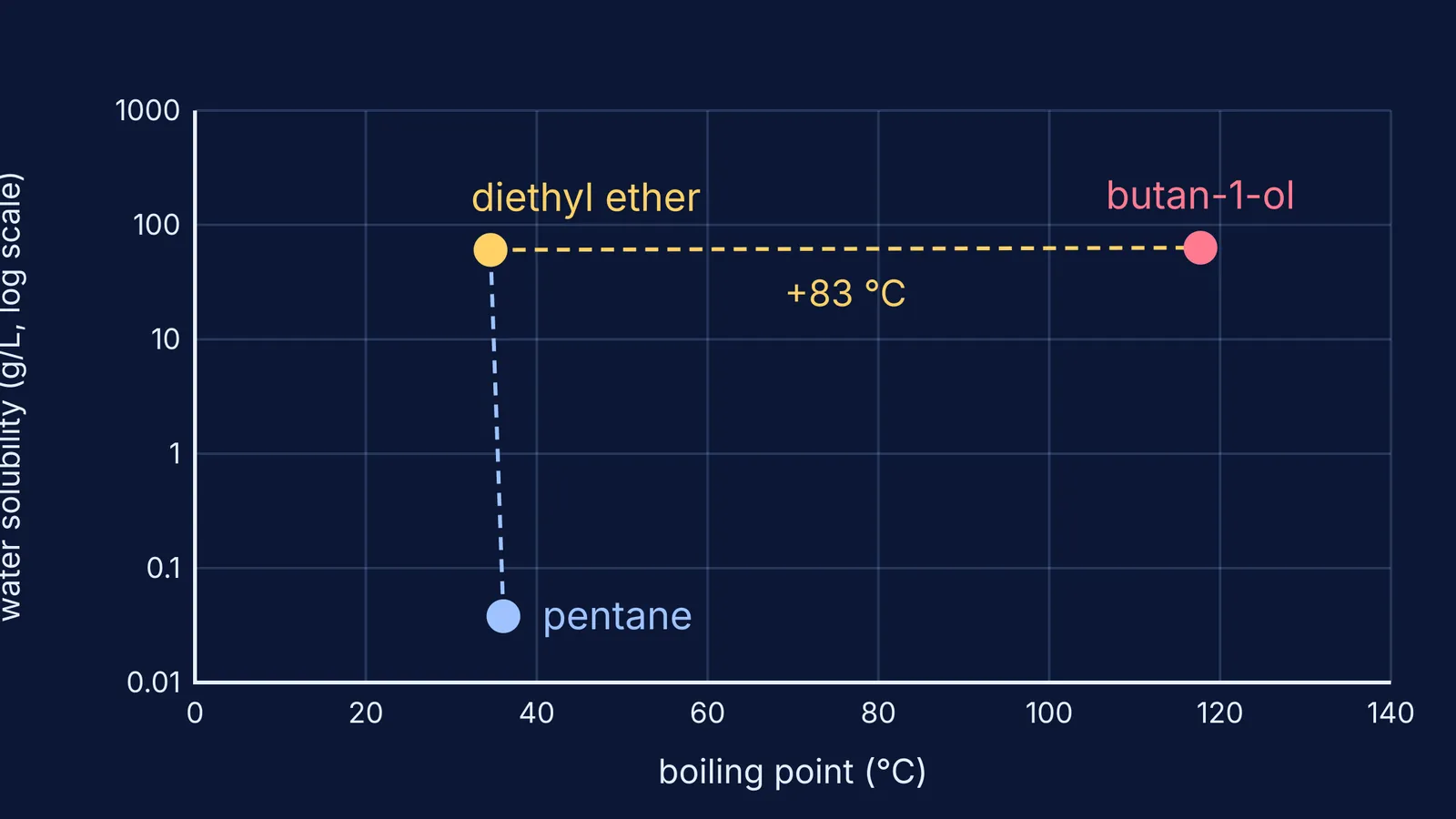
Diethyl ether (ethoxyethane, 74.12 g/mol) boils at 34.6 °C and dissolves in water to 60.4 g/L at 25 °C.
Butan-1-ol (74.12 g/mol, the same formula) boils at 117.7 °C and dissolves to 63.2 g/L at 25 °C.
Pentane (72.15 g/mol, no oxygen at all) boils at 36.1 °C and dissolves to only 38 mg/L at 25 °C.
So the ether's solubility matches the alcohol's, while its boiling point matches the alkane's. The ether boils 83 °C below its isomeric alcohol and is more than 1,500 times as soluble in water as pentane. Any good explanation has to account for both facts at once.
Why do ethers and alcohols of similar mass have similar solubility?
A hydrogen bond needs two partners: a donor, which supplies an H attached to O, N or F, and an acceptor, which supplies a lone pair on an electronegative atom.
Water is generous. Every water molecule has two O–H hydrogens to donate. The ether oxygen has two lone pairs, so it can accept hydrogen bonds from water even though it has nothing to donate. The alcohol oxygen can accept too, and also donate through its O–H.
When either compound mixes with water, water supplies the donors and the oxygen of the ether or alcohol supplies an acceptor. That is enough to pull a small molecule into solution. As LibreTexts' notes on ether properties/Ethers/Properties_of_Ethers/Physical_Properties_of_Ether) put it, ethers with up to three carbon atoms are soluble in water because of hydrogen bonding with water molecules, and an ether has about the same solubility in water as the alcohol that is isomeric with it.
The hydrocarbon part limits how far this goes. Four carbons is already a big oily tail, which is why both C4H10O isomers dissolve only a few per cent, and why the same pattern shows up in why lower amines dissolve in water but aniline does not.
Why do ethers have lower boiling points than alcohols?
Boiling means pulling molecules of the same substance apart. Now water is not there to donate hydrogens, so the question becomes: can these molecules hydrogen bond with each other?
Alcohol molecules can. Each O–H donates to the oxygen of a neighbour, building chains that take extra energy to break. Ether molecules cannot, because an ether, R–O–R′, has no hydrogen on its oxygen. Two acceptors facing each other make no hydrogen bond. The LibreTexts page/Ethers/Properties_of_Ethers/Physical_Properties_of_Ether) states that there is no intermolecular hydrogen bonding between ether molecules, and that ethers boil at about the same temperature as alkanes of comparable molar mass.
The ether does have a small dipole, but that adds little. Its molecules are held mainly by the same dispersion forces as pentane's, which is why their PubChem boiling points sit within 2 °C of each other. The same logic explains why aldehydes boil lower than alcohols: a polar C=O, but no O–H to donate.
How do you answer this in an exam?
Use this three-check routine for any pair of compounds, then write the answer in this order.
Count donors: does the molecule have H on O, N or F? Alcohol yes, ether no.
Count acceptors: does it have an O or N with a lone pair? Both yes.
Match each property to its partner: with water (water donates), or with itself (the molecule must donate).
A model answer for "Explain why diethyl ether and butan-1-ol have similar solubility in water but very different boiling points":
Both are C4H10O and have a similar size of hydrocarbon part.
The oxygen in each can accept a hydrogen bond from water, so both are about equally soluble.
Butan-1-ol has an O–H group, so its molecules are associated by intermolecular hydrogen bonds; more energy is needed to separate them, giving a high boiling point.
Diethyl ether has no H on oxygen, so its molecules cannot hydrogen bond with each other; only weak dipole and dispersion forces act, giving a low boiling point.
The usual slip is writing "ethers cannot form hydrogen bonds". They can, with water. Say "cannot hydrogen bond with each other" and you keep the mark. For more practice, try the isomers of C3H8O, including methoxyethane, and predict which boils lowest before you read.
If donors and acceptors still feel shaky, the Fermi Concept Library covers every concept in chemistry, each with its own lesson and its place in the map, hydrogen bonding included. When you want to test the routine on fresh pairs, the Fermi Problem Library has worked problems with a step-by-step solver that explains the reasoning rather than printing an answer.


