

On this page
Shake a little methylamine solution with water and you get one clear liquid. Shake a generous splash of aniline with water and the excess stays as cloudy droplets that settle into an oily layer. Both carry an –NH2 group, so the difference lies in the rest of the molecule. Once you see that, most Class 12 and JEE questions on amine solubility follow from one idea.
Why are lower amines soluble in water?
The NCERT Class 12 chapter on amines says it in one line: lower aliphatic amines are soluble in water because they can form hydrogen bonds with water molecules (NCERT Chemistry Part II, Unit 9: Amines, section 9.5).
An amine can bond with water in two ways. Its N–H hydrogens are attracted to the oxygen of a water molecule, and the lone pair on nitrogen attracts a hydrogen from water. In methylamine, CH3NH2, the amino group is most of the molecule, so almost every part of it is welcome in water.
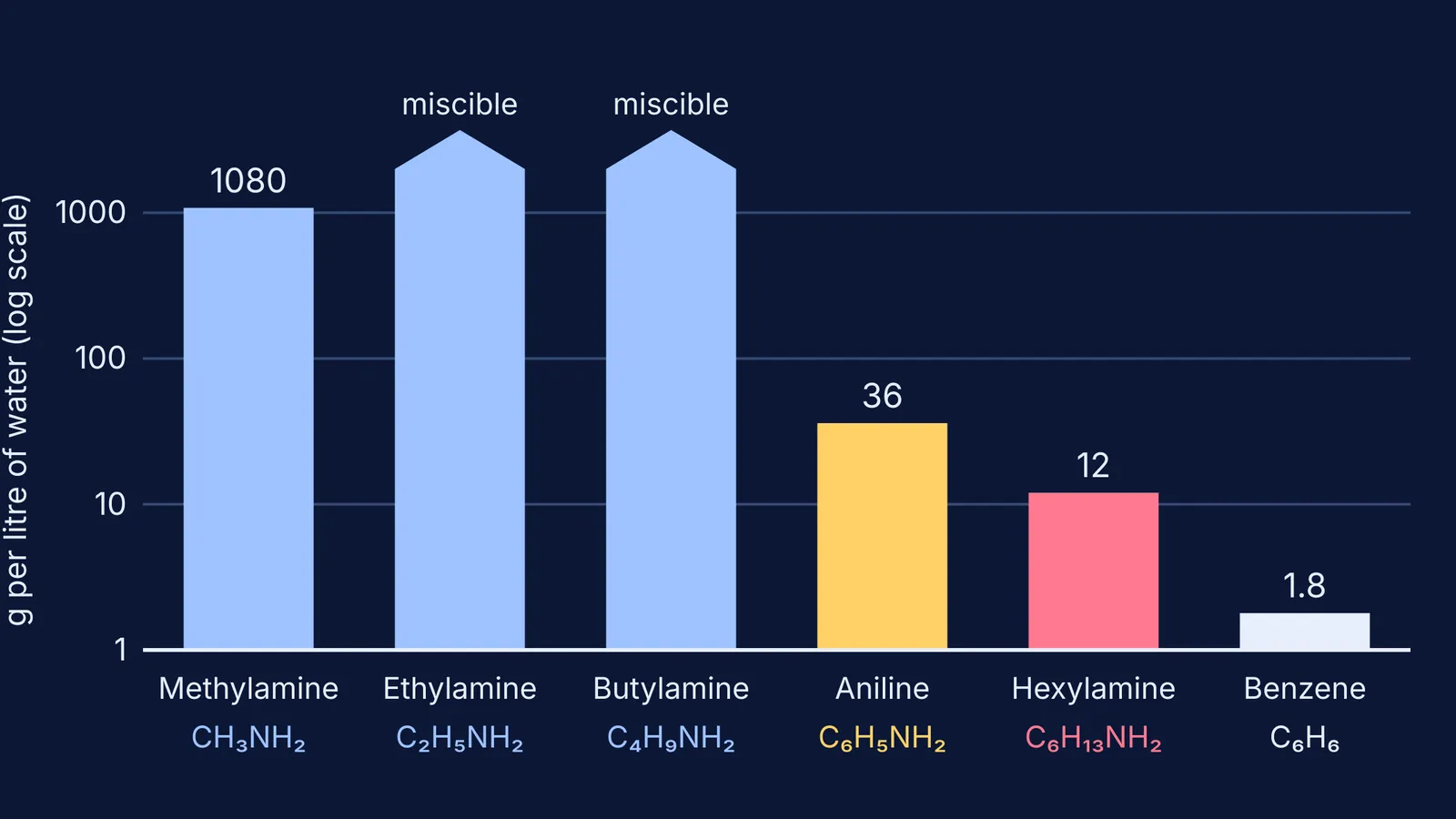
The measured numbers match this. PubChem lists the water solubility of methylamine as 1080 mg/mL at 25 °C (PubChem: Methylamine). Ethylamine is listed as miscible with water (PubChem: Ethylamine), and so is n-butylamine (PubChem: Butylamine). Miscible means they mix with water in any proportion.
If hydrogen bonding with water feels shaky, the same idea explains a boiling-point puzzle in our post on why ammonia boils far higher than phosphine.
Why is aniline not soluble in water?
The same NCERT section gives the second half of the rule: solubility decreases as molar mass increases, because the hydrophobic (water-avoiding) alkyl part gets bigger, and higher amines are essentially insoluble in water (NCERT, Unit 9).
Aniline, C6H5NH2, still has an –NH2 group that can hydrogen bond. But it is attached to a six-carbon benzene ring that cannot. That ring is now most of the molecule, and water does not mix well with it.
Aniline is not completely insoluble, though. PubChem gives its solubility as 36,000 mg/L at 25 °C, which is about 3.6 g in 100 mL of water (PubChem: Aniline). Benzene, the same ring with no –NH2 group, dissolves to only 1.79 g per litre at 25 °C (PubChem: Benzene). So the amino group does help. It just cannot drag a ring that size fully into water.
Is it the phenyl ring or just the number of carbons?
Hexylamine, a straight chain of six carbons with an –NH2 at the end, dissolves to only 12,000 mg/L at 20-25 °C (PubChem: Hexylamine). That is less than aniline, so in this comparison a long alkyl chain cuts solubility even more than a phenyl ring does.
Cyclohexylamine, also six carbons in a ring, is listed as miscible with water (PubChem: Cyclohexylamine). So counting carbons alone does not predict the result, and shape matters too.
The safe takeaway for exams: point to the size of the hydrophobic part compared with the one –NH2 group, as NCERT does, rather than saying that every six-carbon amine behaves the same. The general rule behind all of this is in our explainer on why like dissolves like.
How do you answer an amine solubility question in an exam?
Run these three checks on any amine:
Can it hydrogen bond with water? Primary, secondary and tertiary amines all can, through the nitrogen lone pair.
How big is the hydrocarbon part compared with the –NH2 group? Up to about four carbons: very soluble. A phenyl ring or a long chain: only slightly soluble.
Is it in acid? NCERT notes that amine salts are soluble in water but insoluble in organic solvents like ether (NCERT, Unit 9, section 9.6). Aniline reacts with HCl to form anilinium chloride, which is why aniline dissolves in dilute hydrochloric acid.
Worked example. Arrange methylamine, aniline and benzene in order of solubility in water, and explain.
Model answer: methylamine > aniline > benzene. Methylamine forms hydrogen bonds with water through its N–H hydrogens and the nitrogen lone pair, and its hydrocarbon part is only one carbon, so it is highly soluble. Aniline forms the same hydrogen bonds, but its large hydrophobic phenyl ring outweighs the single –NH2 group, so it is only sparingly soluble. Benzene has no group that can hydrogen bond with water, so it is the least soluble.
Check 3 is also the basis for separating aniline from neutral compounds, which we work through step by step in separating benzoic acid, phenol, aniline and toluene by extraction.
Where to practise this next
If hydrogen bonding or polarity is the part that feels unclear, the Fermi Concept Library has a lesson for every concept in chemistry, so you can go back to the idea this answer depends on. When you want practice, the Fermi Problem Library has worked problems with a step-by-step solver that explains the reasoning rather than printing an answer. Try ordering three new amines with the three checks before you look at any solution.


