

On this page
If you look at the periodic table, phosphine should boil at a higher temperature than ammonia. Phosphine (PH3) has a molecular weight of 34.00 g/mol, nearly twice that of ammonia (NH3) at 17.03 g/mol, according to PubChem's compound database. In most homologous series, heavier molecules have larger electron clouds and stronger London dispersion forces, as explained in our guides on why noble gases have very low boiling points and why iodine is solid, bromine liquid and chlorine gas.
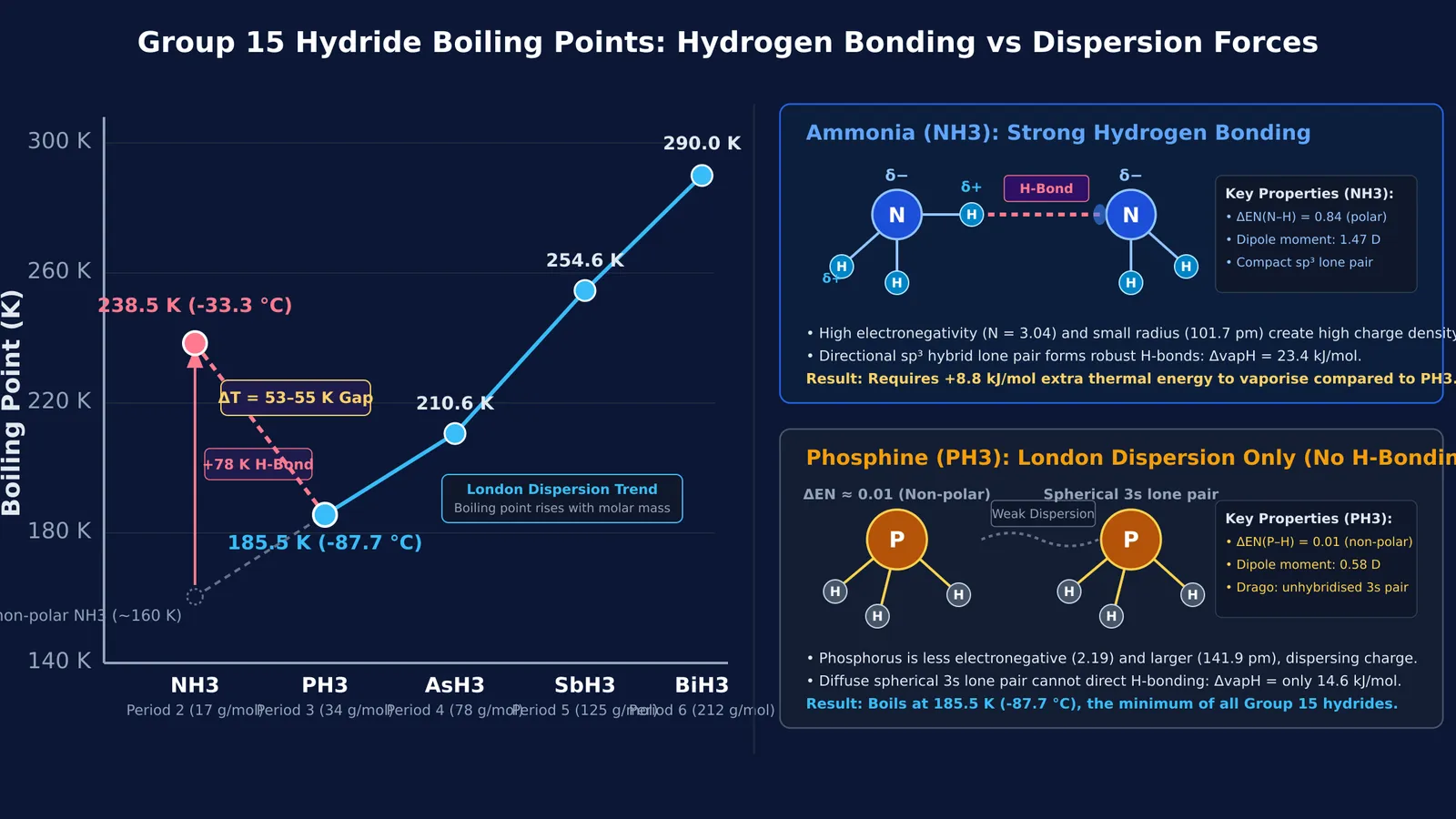
Yet experimental measurements reveal the opposite. Data in the NIST Chemistry WebBook show that ammonia boils at -33.34 °C (239.82 K), while phosphine boils at -87.7 °C (185.5 K), a gap of roughly 54.3 °C. Vaporising liquid ammonia requires an enthalpy of 23.4 kJ/mol at 239 K, whereas phosphine needs only 14.6 kJ/mol, according to NIST WebBook phosphine thermochemistry data. To explain why a lighter molecule demands more thermal energy to boil, we must examine their intermolecular forces.
Why does phosphine not form hydrogen bonds?
A hydrogen bond requires two conditions: a hydrogen atom covalently bonded to a small, highly electronegative atom, and an adjacent molecule with a concentrated lone pair in a compact orbital. Ammonia satisfies both requirements, whereas phosphine meets neither:
Electronegativity gap: On the Pauling scale, nitrogen has an electronegativity of 3.04, while hydrogen is 2.20 and phosphorus is 2.19. The N-H bond has an electronegativity difference of 0.84, producing a net dipole moment of 1.47 D in the NIST Computational Chemistry Database. By contrast, the P-H difference is only 0.01, giving phosphine a modest dipole moment of 0.58 D.
Atomic size and lone pairs: Nitrogen belongs to the second period, yielding an N-H bond length of 101.7 pm, according to benchmark geometry in the NIST Computational Chemistry Database. Its lone pair sits in a compact sp³ hybrid orbital. In phosphine, the P-H bond length is 141.9 pm. As explored in why phosphorus catenates more than nitrogen, nitrogen's compact shell concentrates negative charge density, while phosphorus diffuses it.
Drago's rule: In ammonia, the H-N-H bond angle is 107.8°, as detailed in NCERT Class 11 Chemistry. In phosphine, the H-P-H angle collapses to 93.6°, recorded in the NIST Computational Chemistry Database. Because phosphorus is larger, the energy gap between its 3s and 3p orbitals disfavours hybridisation. Phosphine's lone pair remains in an unhybridised spherical 3s orbital, making it too diffuse and non-directional to act as a hydrogen bond acceptor.
How do boiling points trend across Group 15 hydrides?
Curriculum data and thermochemical records compiled in PubChem reveal a distinct V-shaped trend across Group 15 hydrides:
PH3 boils at 185.5 K (-87.7 °C)
AsH3 boils at 210.6 K (-62.5 °C)
NH3 boils at 238.5 K (-33.3 °C)
SbH3 boils at 254.6 K (-18.6 °C)
BiH3 boils at 290.0 K (16.8 °C)
The overall order is PH3 < AsH3 < NH3 < SbH3 < BiH3. Phosphine sits at the minimum. From PH3 to BiH3, molar mass increases from 34.00 g/mol to 212.0 g/mol, strengthening London dispersion forces and raising boiling points by nearly 105 K. Ammonia breaks the trend because hydrogen bonding adds roughly 94 K of thermal resistance over the expected non-polar baseline. However, by SbH3 and BiH3, dispersion forces become large enough to surpass ammonia's hydrogen bonding.
The Fermi Concept Library covers every concept in physics, chemistry, biology, mathematics and computing, each with its own lesson and its place in the map, helping you trace how periodic trends dictate macroscopic physical properties.
How should you solve hydride boiling point questions in exams?
Questions comparing hydride boiling points appear frequently in CBSE board exams, JEE Main, and NEET-UG, testing the core bonding principles outlined in NCERT Class 11 Chemistry. Use this 4-step framework to avoid common traps:
Check for hydrogen bonding: If the hydride contains nitrogen, oxygen, or fluorine bonded to hydrogen, expect an anomalously high boiling point over its Period 3 counterpart.
Verify lone pair hybridisation: Check bond angles. Period 3 hydrides like PH3 and H2S stay near 90° to 94°, meaning lone pairs reside in unhybridised s orbitals and cannot hydrogen bond.
Rank the remaining hydrides by mass: For hydrides lacking hydrogen bonding, dispersion forces govern boiling points (PH3 < AsH3 < SbH3 < BiH3).
Watch the assertion-reason trap: Examiners often claim PH3 boils lower because of lower molecular weight. That statement is false; phosphine has double the molar mass of ammonia.
The Fermi Problem Library offers worked problems with a step-by-step solver that explains the reasoning rather than printing an answer, making it easy to master periodic anomalies before test day.


