

On this page
Why are noble gas boiling points so unusually low?
Boiling occurs when particles gain enough thermal energy to overcome the forces holding them in a liquid. In ionic salts like sodium chloride or network solids like diamond, this requires breaking strong bonds at high temperatures. Even water requires substantial heat to vaporise because hydrogen bonds hold the molecules together.
Noble gases behave differently because they exist as isolated atoms. Every Group 18 element has a closed-shell electron configuration—1s² for helium and ns² np⁶ for neon through radon. With filled valence shells, these atoms neither gain, lose, nor share electrons, forming no covalent bonds or permanent dipoles. As shown in William Ramsay's discovery of noble gases, this chemical inertness kept them hidden until the late nineteenth century.
Without covalent, ionic, or permanent dipole attractions, only fleeting London dispersion forces hold liquefied noble gases together. Because these attractions are so weak, minimal thermal energy pulls the atoms apart into vapour. Experimental records in the NIST Chemistry WebBook helium data show that helium boils at 4.22 K (-268.93 °C)—the lowest normal boiling point of any known substance.
How do London dispersion forces hold noble gas atoms together?
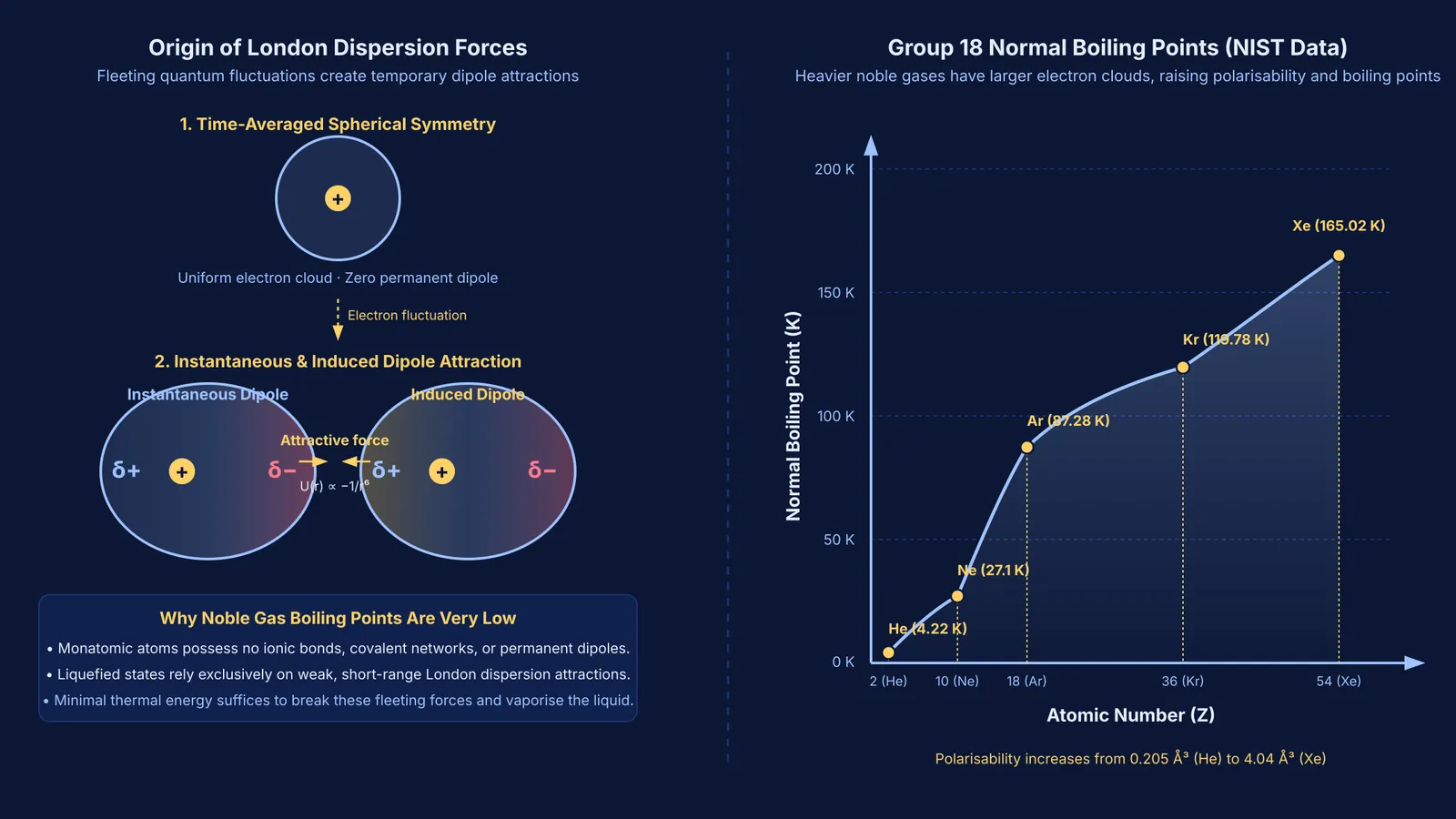
Although the time-averaged electron cloud of a noble gas atom is spherical, electrons are in continuous motion. At any instant, quantum fluctuations can shift electron density momentarily to one side. This creates an instantaneous dipole, giving one flank a partial negative charge (δ−) and the opposite flank a partial positive charge (δ+).
This instantaneous dipole polarises adjacent atoms: its electric field repels electrons in a neighbour, inducing a complementary dipole. The resulting attraction is a London dispersion force. In 1937, physicist Fritz London showed that this attractive potential falls off steeply as the sixth power of distance, varying as -1/r⁶ (London's 1937 paper).
Because dispersion forces depend on momentary fluctuations, their bonding energies are exceptionally small. According to phase change records in the NIST Chemistry WebBook argon data, argon requires just 6.43 kJ/mol to vaporise at 87.28 K, while helium requires only 0.0829 kJ/mol (NIST Chemistry WebBook helium data). By contrast, water requires over 40 kJ/mol because of strong intermolecular forces like hydrogen bonding.
Why do boiling points increase down Group 18?
While all noble gases boil at cryogenic temperatures, their normal boiling points rise steadily down Group 18, as compiled in the NIST Chemistry WebBook:
Helium: 4.22 K
Neon: 27.1 K
Argon: 87.28 K
Krypton: 119.78 K
Xenon: 165.02 K
This rise is driven by atomic polarisability—how easily an electric field distorts an electron cloud. Moving down Group 18, each period adds an electron shell. As electrons increase from 2 in helium to 54 in xenon, outer electrons sit farther from the nucleus and experience greater shielding from inner shells.
Larger electron clouds are held less tightly, making them softer and easier to deform. In their review in Advances in Atomic and Molecular Physics, researchers Thomas M. Miller and Benjamin Bederson compiled static dipole polarisabilities showing that polarisability surges nearly twentyfold down the column, from 0.205 × 10⁻²⁴ cm³ in helium to 4.04 × 10⁻²⁴ cm³ in xenon (Miller and Bederson's review60054-8)).
Greater polarisability produces stronger instantaneous and induced dipoles. These require more thermal energy to overcome, raising the boiling point of neon to 27.1 K (NIST Chemistry WebBook neon data), krypton to 119.78 K (NIST Chemistry WebBook krypton data), and xenon to 165.02 K (NIST Chemistry WebBook xenon data). The same polarisability trend governs attractive van der Waals constants in real gases.
How do you predict boiling points in chemistry exams?
Questions comparing boiling points appear frequently in CBSE Class 11 and 12 examinations, JEE Main, and NEET-UG. Use this five-step hierarchy to rank substances systematically:
Identify the bonding lattice: Separate ionic crystals (NaCl), metallic solids (Fe), and covalent networks (SiO₂) from molecular species. Network substances boil at much higher temperatures.
Check for hydrogen bonding: Look for hydrogen bonded to F, O, or N. Hydrogen bonds substantially elevate boiling points compared to non-hydrogen-bonded analogues of similar size.
Test for permanent dipoles: Check molecular geometry. Polar molecules (such as SO₂ or HCl) experience dipole-dipole attractions in addition to dispersion forces.
Compare polarisability and electron count: For non-polar molecules and noble gases, London dispersion forces dominate. Rank species by electron count and volume; larger clouds produce stronger attractions.
Check molecular shape: Among structural isomers with identical formulas, straight-chain molecules provide greater contact area than compact, branched isomers, giving higher boiling points.
How can you build intuition for intermolecular forces?
Understanding why microscopic fluctuations govern macroscopic phase changes is essential for competitive examinations. When working through chemical bonding and gas law problems, the Fermi Concept Library offers dedicated lessons across physics and chemistry, mapping every concept in its broader scientific context.
To practice applying intermolecular force hierarchies to challenging problems, the Fermi Problem Library features worked problems with a step-by-step solver that explains the reasoning rather than printing an answer. For phenomena that are easier to see than to read, such as fluctuating electron densities, the Fermi Simulation Lab provides interactive simulations to help you visualise physical principles in action.


