

On this page
In Group 14, catenation follows an intuitive rule: carbon forms vast chains, and heavier elements form progressively shorter chains as bonds lengthen and weaken. In Group 15, however, the trend breaks. Nitrogen forms almost no chains beyond two or three atoms, while phosphorus forms extensive allotropes, including tetrahedral cages, polymeric networks, and puckered sheets.
If you are preparing for Class 12 boards, JEE Main, or NEET-UG, understanding why nitrogen shows less catenation than phosphorus requires examining two physical factors: lone-pair electrostatic repulsion across short bond lengths, and the energy balance between single and triple bonds.
Why is the N-N single bond so weak?
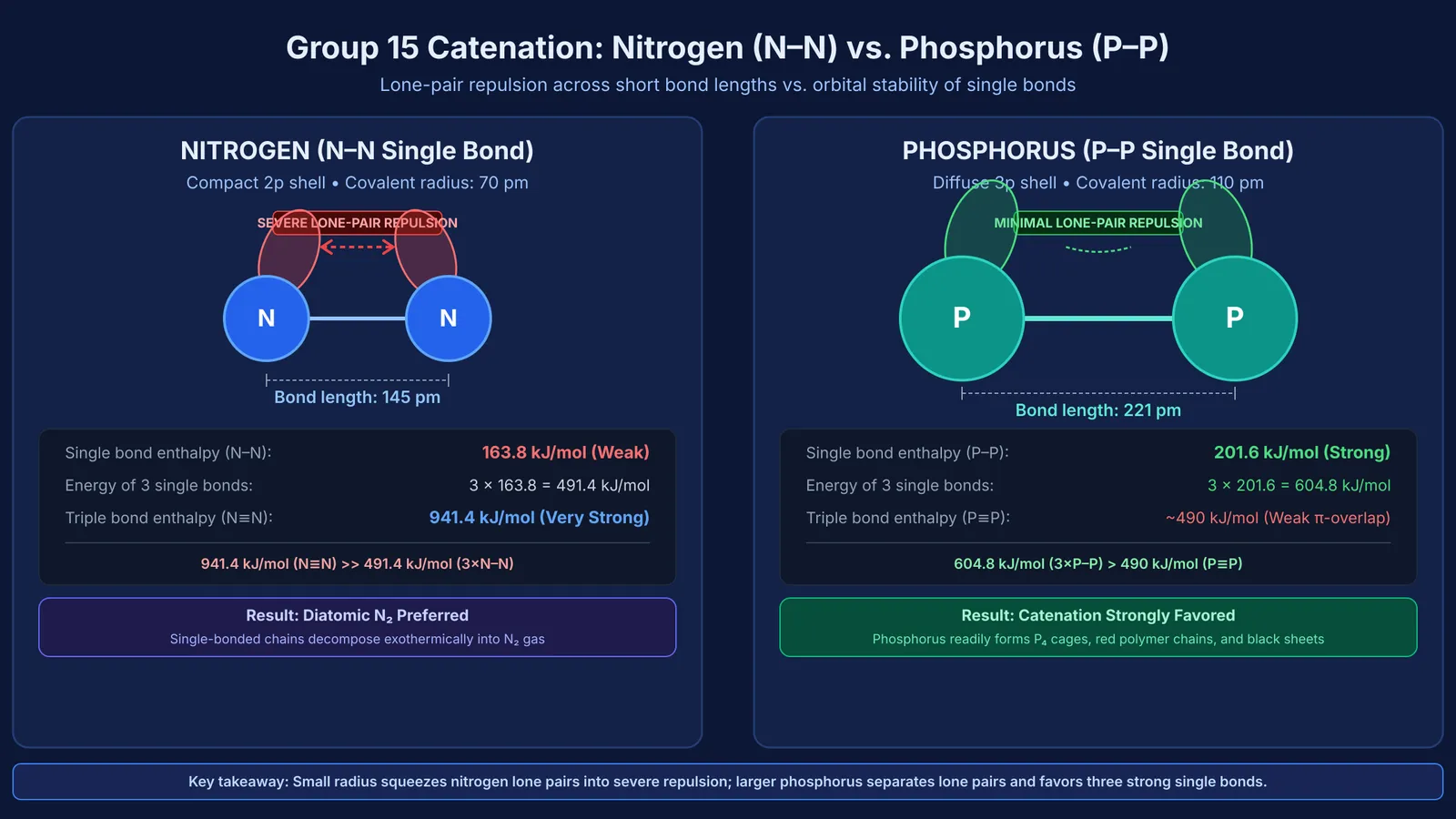
Catenation requires strong, stable single bonds between identical atoms. Nitrogen is a compact second-period element with a covalent radius of 70 pm. In hydrazine (H₂N–NH₂), the N–N bond length is roughly 145 pm, as recorded in the NIST Chemistry WebBook. At this short distance, the non-bonding 2p lone pairs on adjacent nitrogen atoms are squeezed into close proximity.
In 1948, Kenneth S. Pitzer showed in the *Journal of the American Chemical Society* that non-bonding electron pairs destabilise single bonds between small atoms. Strong interelectronic repulsion weakens the N–N single bond, dropping its bond dissociation enthalpy to just 163.8 kJ/mol, according to OpenStax Chemistry 2e. Chains of single-bonded nitrogen atoms are therefore fragile and easily broken.
Phosphorus sits in the third period with a covalent radius of 110 pm and a P–P bond length of 221 pm, documented in OpenStax Chemistry 2e. Because its valence shell is larger, adjacent lone pairs remain further apart. Negligible lone-pair repulsion allows the P–P single bond to achieve a dissociation enthalpy of 201.6 kJ/mol, making it stronger than nitrogen's single bond.
Why does phosphorus prefer single bonds over triple bonds?
Single bond strength is only half the story. The remaining factor is whether an element achieves lower free energy in single bonds or multiple bonds. Nitrogen's compact 2p orbitals overlap sideways effectively to form an exceptionally stable triple bond. The N≡N bond enthalpy in dinitrogen is 941.4 kJ/mol, documented in the NIST Chemistry WebBook. Forming three N–N single bonds yields only 3 × 163.8 = 491.4 kJ/mol, so single-bonded nitrogen chains decompose exothermically into N₂ gas.
To see how compact orbitals influence geometry across Group 15, explore our guides on oxides of nitrogen structures and comparing bond angles in NH3 vs PH3.
Phosphorus exhibits the reverse balance. Its diffuse 3p orbitals overlap poorly sideways, yielding a weak P≡P triple bond of approximately 490 kJ/mol in gaseous diphosphorus, according to the NIST Chemistry WebBook. Conversely, three P–P single bonds release 3 × 201.6 = 604.8 kJ/mol. Because three single bonds release far more energy than one triple bond, phosphorus readily forms catenated structures.
When you need to visualize how orbital overlap and periodic trends connect across inorganic chemistry, the Fermi Concept Library maps every concept in chemistry with dedicated visual lessons.
How does catenation shape phosphorus allotropes?
Because single bonds are thermodynamically favored, phosphorus forms several stable allotropes, as detailed in OpenStax Chemistry 2e:
White phosphorus (P₄): Tetrahedral molecules where each atom forms three single bonds, catalogued in the NIST Chemistry WebBook. Even with 60° bond angles causing significant ring strain, strong P–P bonds hold the cage intact.
Red phosphorus: Formed by heating white phosphorus to roughly 573 K, opening one bond per tetrahedron to build polymeric chains.
Black phosphorus: A puckered sheet structure with bond angles between 99° and 102°, representing the most thermodynamically stable form.
To see how phosphorus behaves in gas-phase equilibria, read our guide on the degree of dissociation of PCl5 from vapour density.
For practice applying these structural principles to numericals, the Fermi Problem Library provides worked problems with a step-by-step solver that explains the reasoning rather than printing an answer.
What is the exam-tested framework for catenation questions?
When answering Group 15 catenation questions in competitive exams, structure your response around this four-point framework from OpenStax Chemistry 2e and standard inorganic reference data:
Compare single bond strengths: State that the P–P bond (201.6 kJ/mol) is stronger than the N–N bond (163.8 kJ/mol).
Identify lone-pair repulsion: Explain that nitrogen's small radius (70 pm) causes a short bond length (145 pm), generating severe interelectronic repulsion between non-bonding pairs.
Compare multiple bonding: Note that nitrogen forms a very strong triple bond (941.4 kJ/mol > 3 × 163.8 kJ/mol), making N₂ the favored product.
Contrast phosphorus energetics: Conclude that diffuse 3p orbitals make three P–P single bonds (604.8 kJ/mol) more stable than one P≡P triple bond (490 kJ/mol).
This energy balance explains why nitrogen stays diatomic while phosphorus builds stable rings, chains, and layers.


