

On this page
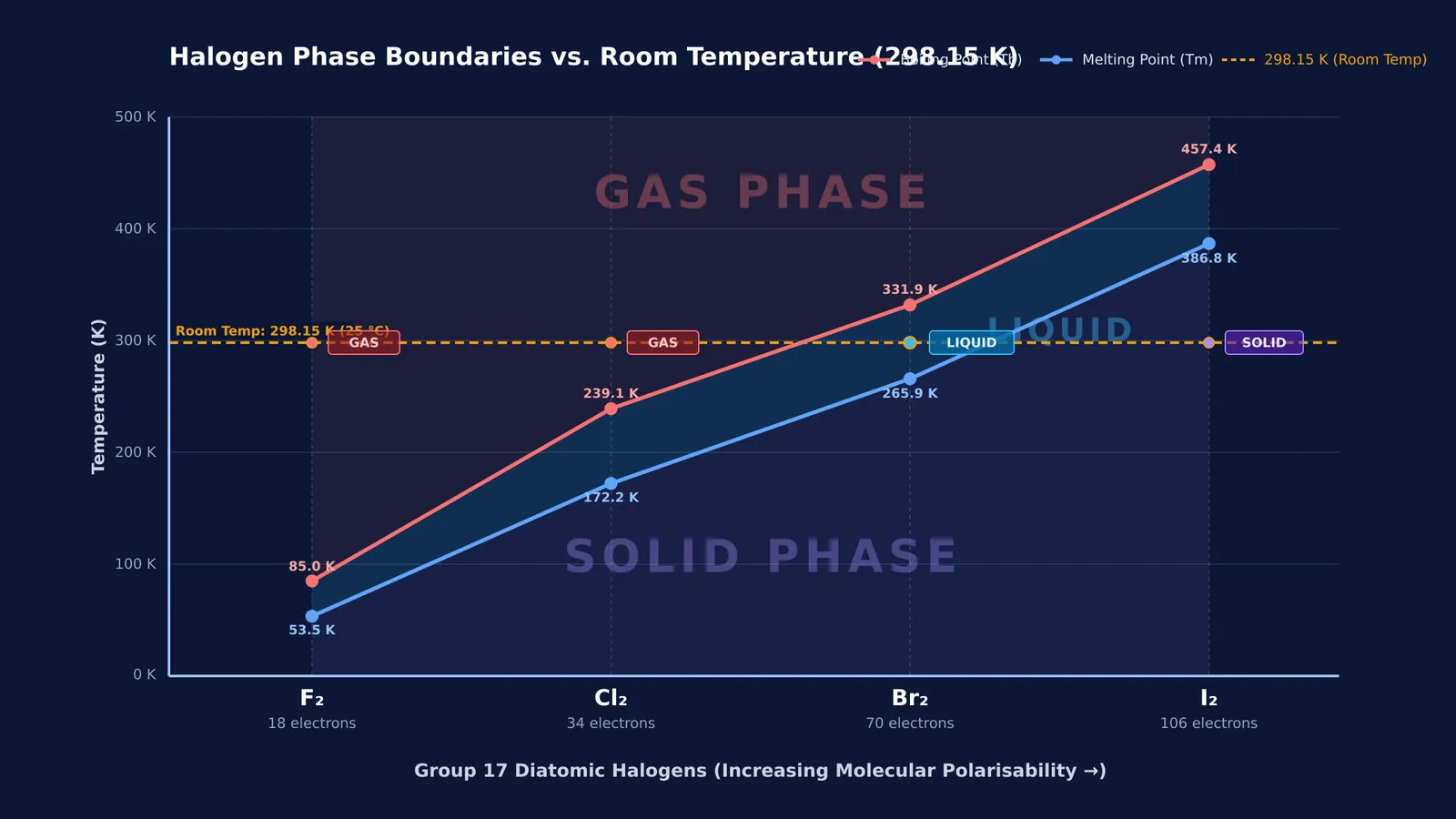
Tracing Group 17 down the periodic table reveals a striking physical progression. At room temperature, fluorine and chlorine are gases, reddish-brown bromine is a dense liquid, and iodine forms a lustrous crystalline solid.
Because halogens exist as neutral, non-polar diatomic molecules (X₂), this variation cannot stem from ionic or permanent dipole-dipole attractions. Instead, it is driven by the steady growth of London dispersion forces as molecular size and electron count expand.
How do London dispersion forces work in non-polar halogens?
In a homonuclear diatomic molecule like Cl₂ or I₂, identical atoms share bonding electrons equally, yielding no permanent dipole moment. Yet orbital electrons move constantly. At any instant, slight fluctuations in electron density generate a temporary dipole across the molecule.
According to the IUPAC Gold Book definition of van der Waals forces, this temporary dipole induces complementary dipoles in adjacent molecules, creating an attractive force.
In his 1937 paper on the general theory of molecular forces, physicist Fritz London showed through quantum mechanical perturbation theory that the attractive potential energy between two identical non-polar molecules at distance r is:
V(r) = −(3/4) · (α² · I) / r⁶
Here, α is molecular polarisability, I is the first ionisation energy, and r is intermolecular distance. Operating over short intermolecular distances, the interaction scales with the square of polarisability (α²), so greater cloud deformability creates a large surge in cohesive attraction.
For intermolecular interactions that are easier to see than to read, the Fermi Simulation Lab provides interactive simulations that model how electron clouds distort and induce transient dipoles.
Why does molecular polarisability increase down Group 17?
Polarisability measures how readily an electric field distorts an electron cloud. In their dipole sum-rule analysis of molecular properties, Olney et al. (1997)00145-6) showed how atomic structure dictates halogen dimensions. Down Group 17, each successive element adds an electron shell:
Fluorine (F₂) has 18 electrons filling shells to n = 2.
Chlorine (Cl₂) carries 34 electrons filling shells to n = 3.
Bromine (Br₂) contains 70 electrons expanding into n = 4.
Iodine (I₂) packs 106 electrons distributed through n = 5.
In fluorine, nine protons hold nine electrons tightly near the nucleus. In iodine, 53 protons are screened by 46 core electrons, making the valence cloud diffuse and easily shifted.
Experimental measurements by Olney et al. reveal how polarisability volume (α) climbs down the group:
F₂: 1.27 × 10⁻²⁴ cm³
Cl₂: 4.61 × 10⁻²⁴ cm³
Br₂: 6.33 × 10⁻²⁴ cm³
I₂: 10.1 × 10⁻²⁴ cm³
Iodine's polarisability is roughly 8 times that of fluorine and 1.6 times that of bromine. Because London attraction depends on α², the cohesive factor scales from (4.61)² ≈ 21.3 in chlorine to (6.33)² ≈ 40.1 in bromine and (10.1)² ≈ 102.0 in iodine. Unlike directional bonds in intermolecular hydrogen bonding and boiling points, dispersion forces act across the whole molecular surface.
How do boiling and melting points separate the halogen phases?
Phase states reflect the balance between intermolecular attraction and thermal kinetic energy. Phase transitions occur when thermal energy matches the enthalpy needed to overcome cohesive forces.
Thermodynamic values from the NIST Chemistry WebBook track this increase:
Fluorine: melting point 53.5 K (−219.7 °C), boiling point 85.0 K (−188.1 °C), enthalpy of vaporization 6.62 kJ/mol.
Chlorine: melting point 172.2 K (−101.0 °C), boiling point 239.1 K (−34.0 °C), enthalpy of vaporization 20.41 kJ/mol.
Bromine: melting point 265.9 K (−7.2 °C), boiling point 331.9 K (58.8 °C), enthalpy of vaporization 29.96 kJ/mol.
Iodine: melting point 386.8 K (113.7 °C), boiling point 457.4 K (184.3 °C), enthalpy of sublimation 62.42 kJ/mol.
At standard room temperature (298.15 K or 25 °C):
Chlorine's boiling point (239.1 K) lies below 298.15 K, so thermal energy overcomes the 20.41 kJ/mol vaporization barrier, leaving Cl₂ a gas.
Bromine's melting point is 265.9 K and its boiling point is 331.9 K. Because 298.15 K sits between both values, thermal energy disrupts the crystal lattice but cannot vaporize the liquid, keeping Br₂ a dense liquid.
Iodine's melting point is 386.8 K. Its cohesive forces require 62.42 kJ/mol to sublime, locking I₂ in a solid lattice.
This trend mirrors patterns in enthalpies of sublimation and phase change and the molecular geometry of interhalogen compounds.
How can you predict halogen physical states from periodic trends?
For examination questions on periodic trends, you can predict physical states using this rubric:
Count total electrons: Sum atomic numbers to find molecular electrons (18 for F₂, 34 for Cl₂, 70 for Br₂, 106 for I₂).
Evaluate cloud polarisability: Larger principal quantum numbers (n = 2 to n = 5) give larger radii and greater screening, increasing polarisability.
Apply the quadratic dispersion law: London attraction scales with α². Higher polarisability raises enthalpies of fusion and vaporization.
Compare transition points to 298.15 K: Using transition data from the NIST Chemistry WebBook, compare against room temperature: above boiling point is gas; between melting and boiling points is liquid; below melting point is solid.
For students mastering chemical bonding, the Fermi Concept Library maps every concept in chemistry with its own lesson and its place in the map, while the Fermi Problem Library provides worked problems with a step-by-step solver that explains the reasoning rather than printing an answer.


