

On this page
When studying organic chemistry, a common exam question asks you to arrange compounds in order of their boiling points. The fundamental rule to remember is that alcohols boil at significantly higher temperatures than aldehydes of a similar mass. This simple rule often determines the correct answer in multiple-choice questions on competitive exams like JEE Main and NEET-UG.
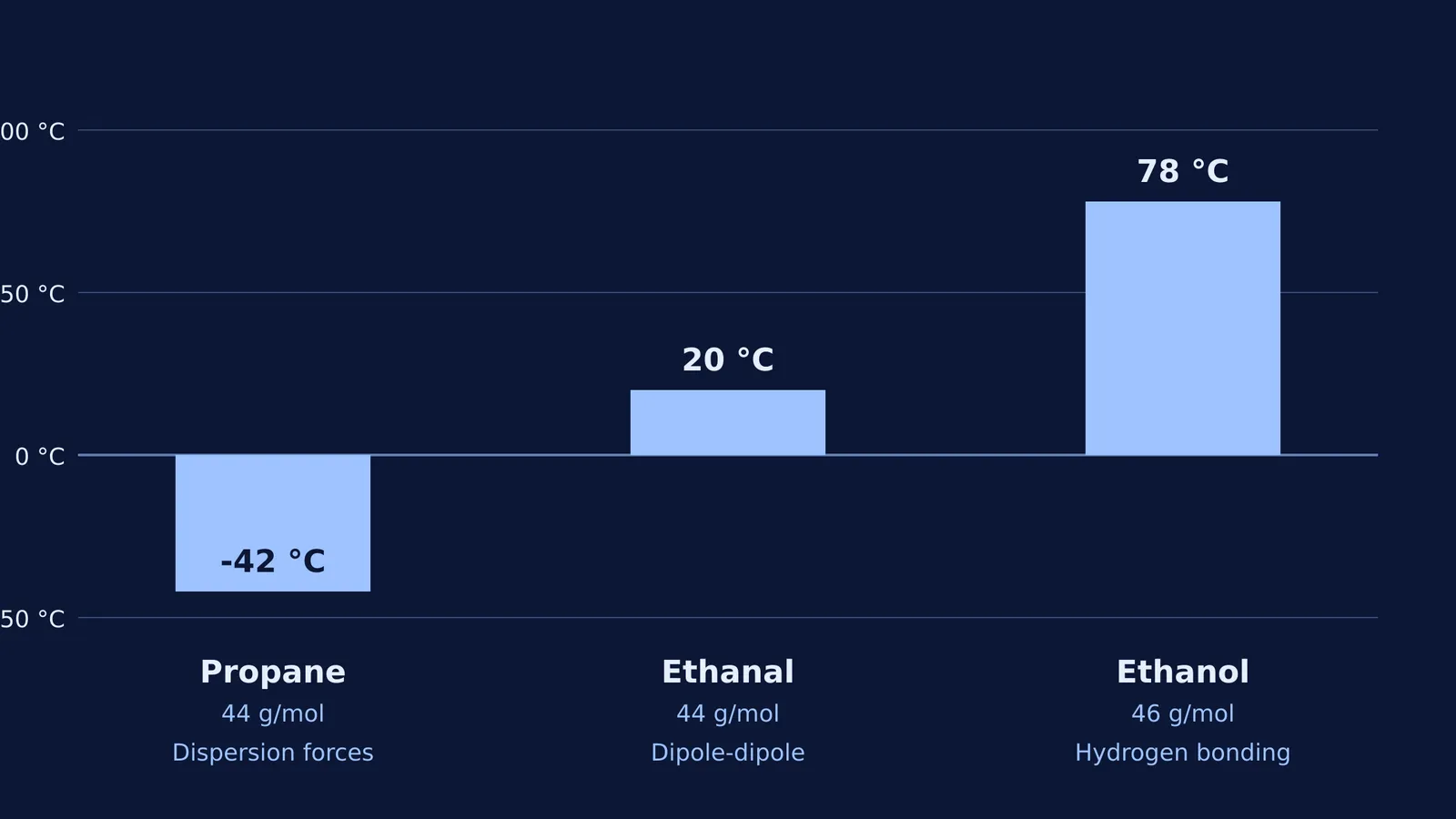
If you compare ethanal (an aldehyde) and ethanol (an alcohol), you will notice they weigh almost the same—44 and 46 g/mol, respectively. Yet, ethanal boils at 20 °C, while ethanol boils at a much higher 78 °C (Chem.LibreTexts/14%3A_Organic_Compounds_of_Oxygen/14.09%3A_Properties_of_Aldehydes_and_Ketones)). This difference of 58 degrees is massive for molecules of nearly identical size. To understand this drastic jump, you have to look closely at the invisible forces holding the molecules together in the liquid state.
Why do aldehydes boil lower than alcohols of similar mass?
The boiling point of a liquid depends entirely on how much heat energy it takes to pull its molecules apart and send them into the air as a gas. The stronger the molecules hold onto each other, the more heat you need to supply to separate them.
Alcohols feature a hydroxyl group (−OH), meaning a hydrogen atom is directly attached to a highly electronegative oxygen atom. This specific arrangement allows alcohol molecules to form strong intermolecular hydrogen bonds with one another. Breaking these strong connections takes a considerable amount of thermal energy, driving up the boiling point.
Aldehydes, on the other hand, contain a carbonyl group (C=O). While the oxygen atom in this group is electronegative and creates a polar molecule, there is no hydrogen atom attached directly to it. Because they lack this crucial O−H bond, aldehydes cannot form hydrogen bonds with each other. Instead, they are held together by dipole-dipole interactions. These electrostatic attractions are much weaker than hydrogen bonds, meaning they are far easier to overcome with less heat. Therefore, aldehydes boil at lower temperatures than alcohols of the same mass.
What is the boiling point tie-breaker?
To make sense of these ranking questions quickly, you can group intermolecular forces into three main categories, ordered from weakest to strongest:
London dispersion forces: These are weak, temporary, and fluctuating forces found in non-polar molecules like alkanes. Because they are so easily broken by thermal energy, these compounds typically have very low boiling points and exist as gases at room temperature.
Dipole-dipole interactions: These operate in polar molecules like aldehydes and ketones. The permanent partial positive charge on the carbon and the partial negative charge on the oxygen attract neighbouring molecules, creating a moderate but significant hold.
Hydrogen bonding: The strongest of the three, found exclusively in molecules where hydrogen is directly attached to a highly electronegative atom like nitrogen, oxygen, or fluorine (such as in alcohols, amines, or carboxylic acids). This specific interaction forms a rigid network that strongly resists boiling.
This hierarchy is essential. If you are comparing ionic vs covalent compounds or studying physical properties across different organic functional groups, identifying the dominant intermolecular force gives you the answer instantly.
Why do we compare molecules of similar mass?
If you are wondering why textbooks and exam papers always specify "comparable molecular mass", it is because mass changes the baseline strength of London dispersion forces.
As molecules get heavier and longer, their surface area increases. A larger surface area makes their dispersion forces stronger. A very large aldehyde will eventually have a higher boiling point than a very small alcohol simply because of its sheer size and the massive accumulation of weak forces. By locking the mass—such as comparing propane (44 g/mol), ethanal (44 g/mol), and ethanol (46 g/mol)—you isolate the effect of the functional group.
Propane, relying only on weak dispersion forces, boils at −42 °C (Chem.LibreTexts/14%3A_Organic_Compounds_of_Oxygen/14.09%3A_Properties_of_Aldehydes_and_Ketones)). Ethanal, with its dipole-dipole interactions, boils at 20 °C. Ethanol, powered by strong hydrogen bonds, tops the group at 78 °C.
If you want to visualise how these specific forces dictate physical properties, the Fermi Concept Library maps out exactly how structure shapes behaviour across organic chemistry. Similarly, you can observe how temperature and intermolecular forces interact in a salt solubility simulation.
How do you rank boiling points in exams?
When faced with a ranking question in JEE or your board exams, follow this systematic approach to avoid careless mistakes:
Check the molar mass. Ensure the molecules are roughly the same weight. If one molecule has a significantly longer carbon chain, it will likely have a higher boiling point regardless of its functional group. (For more on modifying carbon chains, read about stepping up carbon chains).
Identify the functional groups. Look for the atoms that dictate the intermolecular forces. Does it have an −OH group? A C=O group? Or just carbon and hydrogen?
Rank by force strength. Use the established sequence for similar masses: Alkanes < Ethers < Aldehydes < Ketones < Alcohols < Carboxylic Acids.
Working through organic chemistry exceptions can sometimes feel tedious, but Fermi's AI tutor is designed to help you trace the line of reasoning—such as why ketones boil slightly higher than aldehydes—instead of just handing you the final sequence to memorise. By focusing on the "why" behind the physical forces, you build a lasting intuition that works for every molecule on the paper. Once you understand the fundamental interactions, ranking physical properties becomes a logical exercise rather than a test of memory.


