On this page
In 1860 the German chemist Hermann Kolbe published a short note, pages 125 to 127 of Justus Liebigs Annalen der Chemie, titled "Ueber Synthese der Salicylsäure", on making salicylic acid (Crossref record of Kolbe's 1860 paper). Twenty-five years later Rudolf Schmitt changed the conditions, and the reaction we now call the Kolbe-Schmitt reaction became the way factories made the starting material for aspirin. Here is what Kolbe did, why his first method could never pass a 50% yield, and how to revise it for your exams.
Who was Hermann Kolbe?
Kolbe was born on 27 September 1818 in Elliehausen, now part of Göttingen, and died in Leipzig on 25 November 1884 (chemie.de biography of Hermann Kolbe). He worked as Robert Bunsen's assistant at Marburg in 1842 and moved to the University of Leipzig in 1865. Between 1843 and 1845 he turned carbon disulphide into acetic acid in several steps, a story we tell in Hermann Kolbe and making acetic acid from carbon disulphide.
What is the Kolbe reaction?
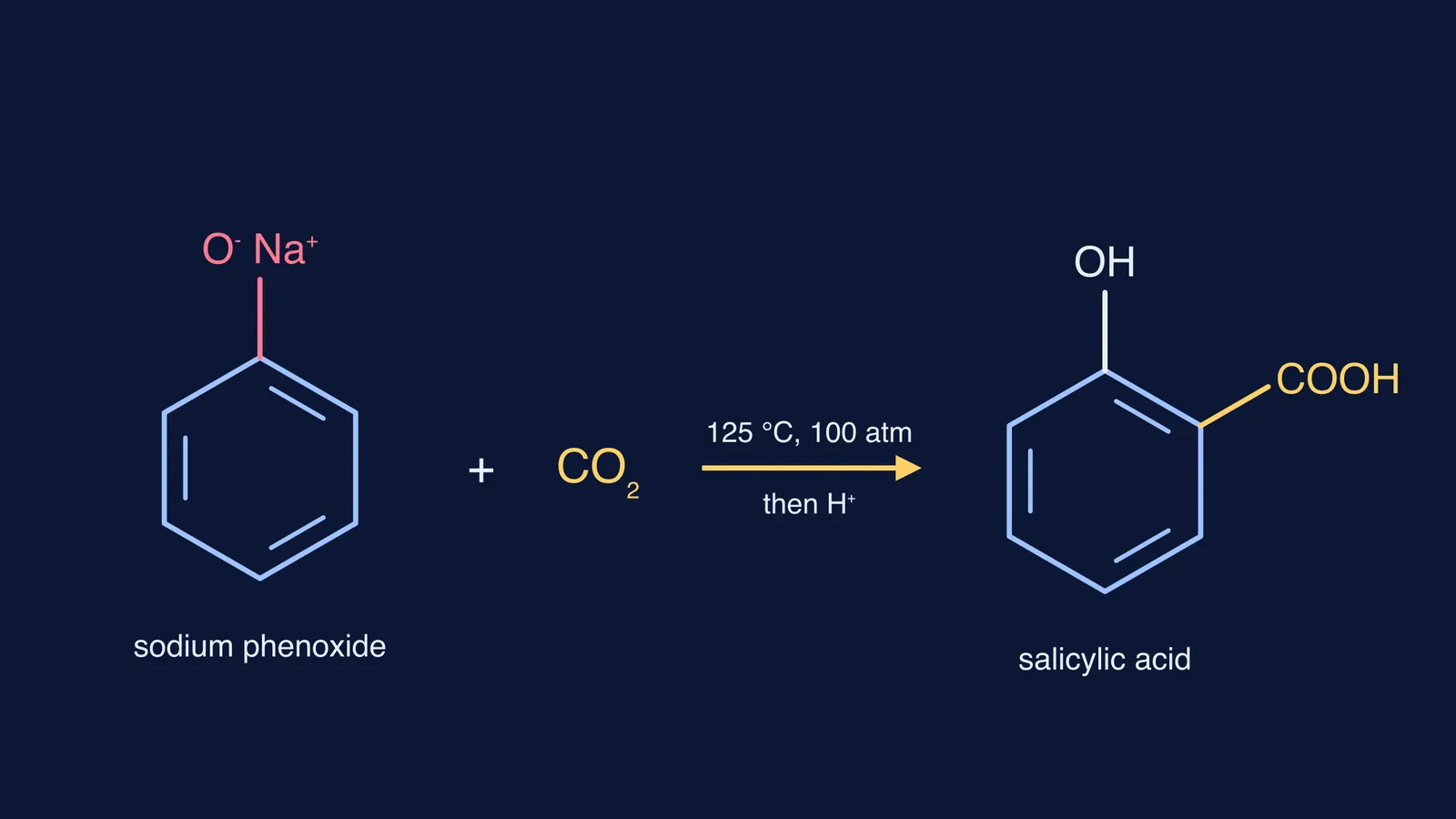
The Kolbe reaction is the addition of a phenoxide, classically sodium phenoxide, to carbon dioxide to give a salicylate, which acid then turns into salicylic acid (Kolbe–Schmitt reaction, Wikipedia). Salicylic acid is 2-hydroxybenzoic acid: the new COOH group sits next to the OH, at the ortho position. If you use potassium hydroxide instead of sodium hydroxide, you get 4-hydroxybenzoic acid as well as salicylic acid.
Kolbe's first version heated phenol and sodium in the presence of CO2 (Mohammad, Onwudili and Yuan, Molecules, 2024).
Why did Kolbe's method waste half the phenol?
Kolbe noticed that for every two moles of sodium phenoxide heated in a stream of CO2, almost exactly one mole of phenol was given off, which held the yield below 50% of the theoretical amount (Mohammad, Onwudili and Yuan, Molecules, 2024). A worked example shows why:
Start with 2 mol sodium phenoxide, C6H5ONa (about 116 g/mol), so about 232 g.
The bookkeeping that fits Kolbe's observation is 2 C6H5ONa + CO2 → C6H4(ONa)COONa + C6H5OH. One phenoxide becomes the disodium salt; the other gives up its sodium and leaves as phenol.
Acidify, and you get at most 1 mol salicylic acid, C7H6O3 (about 138 g/mol), so about 138 g.
In a closed vessel the equation becomes C6H5ONa + CO2 → C6H4(OH)COONa. Every phenoxide can now become salicylate, so the ceiling doubles to 2 mol, about 276 g.
How did Rudolf Schmitt improve the reaction?
Schmitt published "Beitrag zur Kenntniss der Kolbe'schen Salicylsäure Synthese" in the Journal für praktische Chemie in 1885 (Crossref record of Schmitt's 1885 paper). He ran the reaction with dry sodium phenoxide and CO2 in a closed vessel under high pressure and temperature. A 1954 study cited in a 2024 paper reached yields of up to 79% salicylic acid after 8 hours at 125 °C and CO2 pressures of 82 to 138 bar (Mohammad, Onwudili and Yuan, Molecules, 2024). The same paper says the modified Kolbe-Schmitt reaction became the standard industrial procedure for hydroxy aromatic acids.
Dryness matters because water hydrolyses sodium phenoxide back into phenol, leaving less of the reagent that actually reacts (Mohammad and colleagues, ChemSusChem, 2025).
In 1873 Kolbe, Schmitt and Schmitt's student Friedrich von Heyden began working together on a better salicylic acid synthesis, and in 1874 the Salicylsäurefabrik Dr. F. von Heyden was founded in Dresden, moving to Radebeul a year later (idw press release on the Heyden factory). Kolbe became a partner in the firm by contributing his synthesis (chemie.de).
How did salicylic acid lead to aspirin?
Salicylic acid worked as a medicine but irritated the stomach, and some patients could not tolerate it (Science History Institute, Felix Hoffmann). In 1897 Felix Hoffmann at Bayer was adding the acetyl group to many molecules, and acetylsalicylic acid was named Aspirin. From around 1900 the better-tolerated acetylsalicylic acid pushed salicylic acid aside (idw). We follow that part of the story in how Felix Hoffmann turned willow bark chemistry into aspirin.
How should you revise the Kolbe reaction for exams?
A checklist for conversion and name-reaction questions:
Reagents in order: phenol + NaOH gives sodium phenoxide; then CO2 with heat and pressure; then acid (H+).
Product: salicylic acid, 2-hydroxybenzoic acid, with COOH ortho to OH.
Why the phenoxide: the phenoxide is the nucleophile that attacks CO2, so plain phenol is not the reagent.
Metal matters: with potassium, expect 4-hydroxybenzoic acid too.
Next step: adding an acetyl group to the OH gives aspirin.
Do not mix it up with Reimer-Tiemann, which also puts a group ortho to OH; compare the two in Reimer-Tiemann and Kolbe reactions of phenol, step by step.
If you keep writing the wrong product in conversion questions, the Fermi Problem Library has worked problems with a step-by-step solver that explains the reasoning rather than printing an answer. If the gap is the idea underneath, such as why the reagent is the phenoxide rather than phenol, the Fermi Concept Library gives each chemistry concept its own lesson and its place in the map.
Next time you draw the arrow from phenol to salicylic acid, the conditions above it are Schmitt's fix.