On this page
In 1952, Alfred Hershey and Martha Chase asked a simple question about a virus that infects bacteria: when phage T2 infects a cell, which part goes in, the protein or the DNA? Their paper in the Journal of General Physiology answered it with two radioactive labels and a blender. The NCERT Class 12 Biology chapter on molecular basis of inheritance calls it the "unequivocal proof" that DNA is the genetic material, which is why it keeps turning up in NEET-UG biology questions.
The whole experiment rests on one chemical fact, and most wrong answers come from forgetting it.
Why does ³²P label DNA and ³⁵S label protein?
DNA contains phosphorus but protein does not, and DNA contains no sulfur, as the NCERT chapter puts it in section 5.2.1. Phosphorus sits in every nucleotide's phosphate group, and sugars and phosphates together form the backbone of the DNA chain.
So Hershey and Chase grew one batch of phages on a medium with radioactive phosphorus and another on a medium with radioactive sulfur. The first batch had radioactive DNA and ordinary protein. The second had radioactive protein and ordinary DNA.
If the phage's parts are hazy, start with our guide to bacteriophage T4 structure: head, tail and fibres. The DNA is packed in the head; the coat and tail are protein.
What happened in the blender and the centrifuge?
NCERT describes three steps:
Infection. Radioactive phages attach to *E. coli* and inject their genetic material.
Blending. Shaking in a blender shears the empty phage coats off the bacterial surface. The 1952 paper reports the blended cells could still make new phages.
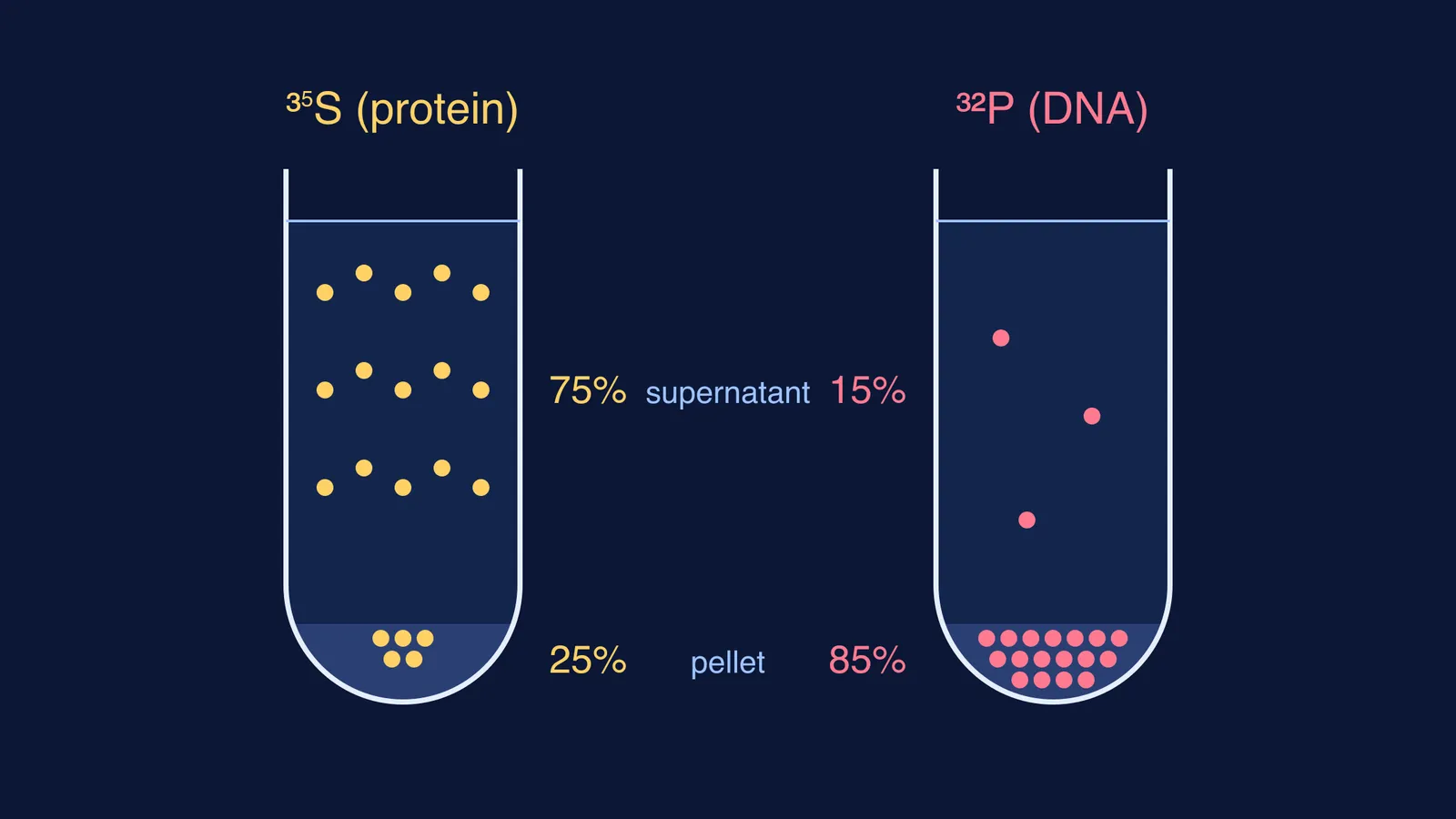
Centrifugation. Spinning sends the heavy bacteria to the bottom as a pellet. The light phage coats stay in the liquid above, the supernatant.
The original paper gives real numbers, not the all-or-nothing picture in textbook diagrams. Blending released 75% of the phage sulfur and only 15% of the phage phosphorus into the solution, according to Hershey and Chase's 1952 abstract. Progeny of ³⁵S-labelled phages carried less than 1% of the parental radioactivity, while progeny of ³²P-labelled phages carried 30% or more of the parental phosphorus, the same paper reports.
Where did the radioactivity end up?
Use this as your answer key:
³⁵S batch (protein labelled): radioactivity mostly in the supernatant, with the empty coats. Less in the pellet. Almost none in the next generation of phages.
³²P batch (DNA labelled): radioactivity mostly in the pellet, inside the bacteria. Some of it turns up in the progeny phages.
The conclusion follows: the material that went into the bacteria and passed to the offspring was DNA. For how this fits with the earlier work, read Griffith's experiment and the transforming principle, and for the people and the story, see the Hershey-Chase experiment: phages, labels and a blender.
What are the NEET-UG traps on the Hershey-Chase experiment?
Swapped labels. An option says ³²P labels protein. Wrong: protein has no phosphorus. Tie P to the phosphate backbone and S to protein.
Pellet means phage. The pellet is the heavy bacteria. The phage coats are in the supernatant.
The blender's job. It removes coats from the outside of the cells. It does not burst the bacteria or push DNA in.
The wrong isotope. Carbon, hydrogen and nitrogen are in both DNA and protein, so ¹⁴C, ³H or ¹⁵N would label both and tell you nothing here.
Mixed-up experiments. Griffith used mice and two bacterial strains; Avery, MacLeod and McCarty used enzymes such as DNase; Hershey and Chase used phages and radioisotopes. NCERT lists all three in section 5.2.
Overstating the result. NCERT itself notes that RNA is the genetic material in some viruses. The experiment shows DNA is the genetic material of phage T2, not of every organism.
A two-minute self-check before your test
Cover the answers and say each one aloud:
Phages labelled with ³⁵S infect bacteria, then blending and centrifugation. Where is most radioactivity? *Supernatant.*
Same with ³²P? *Pellet, and some in progeny phages.*
What if you skip the blender? *The coats stay attached, so most of both labels would likely end up in the pellet.*
Why not label with ¹⁵N? *Both DNA and protein contain nitrogen.*
Which molecule did NCERT say carries no sulfur? *DNA.*
If question 3 or 4 tripped you up, the gap is usually the chemistry of the molecules, not the experiment. The Fermi Concept Library gives every biology and chemistry concept its own lesson and its place in the map, so you can check what DNA and proteins are made of before coming back here.
For practice, the Fermi Problem Library has worked problems with a step-by-step solver that explains the reasoning rather than printing an answer.
Next time you see a phage diagram, ask one question first: which atom is radioactive, and which molecule holds it?