

On this page
Aspirin's story runs from willow bark to a lab notebook entry dated 10 August 1897, and the key step is one reaction you can write in a single line.
Where does aspirin come from: is it really willow bark?
Yes, in a chemical sense. According to a 2017 historical review in the British Journal of Haematology by Michael Desborough and David Keeling, willow bark has been used as a traditional medicine for more than 3500 years, and its active ingredient is salicin.
In 1763 the Reverend Edward Stone sent the Royal Society an account of the bark of the willow in the cure of agues, meaning fevers with shivering.
Chemists then pulled the medicine out of the bark, step by step, as the Desborough and Keeling review sets out:
1828: Johann Buchner refined willow bark into yellow crystals and named them salicin, after Salix, the willow genus.
1838: Raffaele Piria made a stronger compound from salicin and named it salicylic acid.
1852: Charles Gerhardt first attached an acetyl group to salicylic acid, but his compound was not stable and he did not develop it.
Salicin did lower fever, but the review notes that it was not taken up more widely “due to complications with gastritis”. Salicylic acid, the Science History Institute notes, irritated the stomach.
How did Felix Hoffmann make aspirin in 1897?
Felix Hoffmann (1868-1946) was a chemist at the dye company Bayer, which had set up a pharmaceutical division in 1890. In 1897 Arthur Eichengrün, the head of that division, gave him the task of finding a form of salicylate that did not irritate the stomach, according to the same review. The Science History Institute adds that Hoffmann was then adding the acetyl group, CH3CO, to many molecules in the hope of making them stronger or less toxic.
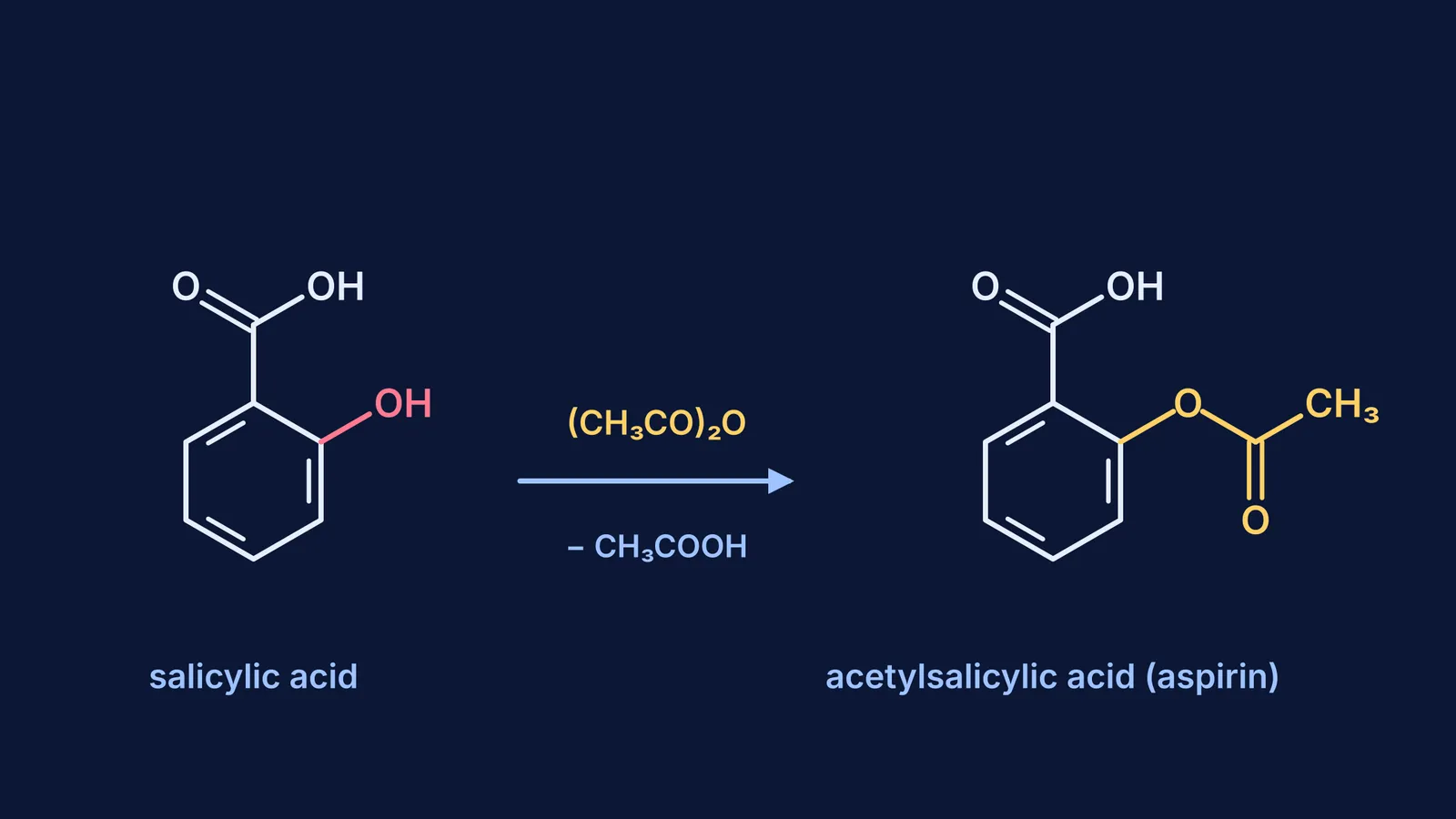
His laboratory notebook for 10 August 1897, quoted in the review, describes heating salicylic acid (100.0 parts) “with acetic anhydride (150.0 parts) for 3 hours under reflux”, and reports that the salicylic acid was fully acetylated.
The equation:
Salicylic acid (C7H6O3) + acetic anhydride (C4H6O3) → acetylsalicylic acid (C9H8O4) + acetic acid (C2H4O2)
The acetyl group replaces the hydrogen of the phenol –OH, turning it into an ester. The –COOH group is untouched. If you have met the Kolbe reaction of phenol, you have seen one way to make salicylic acid; Hoffmann, the review says, extracted his from dry meadowsweet leaves.
Worked example: how much aspirin does Hoffmann's recipe give?
Treat his “parts” as grams and use molar masses from PubChem: salicylic acid 138.12 g/mol, acetic anhydride 102.09 g/mol, aspirin 180.16 g/mol and acetic acid 60.05 g/mol.
Moles of salicylic acid: 100.0 ÷ 138.12 = 0.724 mol.
Moles of acetic anhydride: 150.0 ÷ 102.09 = 1.469 mol.
The equation is 1:1, so the anhydride is in about twofold excess. Salicylic acid is the limiting reagent.
Theoretical aspirin: 0.724 × 180.16 = 130.4 g.
Acetic acid formed: 0.724 × 60.05 = 43.5 g.
Check: 138.12 + 102.09 = 240.21, and 180.16 + 60.05 = 240.21. Mass balances.
An excess of one reagent helps push a reaction to completion, which fits the notebook's report of full acetylation; the same idea appears in Fischer esterification. If the mole steps are where you slip, the Fermi Problem Library has worked problems with a step-by-step solver that explains the reasoning rather than printing an answer.
Did the acetyl group make it gentler on the stomach?
That was the goal at Bayer, and in the review's account acetylating salicylic acid “later proved to be the key step in reducing its irritant properties”. Hoffmann's notebook praised the new compound's “sour taste without being corrosive”. It did not fully solve the problem: after the gastroscope arrived in 1932, the review notes, aspirin use was linked to gastritis. Acetylating an –OH or –NH2 is a common move; you see it again when aniline is acetylated before nitration.
The name came next. The review explains that “aspirin” joins acetyl with spiraea, the Latin name for meadowsweet. How it works in the body came much later: the review's timeline marks 1971 as the year aspirin was shown to inhibit prostaglandin synthesis.
How do you write this up in an exam answer?
For a short answer on aspirin, cover five points:
Name the starting material: salicylic acid (2-hydroxybenzoic acid).
Name the reagent: acetic anhydride, with heat.
Write the balanced equation and name the by-product, acetic acid.
Say which group reacts: the phenolic –OH is acetylated to an ester.
Classify the product: an analgesic and antipyretic (relieves pain, lowers fever).
If esters or functional groups still feel shaky, the Fermi Concept Library gives every concept in chemistry its own lesson and its place in the map. Tonight, try redrawing the reaction from memory.


