On this page
Give toluene to a strong oxidising agent and it races past the aldehyde to benzoic acid. In the 1870s a young chemist working in Paris found a reagent that halts the methyl group one step earlier. His name is now attached to a reaction in the NCERT Class 12 chemistry textbook, Unit 8, which is why it turns up in organic conversion questions.
Who was Alexandre Étard?
Alexandre Léon Étard was born in Alençon in 1852 and died in Paris in 1910, according to the Deutsche Biographie record and his Wikipedia biography. He studied at the Sorbonne and worked as a preparer in Charles-Adolphe Wurtz's laboratory in Paris.
His long interest was chromium. Jaime Wisniak's 2019 biography in Revista CENIC describes his work on chrome compounds, including the action of chlorochromic acid (chromyl chloride) on organic compounds. Wisniak traces the toluene work to Étard's first 1877 paper in the Comptes Rendus of the French Academy of Sciences, and to his doctoral thesis on the oxidising role of chlorochromic acid, defended on 24 December 1880 and published in 1881.
The early experiments were not gentle. Wisniak's account says toluene reacted so lively with the reagent that Étard had to add it in large excess, with cooling, to avoid an explosion. After water was added and the oil distilled, the product contained essence of bitter almond, which he confirmed was benzaldehyde.
What is the Étard reaction?
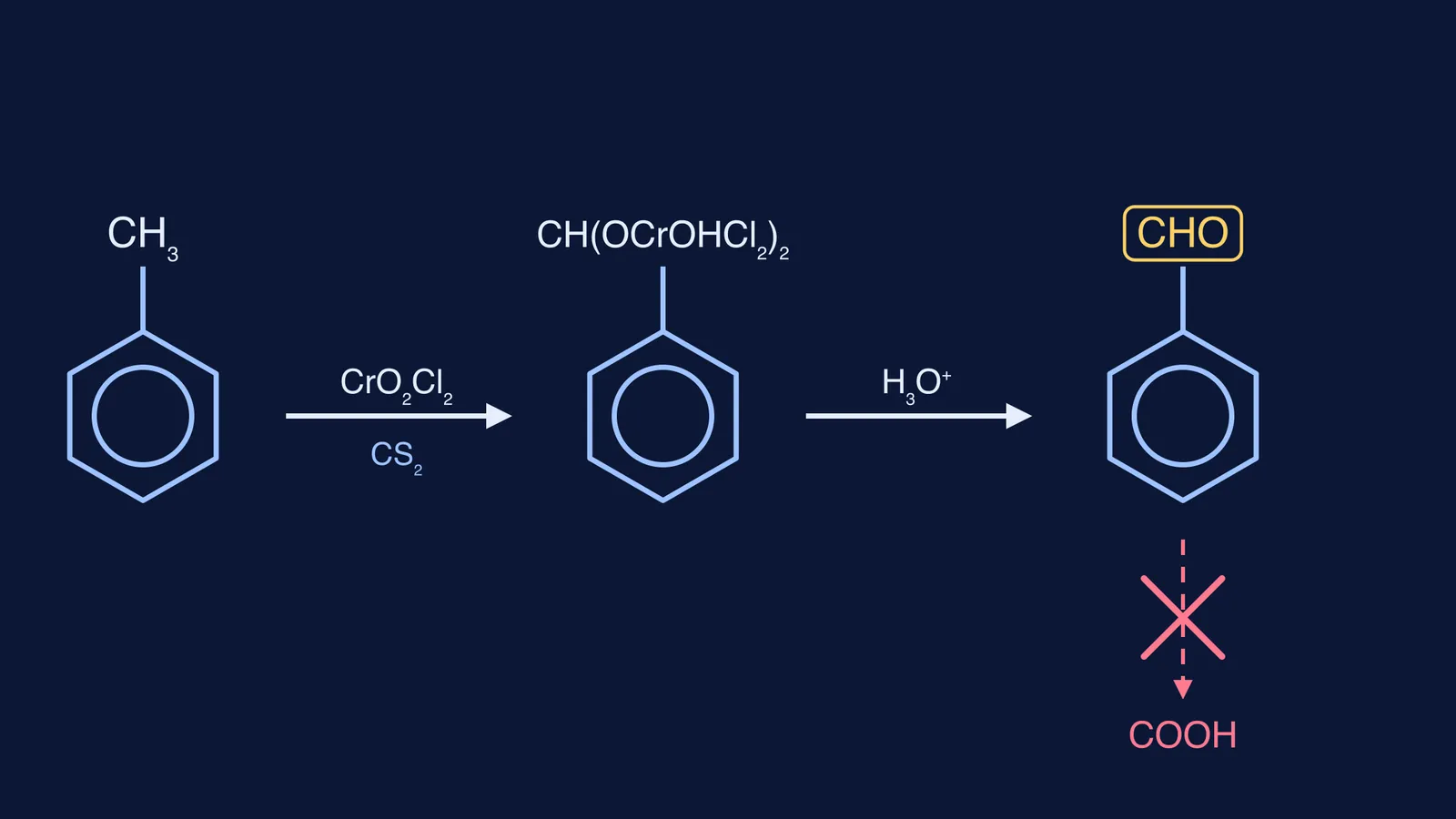
The Étard reaction is the oxidation of a methyl group on an aromatic ring to an aldehyde group using chromyl chloride, CrO2Cl2 (NCERT, Unit 8).
In the NCERT version, toluene and chromyl chloride react in carbon disulphide (CS2) to give a chromium complex, C6H5CH(OCrOHCl2)2. Treating that complex with dilute acid (H3O+) hydrolyses it to benzaldehyde, C6H5CHO.
Chemists kept studying it long after Étard. Owen Wheeler mapped its scope and limits with substituted toluenes in the Canadian Journal of Chemistry in 1958, and a team including A. T. Balaban and C. D. Nenitzescu studied its mechanism in Tetrahedron in 196398572-2).
Why does the oxidation stop at benzaldehyde?
NCERT gives the reason in one line: you can stop at the aldehyde stage with reagents that convert the methyl group to an intermediate that is difficult to oxidise further (NCERT, Unit 8).
The picture to hold in your head: while the oxidant is around, there is no free C=O group yet. The carbon is tied up with two chromium groups, and in the classic procedure the complex separates out as a precipitate (Wikipedia summary of the Étard reaction). Benzaldehyde appears only in a second step, when water or dilute acid is added. By contrast, potassium permanganate or potassium dichromate take the methyl group all the way to the carboxylic acid.
Toluene to benzaldehyde: which reagent does what?
NCERT Unit 8 lists several ways to make benzaldehyde from toluene and benzene (NCERT, Unit 8). Make one revision card with all of them side by side:
Strong oxidising agent: toluene goes to benzoic acid. Keep it apart from the aldehyde routes below.
Étard reaction: CrO2Cl2 in CS2, then H3O+. Chromium complex, then benzaldehyde.
Chromic oxide in acetic anhydride: CrO3 and (CH3CO)2O at 273-283 K give benzylidene diacetate, C6H5CH(OCOCH3)2, which aqueous acid hydrolyses to benzaldehyde.
Side-chain chlorination: Cl2 with light gives benzal chloride, C6H5CHCl2, which water at 373 K turns into benzaldehyde. NCERT calls this a commercial method.
Gattermann-Koch: starts from benzene, not toluene. CO and HCl with anhydrous AlCl3 or CuCl give benzaldehyde.
Notice the pattern in the three toluene-to-aldehyde routes: each one parks the carbon in a protected form (a chromium complex, a diacetate, a dichloride) and only frees the aldehyde at the end.
A 30-second check you can do in the exam
Wisniak's account gives the Étard complex as C6H5CH3·2CrO2Cl2, toluene plus two chromyl chlorides (Revista CENIC). NCERT draws it as C6H5CH(OCrOHCl2)2. Are they the same thing? Count the atoms:
Toluene plus two CrO2Cl2: C7, H8, Cr2, O4, Cl4.
C6H5CH(OCrOHCl2)2: carbon is 6 + 1 = 7; hydrogen is 5 + 1 + 2 = 8; and each bracket carries one Cr, two O and two Cl, so Cr2, O4, Cl4.
They match: the complex is toluene plus two chromyl chlorides, rearranged. Hydrolysis breaks both chromium arms off and leaves CHO.
Counting atoms on both sides is a quick way to catch a wrong structure in conversion questions.
If the idea of an aldehyde as a halfway stage between alcohol and acid still feels shaky, the Fermi Concept Library covers every concept in chemistry, including the carbonyl group. When you get stuck on a multi-step conversion, the Fermi Problem Library has a step-by-step solver that explains the reasoning rather than printing an answer.
Next time you see CrO2Cl2 in a question, think of Étard's bitter-almond smell and stop at the aldehyde.