On this page
Each item below hides a common misconception or a "true, but not the reason" link. Every statement was checked against NCERT Class 12 Chemistry, Unit 7: Alcohols, Phenols and Ethers (Reprint 2026-27), which is Unit 7 of the CBSE 2026-27 Class 12 Chemistry syllabus. For the full chapter with board answers, read our alcohols, phenols and ethers Class 12 board exam guide.
How do you answer assertion-reason questions?
The CBSE Class 12 Chemistry sample question paper for 2026-27 has four assertion-reason questions, Q13 to Q16, in Section A at 1 mark each. Work in three steps: is A true on its own, is R true on its own, and only if both are true, is R the textbook's own cause of A?
Keys for Q1 to Q6:
(A) Both A and R are true and R is the correct explanation of A.
(B) Both A and R are true but R is NOT the correct explanation of A.
(C) A is true but R is false.
(D) A is false but R is true.
Keys for Q7 to Q10:
(A) Both statements are correct.
(B) Both statements are incorrect.
(C) Statement I is correct, Statement II is incorrect.
(D) Statement I is incorrect, Statement II is correct.
Assertion-reason questions on alcohols, phenols and ethers
Q1 (easy). Assertion (A): The C–O bond in phenol is shorter than the C–O bond in methanol. Reason (R): The unshared electron pair on oxygen is conjugated with the benzene ring, giving the C–O bond partial double-bond character.
Answer: (A). Both are true. NCERT puts the phenol C–O bond at 136 pm, slightly less than in methanol, and gives this conjugation as a cause (along with the sp2 carbon).
Trap: thinking all C–O single bonds have the same length.
Q2 (easy). Assertion (A): Ethoxyethane boils at a much lower temperature than butan-1-ol. Reason (R): Ether molecules have no net dipole moment.
Answer: (C). A is true: NCERT lists 307.6 K for ethoxyethane and 390 K for butan-1-ol. R is false: the C–O bonds in ethers are polar and ethers do have a net dipole moment. The gap comes from hydrogen bonding in the alcohol.
Trap: assuming a low boiling point means a non-polar molecule.
Q3 (medium). Assertion (A): A nitro group para to the –OH group lowers the pKa of phenol. Reason (R): Electron-releasing alkyl groups lower the acid strength of phenol, which is why cresols are less acidic than phenol.
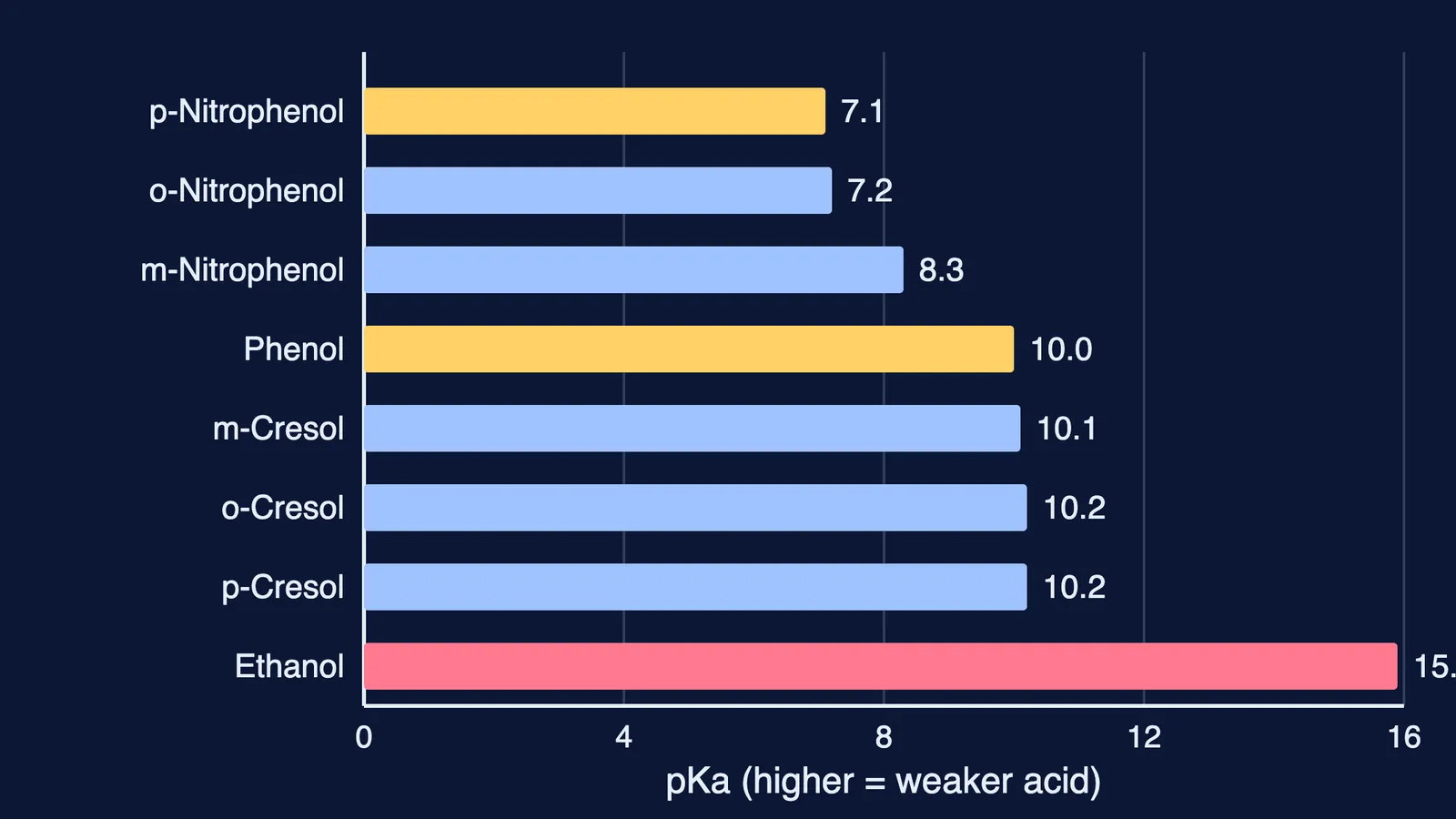
Answer: (B). Both are true: the pKa of p-nitrophenol is 7.1 against 10.0 for phenol (NCERT Table 7.3, plotted at the top). But R is about alkyl groups. A is explained by the electron-withdrawing nitro group delocalising the negative charge of the phenoxide ion.
Trap: choosing (A) because both lines talk about substituents and acidity.
Q4 (medium). Assertion (A): Sodium methoxide and 2-bromo-2-methylpropane give tert-butyl methyl ether in good yield. Reason (R): Alkoxide ions are strong bases as well as nucleophiles.
Answer: (D). A is false: with a tertiary alkyl halide, NCERT says this pair gives only 2-methylpropene and no ether. R is true, and it is why elimination wins. Williamson synthesis works best with a primary alkyl halide.
Trap: putting the tertiary group on the halide instead of on the alkoxide.
Q5 (hard). Assertion (A): Tertiary alcohols are dehydrated under milder conditions than primary alcohols. Reason (R): In acid-catalysed dehydration, protonation of the alcohol is the slowest, rate-determining step.
Answer: (C). A is true. R is false: NCERT names carbocation formation (step 2) as the slowest step. Tertiary carbocations are the most stable and easiest to form, which is the real reason for A.
Trap: assuming the first step of a mechanism is the slow one.
Q6 (hard). Assertion (A): Heating tert-butyl methyl ether with concentrated HI gives mainly tert-butyl iodide and methanol. Reason (R): Loss of methanol from the protonated ether forms a stable tertiary carbocation, so the cleavage follows an SN1 path.
Answer: (A). Both are true, and R is NCERT's own explanation. The "lower alkyl group forms the iodide" rule holds only for primary and secondary groups, where the cleavage is SN2.
Trap: applying the SN2 rule and predicting methyl iodide.
Statement I and Statement II questions
Judge each statement alone; there is no "because" step.
Q7 (easy). Statement I: Hydroboration–oxidation of propene gives propan-1-ol. Statement II: Acid-catalysed hydration of propene gives propan-2-ol.
Answer: (A). Both are correct. Acid hydration follows Markovnikov's rule, while hydroboration–oxidation puts boron, and finally –OH, on the carbon with more hydrogens.
Trap: thinking both routes give the same alcohol.
Q8 (medium). Statement I: Reducing a ketone with NaBH4 gives a primary alcohol. Statement II: A Grignard reagent reacts with methanal, followed by hydrolysis, to give a secondary alcohol.
Answer: (B). Both are incorrect. Ketones give secondary alcohols. Methanal gives a primary alcohol; other aldehydes give secondary and ketones give tertiary alcohols.
Trap: mixing up the two product tables.
Q9 (medium). Statement I: o-Nitrophenol can be separated from p-nitrophenol by steam distillation because of its intramolecular hydrogen bonding. Statement II: m-Nitrophenol is a stronger acid than p-nitrophenol.
Answer: (C). Statement I is correct. Statement II is incorrect: m-nitrophenol has pKa 8.3 and p-nitrophenol 7.1, and the higher pKa is the weaker acid.
Trap: forgetting that the nitro group helps most at ortho and para positions.
Q10 (hard). Statement I: A primary alcohol turns Lucas reagent turbid immediately at room temperature. Statement II: Phenol with bromine in CS2 at low temperature gives monobromophenols, while bromine water gives 2,4,6-tribromophenol.
Answer: (D). Statement I is incorrect: tertiary alcohols give turbidity immediately and primary alcohols give none at room temperature. Statement II is correct, as NCERT describes both conditions.
Trap: reversing the Lucas order.
How should you use this set?
Cover the answers and write your key for all ten, with one line on why.
For each miss, note what you misjudged: A, R, or the link between them.
Wrong on a fact? Reread that NCERT section. Wrong only between (A) and (B)? Find the textbook's own reason.
Then work through our CBSE Class 12 chemistry paper plan and the assertion-reason strategy guide.
If a trap shows a gap in an idea, such as why the phenoxide ion is stabilised, the Fermi Concept Library has a lesson for every concept in chemistry, each with its place in the map.