On this page
This chapter rewards reasons, not just reactions. You compare acidities, tell compounds apart and convert one into another, and every visible step earns marks.
How many marks is Alcohols, Phenols and Ethers in Class 12?
The CBSE Chemistry curriculum for 2026-27 lists Unit 7, Alcohols, Phenols and Ethers, at 6 marks out of 70 in the three-hour theory paper. Its question paper design also says no chapter-wise weightage is provided, so treat 6 as a guide.
The 2026-27 sample paper has 33 questions: 16 one-mark MCQs, 5 two-mark, 7 three-mark, 2 four-mark case-based and 3 five-mark questions. Everything below follows the NCERT chapter (lech202, Reprint 2026-27). For the entrance-exam side, see our Alcohols, Phenols and Ethers for JEE Main guide.
How do you answer "give reasons" questions on acidity order?
Try this practice question: arrange ethanol, 3-methylphenol, phenol, 3-nitrophenol and 4-nitrophenol in increasing acid strength. Solve it twice.
Pass 1: from data. In NCERT Table 7.3, a greater pKa means a weaker acid: ethanol 15.9, m-cresol (3-methylphenol) 10.1, phenol 10.0, m-nitrophenol 8.3, p-nitrophenol 7.1. Sort by falling pKa: ethanol < 3-methylphenol < phenol < 3-nitrophenol < 4-nitrophenol.
Pass 2: cross-check by reasoning.
Ethoxide keeps its negative charge on oxygen; phenoxide spreads it over the ring by resonance, so every phenol here beats ethanol.
Methyl releases electrons, destabilising phenoxide, so 3-methylphenol is slightly weaker than phenol.
A meta nitro group withdraws electrons by –I only, stabilising phenoxide, so 3-nitrophenol is stronger than phenol.
At the para position the charge also delocalises onto nitro (–M plus –I), which NCERT says is the stronger effect, so 4-nitrophenol is the strongest acid of the five.
Both passes agree. Write the order, then one reason per step: that is where the marks sit. More practice: our acidity order of substituted phenols. If phenoxide resonance feels shaky, the Fermi Concept Library has every concept in chemistry, each with its own lesson.
Which tests, named reactions and conversions keep coming back?
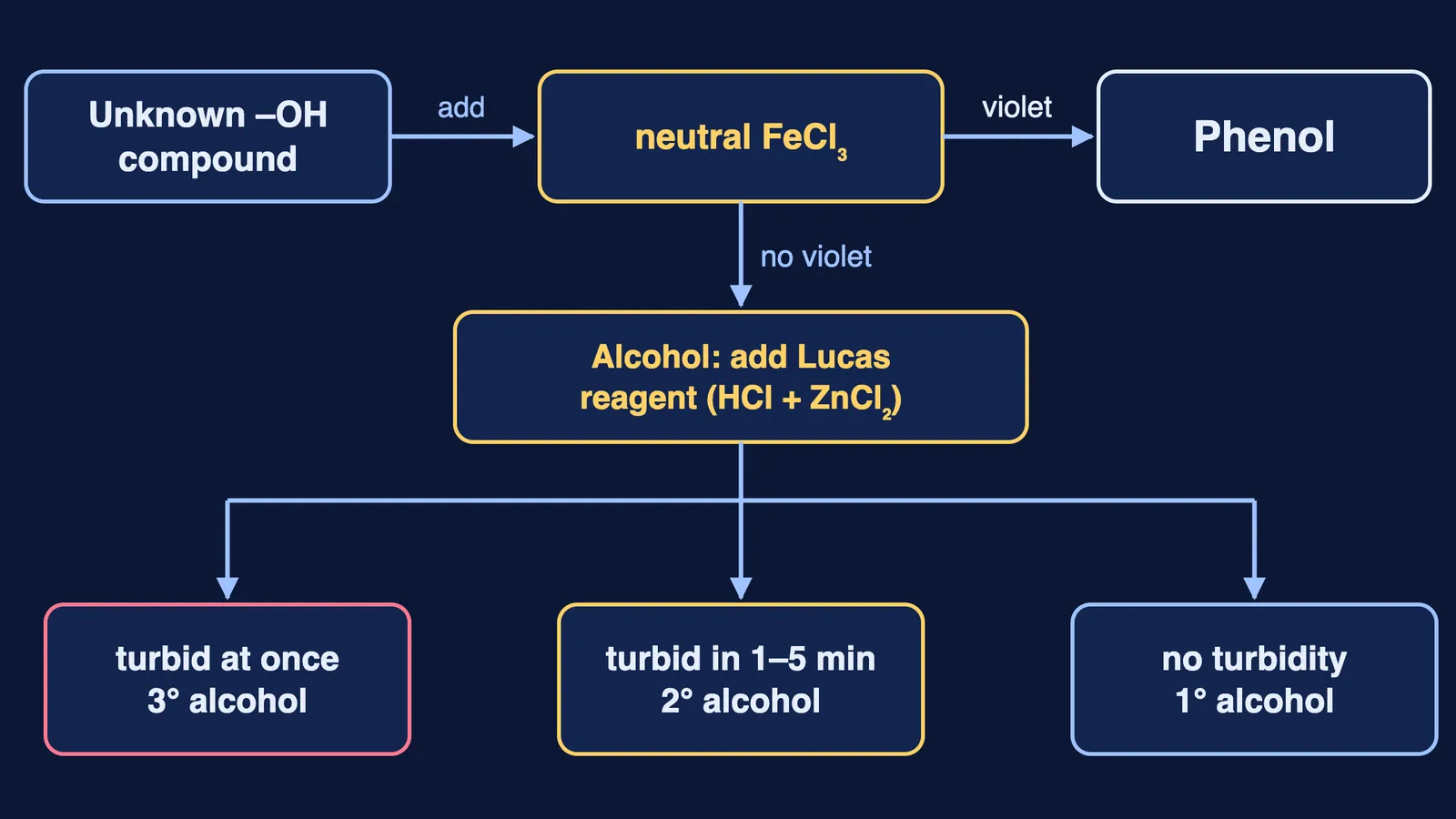
Lucas test (conc. HCl + ZnCl2): NCERT says tertiary alcohols turn turbid immediately and primary alcohols give no turbidity at room temperature. The NCERT lab manual adds that secondary alcohols separate a layer within 1-5 minutes.
Neutral ferric chloride test: the lab manual says phenol gives a violet complex; alcohols give no such colour. It comes from the lab manual (the practical syllabus lists tests for phenolic groups), not the chapter text. Our guide on how to distinguish ethanol and phenol walks through it.
Named reactions, per NCERT:
Kolbe's reaction: phenoxide plus carbon dioxide gives ortho-hydroxybenzoic acid as the main product.
Reimer-Tiemann reaction: phenol with chloroform and sodium hydroxide puts –CHO at the ortho position, giving salicylaldehyde.
Williamson synthesis: alkyl halide plus sodium alkoxide by SN2; use a primary halide. A tertiary halide gives only an alkene: CH3ONa and (CH3)3C–Br give 2-methylpropene.
Conversions from Exercise 7.20 (propene to propan-2-ol, benzyl chloride to benzyl alcohol, Grignard routes) need a reagent over every arrow. The Fermi Problem Library has worked problems with a step-by-step solver that explains the reasoning rather than printing an answer.
How should you set out 2-, 3- and 5-mark answers?
The 2026-27 marking scheme gives 1 mark for saying phenol has a lower pKa than cyclohexanol and 1 mark for the reason (resonance-stabilised phenoxide). Copy that shape.
2 marks: the claim, then one reason with the effect named (resonance, –I, +I).
3 marks: often split into parts (sample Q28 is 2 + 1); give each its own line.
5 marks: sample Q31(A) is a 3 × 1 "account for" plus a 2-mark task. Number each part.
What traps hide in assertion-reason and case-study questions?
Sample paper Q15: ethers mix with water like alcohols of similar mass, because ether oxygen hydrogen-bonds with water. The key is A: both true, R explains A. NCERT gives 7.5 and 9 g per 100 mL water for ethoxyethane and butan-1-ol. The trap: ethers cannot hydrogen-bond with each other, but they can with water.
Case study Q29 graphs pKa values: p-bromophenol 9.34, p-chlorophenol 9.38, p-fluorophenol 9.9, phenol 10. The marked answer puts p-bromophenol as the most acidic. Rank by electronegativity alone and you pick fluorine and lose the mark.
What is a good seven-day revision plan for this chapter?
Day 1: read lech202; list every reagent.
Day 2: acidity; redo the practice order above both ways, then NCERT Example 7.4.
Day 3: Lucas and ferric chloride; draw a flowchart.
Day 4: Kolbe, Reimer-Tiemann, Williamson.
Day 5: Exercises 7.20 and 7.21, timed.
Day 6: sample Q15 and Q29 against the marking scheme.
Day 7: write three "give reasons" answers from memory; self-mark.