On this page
This sheet follows Chapter 1 of the NCERT Class 12 Chemistry textbook (reprint 2026-27); the CBSE 2026-27 Chemistry syllabus lists the same Unit 1 topics. Subscript 1 is the solvent, 2 the solute; n is moles, w mass in g, M molar mass in g mol⁻¹.
How do you express the concentration of a solution?
Mass % (w/w) = (mass of component ÷ mass of solution) × 100
Volume % (V/V) = (volume of component ÷ volume of solution) × 100
Mass by volume % (w/V) = grams of solute in 100 mL of solution
ppm = (parts of component ÷ total parts of all components) × 10⁶ (by mass, volume or mass/volume)
Mole fraction: xA = nA ÷ (nA + nB), dimensionless; all fractions sum to 1
Molarity: M = n2 ÷ volume of solution in L, in mol L⁻¹
Molality: m = n2 ÷ mass of solvent in kg, in mol kg⁻¹
Molarity changes with temperature; mass %, ppm, mole fraction and molality do not (NCERT, section 1.2).
Worked example: 12.0 g urea (M2 = 60 g mol⁻¹) in 200 g water gives n2 = 0.200 mol and m = 0.200 ÷ 0.200 kg = 1.00 mol kg⁻¹. Water is 11.11 mol, so x2 = 0.200 ÷ 11.31 = 0.0177. Taking the solution's density as 1.02 g mL⁻¹, its 212 g occupy 207.8 mL, so M = 0.962 mol L⁻¹.
Watch for: molality divides by solvent mass in kg, not solution mass.
What is Henry's law formula?
p = KH x, where p is the gas's partial pressure (bar or Pa), x its mole fraction in solution (dimensionless) and KH the Henry's law constant (same unit as p; NCERT lists it in kbar), at constant temperature
Higher KH means lower solubility at a given pressure; KH for N2 and O2 rises with temperature, so solubility falls (NCERT, section 1.3.2)
Worked example: NCERT gives KH for N2 at 293 K as 76.48 kbar (NCERT, Table 1.2). At p = 2.0 bar, x = 2.0 ÷ 76 480 = 2.62 × 10⁻⁵; so 1 L of water (55.5 mol) dissolves about 1.45 × 10⁻³ mol of N2.
Watch for: convert kbar to bar before dividing.
Raoult's law and ideal solutions: which formulas apply?
p1 = x1 p1°, p2 = x2 p2°, with p° the pure liquid's vapour pressure (bar, mm Hg or kPa), x its liquid mole fraction
p_total = p1 + p2 = p1° + (p2° − p1°) x2 (two volatile liquids)
yi = pi ÷ p_total, the vapour-phase mole fraction (dimensionless)
Ideal solution (obeys Raoult's law at all compositions): ΔmixH = 0 and ΔmixV = 0 (no heat or volume change on mixing)
Positive deviation: p_total above the Raoult line; negative deviation: below (NCERT, section 1.5)
Worked example: ideal liquids A (pA° = 300 mm Hg) and B (pB° = 120 mm Hg), xA = 0.40: pA = 120 mm Hg, pB = 0.60 × 120 = 72 mm Hg, p_total = 192 mm Hg and yA = 120 ÷ 192 = 0.625.
Watch for: x belongs to the liquid, y to the vapour.
Which formulas cover colligative properties and molar mass?
For dilute solutions of a non-volatile non-electrolyte (NCERT, section 1.6):
Relative lowering: (p1° − p1) ÷ p1° = x2 ≈ n2 ÷ n1 = (w2 × M1) ÷ (M2 × w1), dimensionless
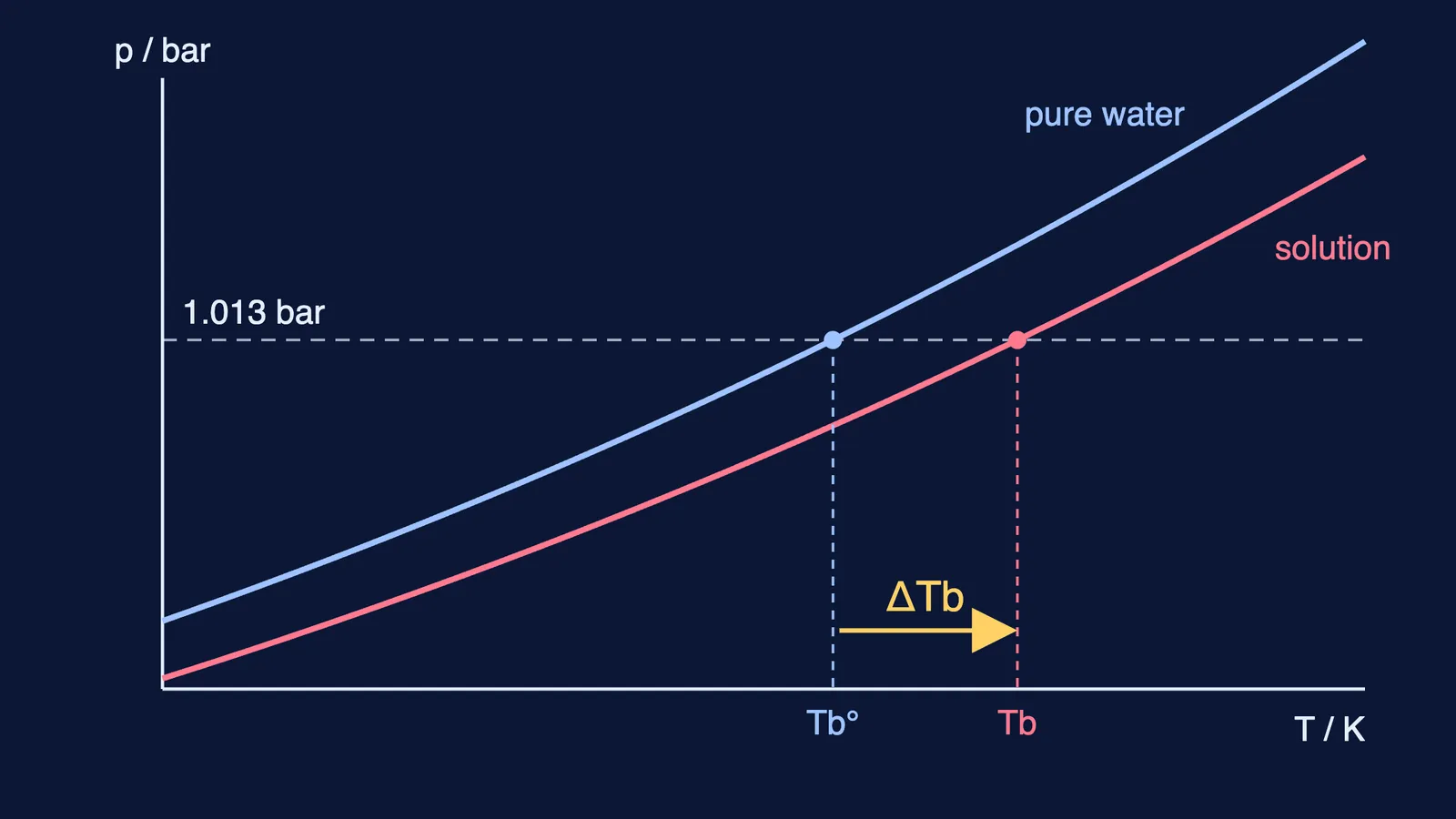
ΔTb = Kb m; ΔTb in K, Kb in K kg mol⁻¹ (0.52 for water), m in mol kg⁻¹
ΔTf = Kf m; Kf in K kg mol⁻¹ (1.86 for water)
Molar mass: M2 = (1000 × K × w2) ÷ (ΔT × w1) in g mol⁻¹; K = Kb or Kf, w in g
Kf = (R × M1 × Tf²) ÷ (1000 × ΔfusH) and Kb = (R × M1 × Tb²) ÷ (1000 × ΔvapH), in K kg mol⁻¹, with R = 8.314 J mol⁻¹ K⁻¹, M1 in g mol⁻¹, T in K, ΔH in J mol⁻¹ (1000 converts g to kg)
Osmotic pressure: Π = CRT = (n2 ÷ V) RT; Π in bar, C in mol L⁻¹, V in L, R = 0.083 L bar mol⁻¹ K⁻¹, T in K
M2 = (w2 × R × T) ÷ (Π × V), in g mol⁻¹
Worked example: 3.00 g of a non-electrolyte in 150 g water lowers the freezing point by 0.248 K. M2 = (1000 × 1.86 × 3.00) ÷ (0.248 × 150) = 150 g mol⁻¹.
Watch for: ΔT uses molality; Π uses molarity.
How does the van't Hoff factor change the formulas?
i = normal ÷ abnormal molar mass = observed ÷ calculated colligative property = moles of particles after ÷ before dissociation or association (dimensionless); i > 1 for dissociation, i < 1 for association (NCERT, section 1.7)
Corrected forms (units as above): (p1° − p1) ÷ p1° = i n2 ÷ n1; ΔTb = i Kb m; ΔTf = i Kf m; Π = i n2RT ÷ V
Derived shortcuts, 0 ≤ α ≤ 1 (not stated as general formulas in NCERT; derived from its particle counting in Examples 1.12-1.13):
Dissociation into ν ions, degree α: (1 − α) + να particles, so i = 1 + (ν − 1)α
Dimerisation (2A ⇌ A2), degree of association α: (1 − α) + α ÷ 2 particles, so i = 1 − α ÷ 2
Worked example: suppose 0.0500 mol kg⁻¹ aqueous CaCl2 shows ΔTf = 0.250 K. Calculated ΔTf = 1.86 × 0.0500 = 0.0930 K, so i = 0.250 ÷ 0.0930 = 2.69; with ν = 3 (Ca²⁺ + 2 Cl⁻), the derived shortcut gives α = (2.69 − 1) ÷ 2 = 0.845.
Watch for: dissociation makes the experimental molar mass too low, association too high.
How to revise this formula sheet
Make one card per group, noting each formula's condition (dilute, non-volatile, ideal), and practise turning ΔTf, ΔTb and Π data into M2.
Try these Solutions assertion-reason questions with answers, plan revision with our Solutions Class 12 board exam guide, and for JEE see how to prepare Solutions for JEE Main.
If a numerical goes wrong, the Fermi Problem Library has worked problems with a step-by-step solver that explains the reasoning rather than printing an answer.