

On this page
Here are six assertion-reason items and four Statement I / Statement II pairs on Solutions, each block running from easy to hard. Every statement was checked against Unit 1 of NCERT Class 12 Chemistry Part I (reprint 2026-27). The NMC NEET (UG)-2026 syllabus lists Solutions as Unit 5 of Physical Chemistry.
How do you answer assertion-reason questions on Solutions?
Assertion-reason:
(A) Both A and R are true and R is the correct explanation of A.
(B) Both A and R are true but R is NOT the correct explanation of A.
(C) A is true but R is false.
(D) A is false but R is true.
Statement pairs:
(A) Both statements are correct.
(B) Both statements are incorrect.
(C) Statement I is correct, Statement II is incorrect.
(D) Statement I is incorrect, Statement II is correct.
Judge A alone, then R alone, and only if both are true ask, "Is R the reason NCERT gives for A?" Most false lines in this chapter flip a direction (up for down, minimum for maximum), so say the direction aloud before marking T or F.
See also our Solutions for NEET preparation guide and the Solutions NEET practice questions with worked solutions.
Assertion-reason questions on Solutions
Q1 (easy). Assertion (A): Warming a sealed glucose solution from 20 °C to 40 °C leaves the mole fraction of glucose unchanged. Reason (R): Mole fraction is worked out from amounts fixed by mass, and mass does not depend on temperature.
Answer: (A). Both are true, and NCERT section 1.2 gives this reason: mole fraction and molality use mass, while molarity uses volume, which changes with temperature. Trap: choosing (B) because R sounds like a definition.
Q2 (easy). Assertion (A): At the same partial pressure of CO2, more CO2 dissolves in water at 10 °C than at 40 °C. Reason (R): Dissolving a gas in a liquid is an endothermic process.
Answer: (C). A is true. R is false: NCERT says dissolving a gas is exothermic, which is why gas solubility decreases as temperature rises. Trap: carrying over the rule for solids that dissolve with heat absorbed.
Q3 (medium). Assertion (A): Nitric acid and water form an azeotrope that boils above the boiling points of both pure liquids. Reason (R): An azeotrope has the same composition in the liquid and vapour phases.
Answer: (B). Both are true, but R also describes ethanol-water, a minimum boiling azeotrope. NCERT ties a maximum boiling azeotrope to a large negative deviation from Raoult's law. Trap: a definition feels like an explanation.
Q4 (medium). Assertion (A): 1 m aqueous urea and 1 m aqueous NaCl show the same elevation in boiling point. Reason (R): Elevation in boiling point depends on the number of solute particles, not on their nature.
Answer: (D). R is true, and it is why A is false: NaCl gives two ions per formula unit, so its boiling point rises nearly twice as much. Trap: reading "same molality" as "same number of particles".
Q5 (hard). Assertion (A): The molar mass of ethanoic acid found from freezing point depression in benzene comes out close to twice its formula mass. Reason (R): In benzene, ethanoic acid molecules dimerise through hydrogen bonding, which roughly halves the number of solute particles.
Answer: (A). Both are true, and R is the cause: fewer particles give a smaller depression and a larger calculated molar mass. NCERT section 1.7 puts i for ethanoic acid in benzene near 0.5. Trap: thinking any abnormal molar mass must be lower than normal.
Q6 (hard). Assertion (A): The measured van't Hoff factor of 0.1 m aqueous KCl is less than 2. Reason (R): Each formula unit of KCl gives two ions on complete dissociation.
Answer: (B). Both are true: NCERT's Table 1.4 lists i = 1.85 for 0.1 m KCl and 2.00 for complete dissociation. R sets the ceiling of 2; it does not explain the shortfall, which comes from incomplete dissociation. Trap: R sits in the same table as A.
Statement I and Statement II questions on Solutions
Q7 (easy). Statement I: For an ideal solution, the enthalpy of mixing and the volume of mixing are both zero. Statement II: n-Hexane and n-heptane form a nearly ideal solution.
Answer: (A). Both match NCERT section 1.5.1. Trap: rejecting Statement II because a perfectly ideal solution is rare; "nearly" makes it correct.
Q8 (medium). Statement I: Raoult's law is a special case of Henry's law in which the Henry's law constant equals the mole fraction of the solvent. Statement II: At a given pressure, the higher the Henry's law constant of a gas, the lower its solubility.
Answer: (D). Statement I is wrong: in Raoult's law the constant equals the vapour pressure of the pure component. Statement II follows from p = KH x. Trap: both laws use a mole fraction.
Q9 (medium). Statement I: In osmosis, solvent flows through a semipermeable membrane from the dilute solution into the concentrated one. Statement II: In reverse osmosis for desalination, the pressure applied on the sea-water side must be less than its osmotic pressure.
Answer: (C). Statement I matches NCERT. Statement II is wrong: reverse osmosis needs a pressure larger than the osmotic pressure. Trap: "reverse" sounds like "less".
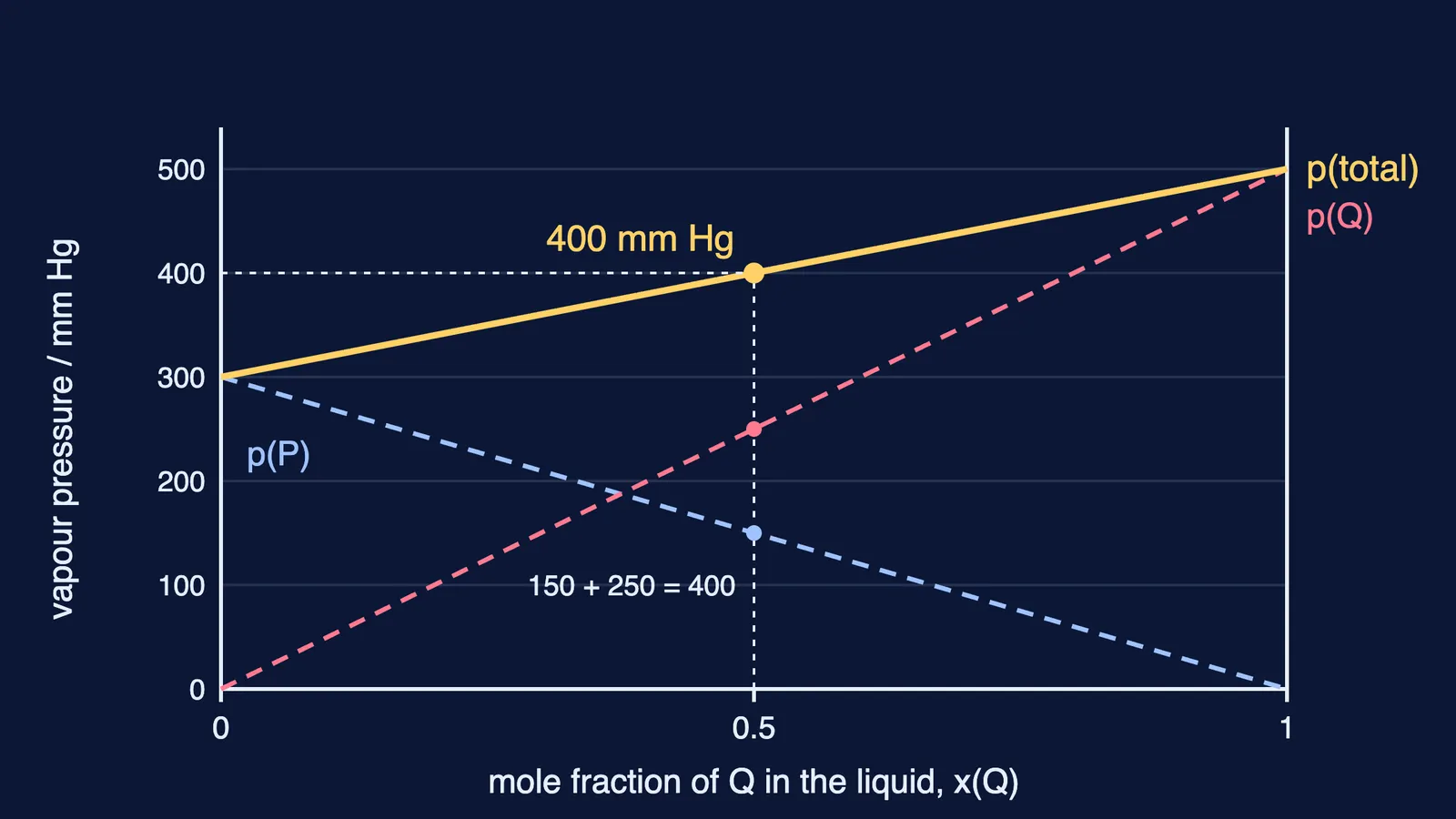
Q10 (hard). Statement I: An equimolar ideal mixture of liquids P (pure vapour pressure 300 mm Hg) and Q (500 mm Hg) has a total vapour pressure of 800 mm Hg. Statement II: A solution showing a large positive deviation from Raoult's law forms a maximum boiling azeotrope.
Answer: (B). Both are incorrect. By Raoult's law the total is 0.5 × 300 + 0.5 × 500 = 400 mm Hg. A large positive deviation gives a minimum boiling azeotrope. Trap: adding the pure vapour pressures without the mole fractions.
How should you use this set?
Do all ten in 12 minutes without notes, marking T or F on each line first.
Sort each miss: a wrong fact (fix it in NCERT) or a wrong link (use the counter-example test).
Redo the misses two days later.
If a miss comes from a gap in the idea, such as why a non-volatile solute lowers vapour pressure, the Fermi Concept Library has every concept in chemistry with its own lesson. For more on the format itself, read our assertion-reason strategy.


