On this page
Most NEET Solutions questions test one habit: counting particles correctly. These 8 original questions, easy to hard, target the usual slips: a missing van't Hoff factor, Raoult's law read the wrong way round, two constants swapped.
The NEET (UG)-2026 syllabus notified by the National Medical Commission lists Solutions as Unit 5 of Physical Chemistry. Every question stays inside that list and inside NCERT Class 12 Chemistry, Unit 1 Solutions (Reprint 2026-27). Constants are from NCERT Table 1.3: Kf (water) = 1.86 K kg mol⁻¹, Kb (water) = 0.52 K kg mol⁻¹ and Kf (benzene) = 5.12 K kg mol⁻¹.
How should you use this Solutions practice set?
Cover the answers and time yourself on each question.
Before you touch a number, write the formula and the value of i you will use.
Read the trap even when you got it right, and redo missed questions a few days later.
For the full chapter plan, read how to prepare Solutions for NEET.
Easy: can you handle concentration and deviations?
Q1 (easy). 4.5 g of glucose (M = 180 g mol⁻¹) is dissolved in 125 g of water. What is the molality of the solution?
(A) 0.025 mol kg⁻¹ (B) 0.20 mol kg⁻¹ (C) 2.0 × 10⁻⁴ mol kg⁻¹ (D) 0.036 mol kg⁻¹
Answer: (B). Moles of glucose = 4.5/180 = 0.025 mol, and the solvent mass is 0.125 kg, so m = 0.025/0.125 = 0.20 mol kg⁻¹. Trap: (C) divides by 125 instead of 0.125, forgetting that molality is per kilogram of solvent.
Q2 (easy). Which pair of liquids forms a solution with negative deviation from Raoult's law?
(A) Ethanol and acetone (B) Carbon disulphide and acetone (C) Chloroform and acetone (D) Benzene and toluene
Answer: (C). NCERT explains that chloroform forms a hydrogen bond with acetone, so the A-B attraction is stronger than A-A or B-B and the vapour pressure falls below the Raoult value. Trap: (A) looks like a hydrogen-bonding pair, but acetone breaks the hydrogen bonds between ethanol molecules, which gives a positive deviation.
Q3 (easy). An aqueous solution of a non-volatile solute freezes at −0.465 °C. At what temperature does it boil at 1.013 bar? (Pure water boils at 373.15 K.)
(A) 374.81 K (B) 373.62 K (C) 373.41 K (D) 373.28 K
Answer: (D). ΔTf = Kf × i m, so i m = 0.465/1.86 = 0.25 mol kg⁻¹. Then ΔTb = 0.52 × 0.25 = 0.13 K, and the solution boils at 373.28 K. Trap: (A) swaps the two constants, giving a rise of 1.66 K.
Medium: can you link vapour, osmosis and the van't Hoff factor?
Q4 (medium). Liquids P and Q form an ideal solution. At a fixed temperature, p°(P) = 240 mm Hg and p°(Q) = 90 mm Hg. A mixture of the two has a total vapour pressure of 150 mm Hg. What is the mole fraction of P in the vapour?
(A) 0.40 (B) 0.36 (C) 0.64 (D) 0.60
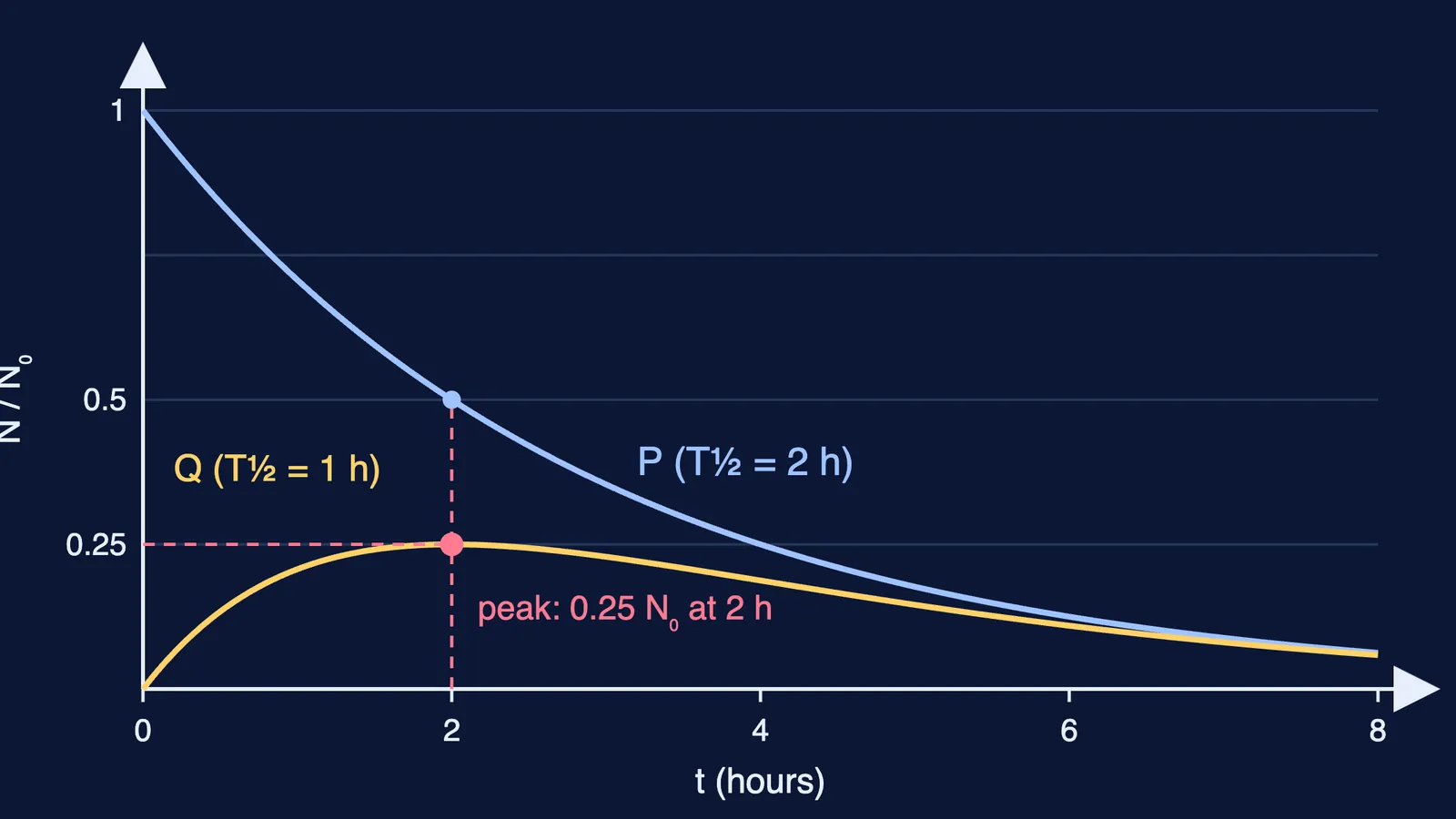
Answer: (C). From p = p°(Q) + [p°(P) − p°(Q)]x(P), 150 = 90 + 150x(P), so x(P) = 0.40 in the liquid. Then p(P) = 0.40 × 240 = 96 mm Hg, and y(P) = 96/150 = 0.64. Trap: (A) is the liquid composition, not the vapour.
Q5 (medium). At the same temperature, a 3.42% (mass/volume) solution of sucrose (M = 342 g mol⁻¹) is isotonic with a 1.2% (mass/volume) solution of a non-electrolyte Y. What is the molar mass of Y?
(A) 120 g mol⁻¹ (B) 285 g mol⁻¹ (C) 975 g mol⁻¹ (D) 60 g mol⁻¹
Answer: (A). Isotonic solutions of non-electrolytes have equal molar concentrations. Sucrose: 34.2 g L⁻¹ ÷ 342 = 0.10 mol L⁻¹. For Y, 12 g L⁻¹ ÷ 0.10 mol L⁻¹ = 120 g mol⁻¹. Trap: (C) sets up the ratio upside down; (D) wrongly gives sucrose i = 2.
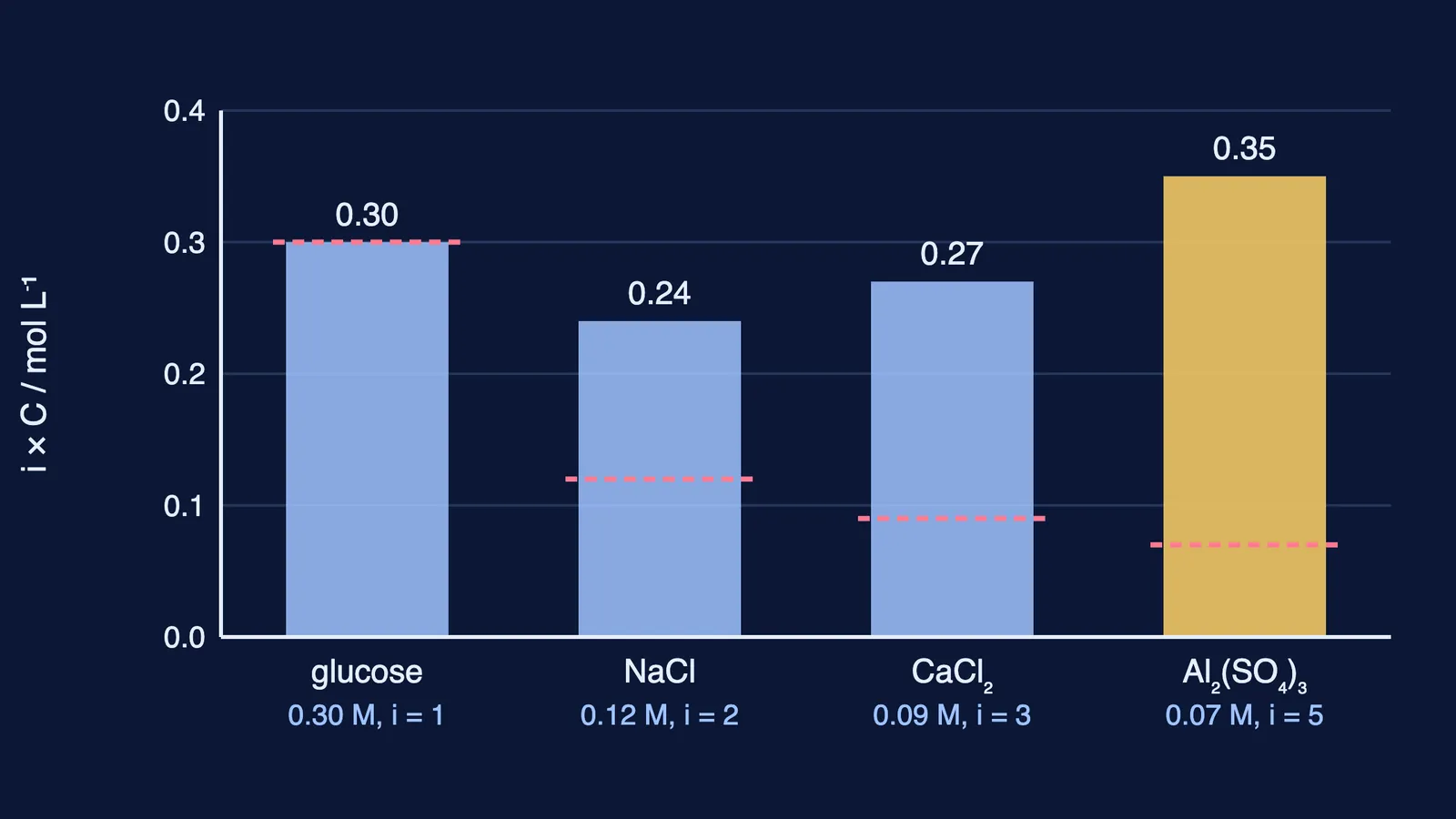
Q6 (medium). Assuming complete dissociation of the salts, which aqueous solution has the highest osmotic pressure at the same temperature?
(A) 0.30 M glucose (B) 0.12 M NaCl (C) 0.09 M CaCl₂ (D) 0.07 M Al₂(SO₄)₃
Answer: (D). Since π = iCRT, compare i × C: glucose 1 × 0.30 = 0.30, NaCl 2 × 0.12 = 0.24, CaCl₂ 3 × 0.09 = 0.27, and Al₂(SO₄)₃ 5 × 0.07 = 0.35 mol L⁻¹. Trap: (A) has the largest molarity, but glucose does not dissociate.
Hard: can you handle association and a second vaporisation?
Q7 (hard). An organic acid HX (M = 74 g mol⁻¹) dimerises in benzene. A solution of 1.48 g of HX in 40 g of benzene shows a freezing point depression of 1.664 K. What percentage of HX is associated?
(A) 35% (B) 70% (C) 65% (D) 30%
Answer: (B). Molality = (1.48/74)/0.040 = 0.50 mol kg⁻¹, so with no association ΔTf would be 5.12 × 0.50 = 2.56 K. Then i = 1.664/2.56 = 0.65. For 2HX ⇌ (HX)₂, i = 1 − α/2, so α = 2(1 − 0.65) = 0.70. Trap: (A) takes 1 − i as the answer, forgetting that two molecules make one dimer.
Q8 (hard). Liquids A and B form an ideal solution, with p°(A) = 360 mm Hg and p°(B) = 120 mm Hg at a fixed temperature. The vapour above a liquid with x(A) = 0.25 is collected and condensed completely. What is the total vapour pressure of this condensed liquid at the same temperature?
(A) 180 mm Hg (B) 300 mm Hg (C) 240 mm Hg (D) 480 mm Hg
Answer: (C). Over the first liquid, p(A) = 0.25 × 360 = 90 and p(B) = 0.75 × 120 = 90 mm Hg, so y(A) = 90/180 = 0.50. The condensate has x(A) = 0.50, so its vapour pressure is 0.50 × 360 + 0.50 × 120 = 240 mm Hg. Trap: (A) is the vapour pressure of the original liquid.
What should you do after this set?
Sort every miss into one bin: units, a missing or wrong i, or liquid versus vapour.
In every Raoult's law question, circle whether it asks for x (liquid) or y (vapour).
For more practice on a weak step, the Fermi Problem Library has worked problems with a step-by-step solver that explains the reasoning rather than printing an answer.
For the board exam, see Solutions Class 12: board answers and a plan. Our physical chemistry numericals plan for NEET places this chapter among the others.