On this page
Shaping Materials is Chapter 5 of Kaushal Vikas, the NCERT Class 9 skill education textbook (book code 0916, First Edition, April 2026). It opens Unit II, Work with Machines and Materials, and is mandatory whichever vocation your group picks. These notes follow the NCERT chapter.
What does Shaping Materials cover in Class 9?
The chapter traces how raw material becomes a product:
Why it matters: standard-size Harappan bricks and the fourth-century CE iron pillar in Delhi's Qutub Minar complex. The chapter cites National Accounts Statistics 2025 for one figure: manufacturing makes up roughly 17–18 per cent of Gross Value Added in India (NCERT chapter).
Value addition: each step, such as cotton to fabric to garment, raises the material's worth.
Common processes: shared by fabric, wood, metal, plumbing and construction.
Choosing materials: by properties such as hardness, thermal conductivity, corrosion resistance and water resistance.
Three basic skills: safety protocols, measurement and technical drawing.
What are the common processes for shaping materials?
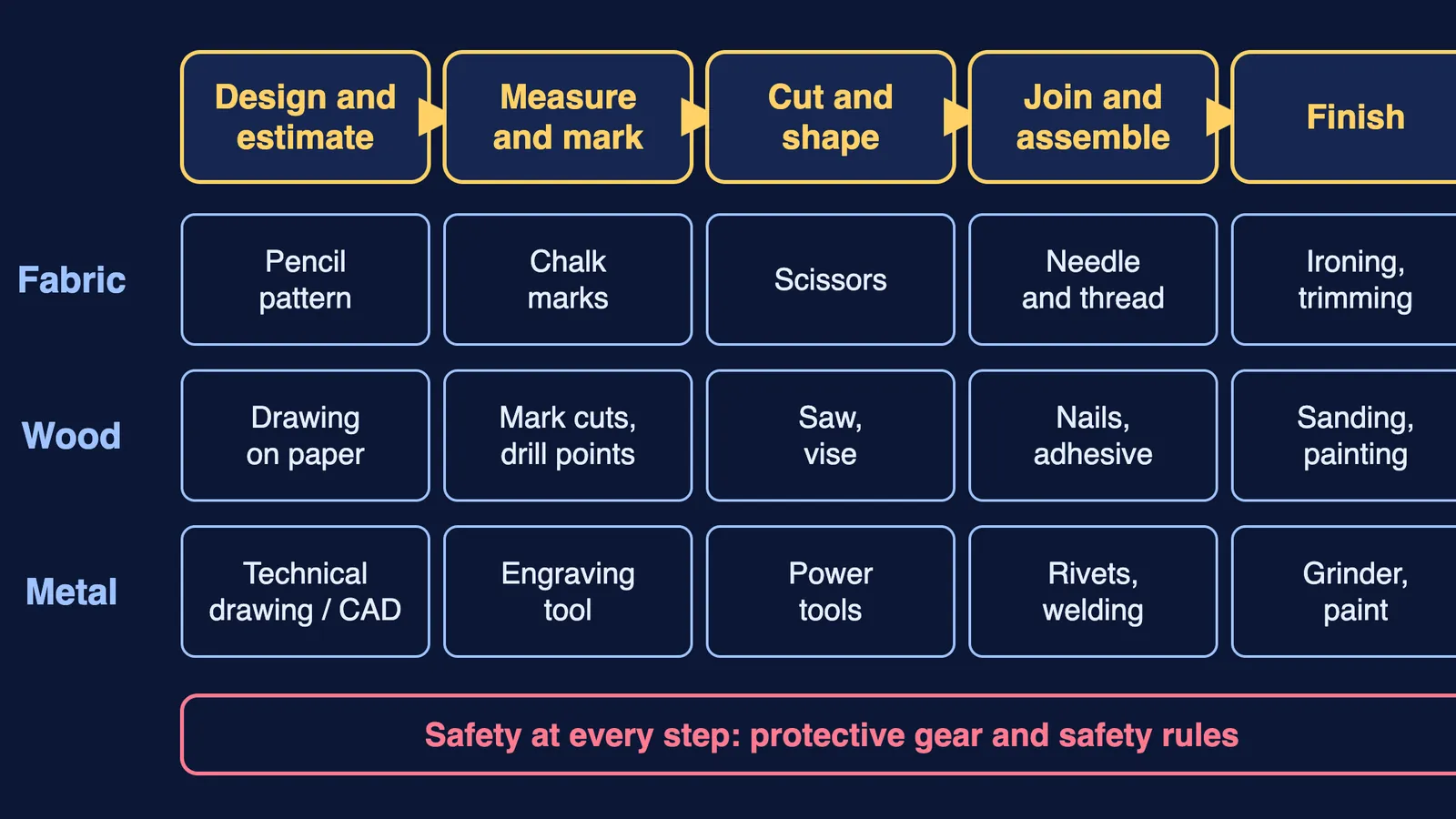
The chapter's Figure 5.3 gives five steps, shown in the diagram above: design and estimate, measure and mark, cut and shape, join and assemble, and finish. Only the tools change: chalk and scissors for fabric, a vise and saw for wood, rivets or welding for metal. Safety runs through every step.
Material matters too. Steel or aluminium suits a cooking pot because it takes high heat, while plastic melts. Clay has two uses: shaped soft for craft, or moulded, dried and fired into pots and bricks.
How do safety signs and measuring tools work?
Safety sign colours in the book: red for fire and prohibition, yellow for warnings and physical hazards, blue for mandatory actions such as wearing a helmet, and green for guidance and safe conditions such as an emergency exit.
Least count is the smallest value an instrument measures accurately. Tolerance is the error you can allow. The book's figures (NCERT chapter):
Vernier callipers: least count 0.02 mm, for the diameter or thickness of small objects.
Metre scale (objects under a metre) and metre tape (larger or curved objects): least count 1 mm.
Joining two pipes needs very low tolerance, so a metre scale's 1 mm is too coarse and vernier callipers fit. Cutting cloth for a bag allows more error, so a metre tape is enough. When you measure cloth, keep it straight with no sag (the book's Table 5.5 prints "slag"; "sag" is the intended word).
How do you read and make a technical drawing?
A technical drawing records dimensions and materials so every copy of a product matches. One view hides a dimension, so you draw the front, top and side. This is projection. In construction, the top view is the plan and the front view is the elevation.
A scale written 1:XX means 1 unit on paper stands for XX units in real life; the scale sits in the title box.
Worked example (our numbers). A shoe rack is 80 cm wide, 30 cm deep and 45 cm tall.
At 1:10, divide each size by 10: 80 ÷ 10 = 8 cm, 30 ÷ 10 = 3 cm, 45 ÷ 10 = 4.5 cm on paper.
Estimate board for three shelves (80 × 30 cm) and two sides (45 × 30 cm): 3 × 2400 + 2 × 1350 = 7200 + 2700 = 9900 cm², or 0.99 m².
Reading the other way, a room drawn 9 cm by 7 cm at 1:50 is 9 × 50 = 450 cm and 7 × 50 = 350 cm, so 4.5 m by 3.5 m.
For area practice, see Math of Space in Class 9 Ganita Manjari; for units, Class 9 Exploration Chapter 1.
How is Kaushal Vikas assessed in Class 9?
Kaushal Vikas is assessed in school. The CBSE assessment guidelines for 2026-27 give the weightage as: paper-pencil test 40 per cent, demonstration and oral presentation or viva voce 20 per cent, site visit report or observation notes 10 per cent, portfolio 20 per cent and teachers' observations 10 per cent. The recommended 40-mark test has objective (8), short answer (12), scenario- or case-based (16) and reflective or decision-making (4) sections. These are whole-subject figures for a school-assessed subject; no chapter has its own marks (general guide: internal assessment marks and projects).
The CBSE 2026-27 curriculum does not name the textbook; this chapter maps to its "Introduction to Vocational Area" theme for Work with Machines and Materials (suggested 10 hours): properties of materials, technical drawing, measurement and quality criteria.
Practice questions (mark labels are our suggestion):
Arrange in order: join and assemble, measure and mark, finish, design and estimate, cut and shape. (1 mark)
A drawing at 1:20 shows a table top 6 cm by 4 cm. Find its real size. (2 marks)
Which safety sign colour would you use for "Wear ear protection", and why? (2 marks)
Your group must make a planter for a sunny, rainy balcony. Compare wood and clay using two properties each, and choose one. (4 marks)
Not sure where to start with scale questions? Fermi's AI tutor works out what you already know and builds a plan for the session.