On this page
Chapter 1 of Exploration, NCERT's new Class 9 science textbook, may surprise you. It is a seven-page guide to how science works, with no formulas to learn, and it sets up habits the later chapters use. The book is a first edition dated April 2026 (NCERT, Exploration prelims), and CBSE's 2026-27 Class IX curriculum is built on its chapters. Our guide to the new NCERT Class 9 books covers the rest. The old Class 9 course had no chapter like this: the CBSE 2025-26 syllabus opened straight with Matter in Our Surroundings.
What is Chapter 1 of the new Class 9 science book about?
The chapter (NCERT, Chapter 1 PDF) makes six ideas:
Models. A model is a simplified picture of a real system that keeps only what matters for your question. A moving car becomes a point; a falling stone ignores air resistance. Leaving details out on purpose is not a mistake.
Precise language. Words such as force, work and cell mean something narrower in science. Quantities get symbols and agreed units.
Maths as a language. An equation is a short statement of how quantities are related; understand the situation before picking one.
Laws, theories and principles. A law describes a regular pattern. A theory explains why the pattern happens, using evidence. A principle is a broad idea you apply, such as conservation of energy.
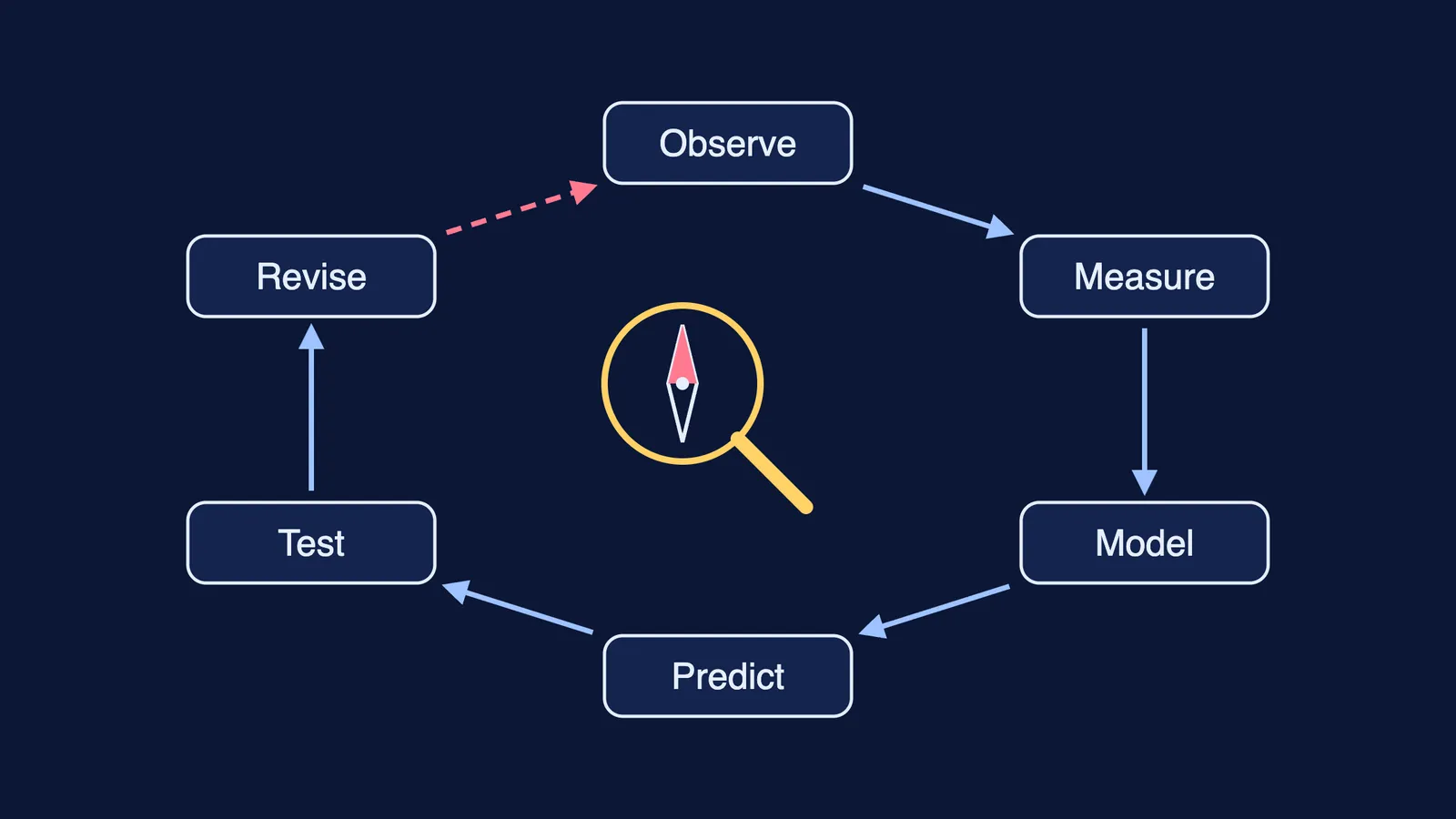
Prediction and correction. Good theories let you predict before you experiment. When a prediction fails, scientists recheck assumptions, models and measurements, and change ideas only on evidence.
Estimation. A rough number tells you quickly whether an answer is sensible or impossible.
The book's page numbers sit inside a magnifying glass (careful observation) and a compass (direction: the right model, and knowing where it stops working). The chapter ends by asking you to look through the "magnifying glass of evidence".
Why do units matter so much in science?
The chapter tells of a passenger aircraft that ran out of fuel in mid-air because the ground crew used a density in pounds per litre instead of kilograms per litre. It needed 22,300 kg of fuel and ended up about 15,000 litres short (NCERT, Chapter 1). Here is a simplified version, with an illustrative fuel density.
Suppose the fuel's density is 0.8 kg per litre. Fuel needed: 22,300 ÷ 0.8 = 27,875 litres.
One pound is about 0.4536 kg (NIST conversion table), so 0.8 kg per litre ≈ 0.8 ÷ 0.4536 ≈ 1.764 lb per litre.
If someone reads 1.764 as kilograms per litre, they load 22,300 ÷ 1.764 ≈ 12,640 litres.
Shortfall: 27,875 − 12,640 ≈ 15,230 litres, close to the chapter's 15,000.
The number was right; its unit was wrong. Write units beside every number and the mistake shows itself: kg divided by lb per litre is not litres.
How do you make a good rough estimate?
The chapter's strategy: understand the situation, pick the quantities that matter, then estimate. Try a question of your own. How many pages will you fill in science notebooks this year? Guess pages per class, classes per week and school weeks, multiply, and ask whether the answer looks like one notebook or fifty.
If unit slips are your usual problem, the Fermi Problem Library has worked problems with a step-by-step solver that explains the reasoning rather than printing an answer.
Is Chapter 1 in the CBSE 2026-27 Class 9 exam?
Not directly. The CBSE 2026-27 Class IX science curriculum splits the 80-mark theory paper into four units built from Chapters 2 to 13: World of Living (27 marks), Matter: Its Nature and Behaviour (25), Motion, Force, Work and Sound (23) and Earth as a System (5). Internal assessment adds 20. Chapter 1 is not in any unit.
Its skills are tested all the same. The curriculum gives 20% of the theory paper to formulating, analysing, evaluating and creating, and asks students to build models and predict results. Whether schools use Chapter 1 in internal assessment is not stated; ask your teacher. Read where Class 9 marks matter and where they don't.
What are the common mistakes, and how should you practise?
Calling a theory a guess. It is a tested explanation that can still improve.
Thinking a model is wrong because it ignores things.
Mixing up a law (what happens) with a theory (why).
Dropping units halfway through a sum.
Practice questions written for this post, not from the textbook:
To model how long a ball takes to roll down a ramp, list three details to keep and three to ignore.
Classify each as law, theory or principle: an explanation of why gases spread out; a rule that the total energy in a closed system stays the same; a pattern linking force and acceleration.
A friend says a lucky pen improves marks. Write two measurable questions to test this.
Answers to check for 2: a theory, a principle (the book's example; often also called a law), a law.
You will use these habits in the lab too: see how to record and draw Class 9 science practicals.