On this page
This glossary covers Chapter 1 of the NCERT Class 12 Biology textbook (Reprint 2026-27), which is in the CBSE 2026-27 Biology syllabus.
What are the key terms for the stamen and pollen grain?
Source: NCERT section 1.2.1.
Anther: the usually two-lobed head of a stamen. Each lobe has two thecae (dithecous), so a typical anther holds four microsporangia, two per lobe.
Tapetum: the innermost of the four wall layers around a microsporangium; it nourishes the developing pollen. Don't confuse with: endothecium, an outer layer that protects and helps the anther split open.
Microsporogenesis: meiosis in a pollen mother cell, giving a tetrad of four haploid microspores. Don't confuse with: megasporogenesis, which happens in the ovule.
Pollen grain: the male gametophyte, generally spherical and about 25-50 micrometres across.
Exine: the hard outer pollen wall, made of sporopollenin, which no known enzyme breaks down. Gaps without sporopollenin are germ pores. Don't confuse with: intine, the thin inner wall of cellulose and pectin.
Generative cell: the small, spindle-shaped cell of a mature pollen grain that divides by mitosis to form two male gametes. Don't confuse with: vegetative cell, the larger cell with the food reserve. Most flowering plants (more than 60 per cent) shed pollen while it is still 2-celled.
What are the parts of an ovule and embryo sac?
Source: NCERT section 1.2.2.
Syncarpous: a gynoecium whose several pistils are fused, as in Papaver. Don't confuse with: apocarpous, where the pistils stay free, as in Michelia.
Ovule (megasporangium): the structure inside the ovary that becomes a seed. It hangs from the placenta by a stalk, the funicle; the hilum is where the two meet.
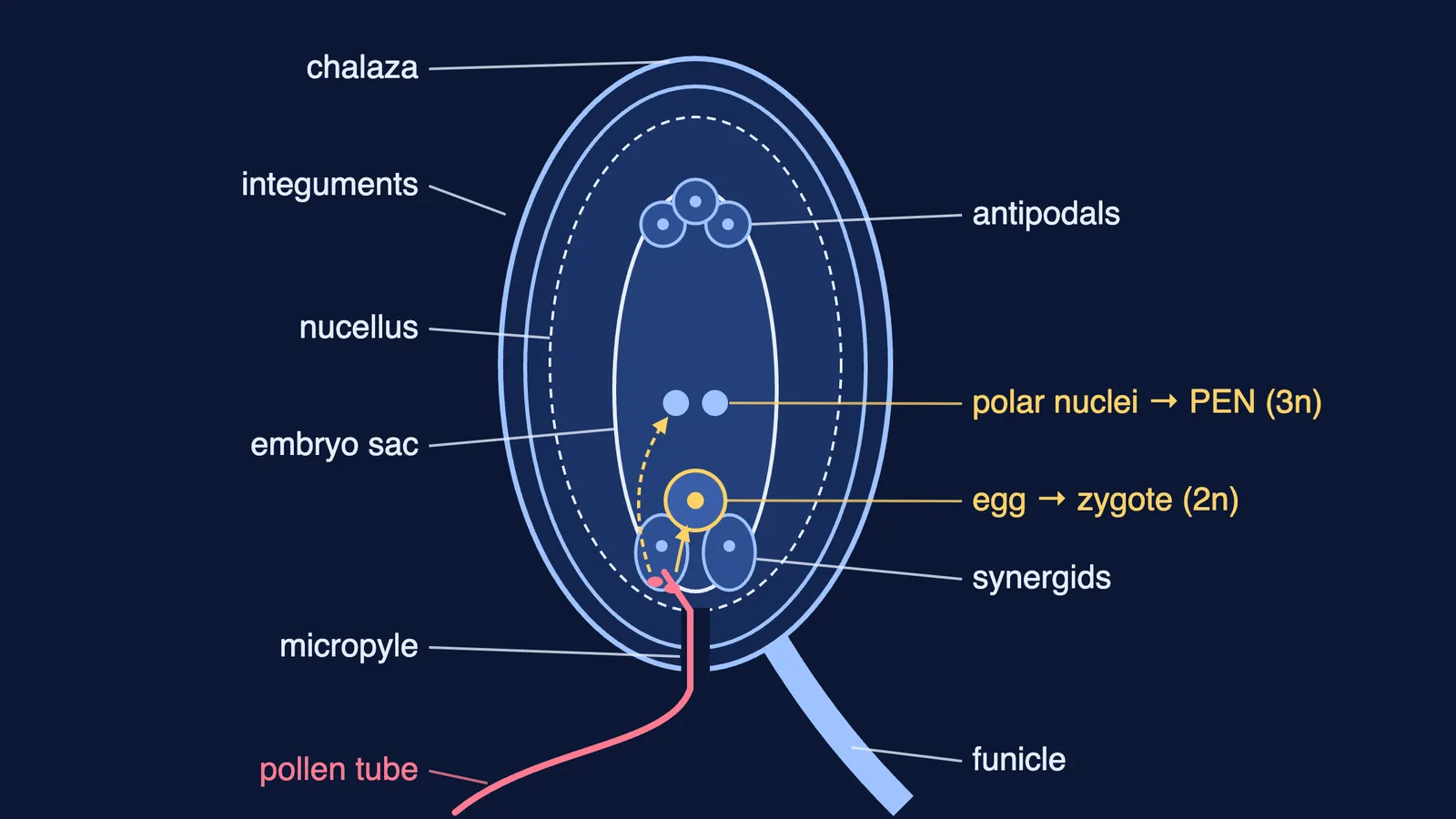
Integuments: one or two protective coats around the ovule, open only at the tip as the micropyle. Don't confuse micropyle with: chalaza, the base of the ovule at the opposite end.
Nucellus: the food-rich tissue inside the integuments that holds the embryo sac.
Megasporogenesis: meiosis in the megaspore mother cell, giving four megaspores.
Monosporic development: forming the embryo sac from just one functional megaspore while the other three degenerate.
Embryo sac: the female gametophyte. Three rounds of free-nuclear mitosis give 8 nuclei, which organise into 7 cells, including a large central cell with two polar nuclei.
Egg apparatus: the three cells at the micropylar end, two synergids and one egg. Don't confuse with: antipodals, the three cells at the chalazal end.
Filiform apparatus: thickenings at the micropylar tip of the synergids that guide the pollen tube in.
What are the types of pollination?
Source: NCERT section 1.2.3.
Autogamy: pollen reaches the stigma of the same flower.
Geitonogamy: pollen reaches another flower on the same plant. It needs a pollinating agent, but genetically it is like autogamy. Don't confuse with: xenogamy, pollen from a different plant, the only type that brings genetically different pollen.
Cleistogamous flowers: flowers that never open, so they are always self-pollinated and set seed without pollinators. Viola, Oxalis and Commelina bear these alongside normal flowers. Don't confuse with: chasmogamous flowers, which open normally.
Self-incompatibility: a genetic block that stops pollen from the same plant germinating or growing a tube in the pistil.
Monoecious: male and female flowers on the same plant, like castor and maize; it prevents autogamy but not geitonogamy. Don't confuse with: dioecious, separate male and female plants, like papaya, which prevents both.
Pollen-pistil interaction: every event from pollen landing on the stigma to the pollen tube entering the ovule.
Emasculation: removing anthers from a flower bud before they burst, in artificial hybridisation. Don't confuse with: bagging, covering the flower with a bag, often of butter paper, to keep out unwanted pollen.
What happens in double fertilisation?
Source: NCERT section 1.3.
Syngamy: one male gamete fuses with the egg, giving the diploid zygote.
Triple fusion: the other male gamete fuses with the two polar nuclei, giving the triploid primary endosperm nucleus (PEN).
Double fertilisation: syngamy and triple fusion together in one embryo sac, an event unique to flowering plants.
Seed, fruit and special-mode terms
Source: NCERT sections 1.4 and 1.5.
Endosperm: triploid food tissue formed from the primary endosperm cell, before the embryo starts developing. Example: tender coconut water is free-nuclear endosperm; the white kernel is cellular endosperm.
Epicotyl: the embryo axis above the cotyledons, ending in the plumule. Don't confuse with: hypocotyl, the axis below, ending in the radicle.
Coleoptile: the hollow sheath around the shoot apex in a grass embryo. Don't confuse with: coleorrhiza, the sheath around the radicle and root cap.
Albuminous seed: a seed that keeps some endosperm, like wheat, maize, castor. Don't confuse with: non-albuminous seed, where the embryo uses it all up, like pea, groundnut.
Perisperm: leftover nucellus in a mature seed, as in black pepper and beet. Don't confuse with: pericarp, the fruit wall formed from the ovary wall.
False fruit: a fruit where the thalamus also forms part of it, as in apple, strawberry and cashew.
Parthenocarpy: fruit formation without fertilisation, giving seedless fruits like banana.
Apomixis: seed formation without fertilisation, an asexual process that mimics sexual reproduction; seen in some Asteraceae and grasses.
Polyembryony: more than one embryo in a seed, as in many Citrus and mango varieties where nucellar cells grow into extra embryos.
How to learn these terms
Draw the ovule from memory, then label micropyle, chalaza, integuments, nucellus and all 7 cells of the embryo sac. Count nuclei and cells separately (8 and 7).
Make each "Don't confuse with" pair a flashcard. NCERT Exercise 13 asks you to differentiate four pairs: epicotyl and hypocotyl, coleoptile and coleorrhiza, perisperm and pericarp, and integument and testa (integuments harden into the seed coat).
Trace one line from sporogenous tissue to pollen mother cell, microspore tetrad, pollen grain and male gametes. Exercise 3 in the same chapter asks for this order.
If a term feels abstract, the Fermi Concept Library gives each biology concept its own lesson. Once the vocabulary is steady, put it to work in the Class 12 board exam guide to sexual reproduction in flowering plants, follow our Sexual reproduction in flowering plants for NEET: how to prepare plan, and test it with these sexual reproduction in flowering plants practice questions with solutions.