On this page
This chapter rewards neat, exact answers more than long ones.
How many marks is this chapter worth in the board exam?
The CBSE 2026-27 Biology curriculum gives Unit VI, Reproduction, 16 marks out of 70 in the Class XII theory paper (CBSE curriculum PDF). Sexual Reproduction in Flowering Plants shares those 16 marks with Human Reproduction and Reproductive Health; no chapter-wise split is given.
In the 2026-27 sample paper it appears as Q1 (1 mark, pistil maturing first), Q17 (2 marks, geitonogamy or hybrid seed) and Q23 (3 marks, a fertilised embryo sac) (sample paper).
Which diagrams and definitions should you learn?
Learn three diagrams from the NCERT chapter (Reprint 2026-27):
Anther T.S. (Figure 1.3): wall layers, outside in: epidermis, endothecium, middle layers, tapetum (which nourishes the pollen).
Embryo sac (Figure 1.8c): egg and two synergids at the micropylar end, three antipodals at the chalazal end, two polar nuclei in the central cell: 7-celled, 8-nucleate.
L.S. of pistil (Figure 1.12c): stigma, style, ovary, ovule and the pollen tube's path.
Then one-line definitions:
Microsporogenesis: a pollen mother cell forms a microspore tetrad by meiosis.
Megasporogenesis: the megaspore mother cell forms four megaspores by meiosis; usually one survives to form the embryo sac.
Pollination types: autogamy (same flower), geitonogamy (another flower, same plant; genetically like autogamy) and xenogamy (a different plant; the only type bringing genetically different pollen).
Outbreeding devices: unsynchronised pollen release and stigma receptivity, separated anther and stigma, self-incompatibility, unisexual flowers. Monoecy (castor, maize) stops autogamy, not geitonogamy; dioecy (papaya) stops both.
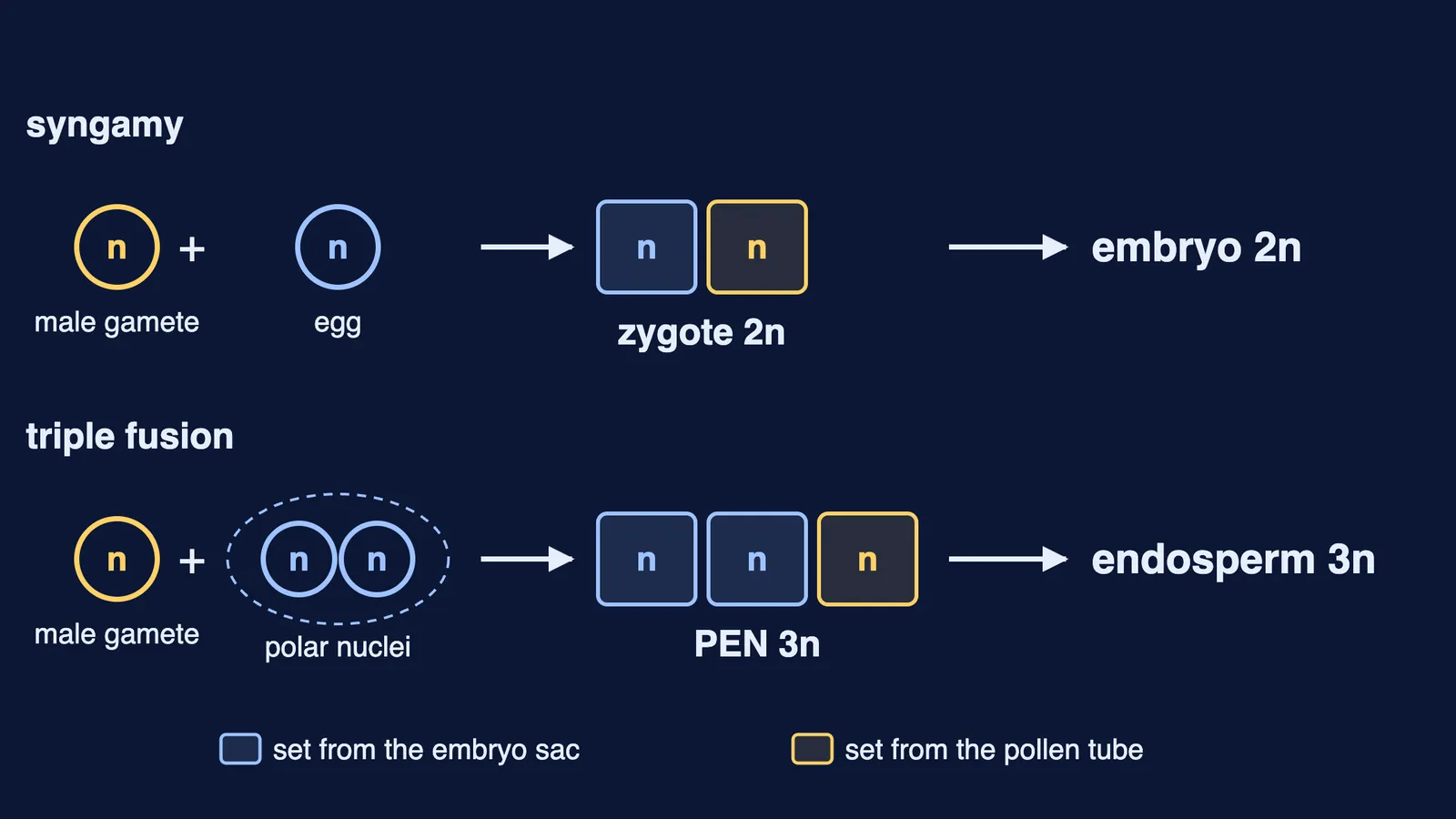
Double fertilisation: syngamy (male gamete + egg = diploid zygote) plus triple fusion (male gamete + two polar nuclei = triploid PEN).
Endosperm and embryo: endosperm develops first, usually free-nuclear then cellular (tender coconut water is free-nuclear); the dicot embryo goes proembryo, globular, heart-shaped, mature.
Seed and fruit: integuments become seed coats; the ovary wall becomes the pericarp. Albuminous seeds keep endosperm (wheat, maize, barley, castor); non-albuminous seeds do not (pea, groundnut). Persistent nucellus is perisperm (black pepper, beet).
Apomixis: seeds without fertilisation (some Asteraceae and grasses). Polyembryony: two or more embryos in one seed (many Citrus and mango varieties).
How do you set out 2-, 3- and 5-mark answers?
The 2026-27 marking scheme gives one mark per idea (marking scheme). Q17A earns one mark for defining geitonogamy and one for saying it is genetically like autogamy.
2 marks: definition, then the twist being tested.
3 marks: three labelled points, such as a name, its ploidy and a reason.
5 marks: none in the 2026-27 sample paper, but if one comes (say, embryo sac development), give a definition, a labelled diagram, numbered steps and one line on significance.
If time runs short, use our 20-minute triage plan for a board paper.
Worked example: can you work back from an endosperm cell?
Question (our own): an endosperm cell has 27 chromosomes. Give the number in a leaf cell, synergid, male gamete, zygote, seed coat, pericarp and a nucellar embryo.
Method 1, from origins. Endosperm is 3n, so n = 27 ÷ 3 = 9 and 2n = 18. Synergid and male gamete descend from meiosis products: 9. Zygote: 18. Seed coat (integuments) and pericarp (ovary wall) are parent tissue: 18. A nucellar embryo copies the parent: 18.
Method 2, independent check by building forward. Egg 9 + male gamete 9 = 18, matching the leaf cell. Two polar nuclei 9 + 9 plus a male gamete 9 = 27, matching the given cell. Endosperm to embryo, 27 : 18, is 3 : 2, as 3n : 2n must be.
Our NEET guide to this chapter works forward from 2n = 24. The Fermi Problem Library has worked problems with a step-by-step solver that explains the reasoning rather than printing an answer.
What assertion-reason and case-study traps catch students?
Sample-paper assertion-reason options run from A (both true, R explains A) to D (A false, R true). Two of our own:
A: Geitonogamy brings genetically different pollen to the stigma. R: Geitonogamy needs a pollinating agent. Answer D: the pollen is from the same plant.
A: Endosperm develops before the embryo. R: The primary endosperm nucleus is triploid. Answer B: both true, but the reason is assured nutrition for the embryo.
Case-study traps: swapping labelled structures (read which fusion makes each part), writing "diploid" when a chromosome number is asked, and calling perisperm endosperm.
What should your revision plan be?
Day 1: read NCERT; list every named example on one page.
Day 2: draw the three diagrams from memory; correct them in another colour.
Day 3: write each definition, then check against NCERT.
Day 4: make a ploidy table for a new 2n; check it both ways.
Day 5: write two assertion-reason items and one 3-mark answer.
Day 6: attempt Q1, Q17 and Q23 timed; mark them with the scheme.
If triple fusion stays fuzzy, the Fermi Concept Library has every concept in physics, chemistry, biology, mathematics and computing, each with its own lesson.