
On this page
Here are the key terms of Chapter 6 of the NCERT Class 11 Physics Part I textbook (Reprint 2026-27), with SI units, examples and mixed-up pairs. For a study plan, see our System of Particles and Rotational Motion Class 11 guide.
The CBSE Class XI Physics syllabus for 2026-27 asks for moment of inertia values of simple shapes with "no derivation". The current chapter has no section on rolling motion and no parallel or perpendicular axes theorems, so those are left out.
What kinds of motion can a rigid body have?
Rigid body: an ideal body whose particles never change their separations, whatever forces act.
Pure translational motion: every particle of the body has the same velocity at each instant. Example: a block sliding without turning.
Rotation about a fixed axis: each particle moves in a circle centred on, and perpendicular to, the axis. Example: a ceiling fan's blades.
Axis of rotation: the fixed line the body turns about; particles on it stay at rest. Example: the hinge line of a door.
Precession: the movement of a spinning top's axis around the vertical. Don't confuse with: the top's own spin.
What is the centre of mass of a system of particles?
Centre of mass (CM): the mass-weighted average position of all the particles; SI unit metre (m). Example: for a uniform thin rod, it is at the midpoint.
External force: a force from outside the system; only these change the CM's motion. Don't confuse with: internal forces, which come in equal and opposite pairs and cancel.
Motion of the centre of mass: the CM moves as if all the mass and all external forces were at that point (MA = F_ext). Example: when a projectile explodes mid-air, its fragments' CM stays on the original parabola.
Linear momentum of a system (P): the sum of all particles' momenta, P = MV; SI unit kg m/s. Constant when total external force is zero.
Vector product and angular kinematics
Vector (cross) product: a × b is a vector of size ab sin θ, perpendicular to both a and b, with direction from the right-hand rule. Don't confuse with: the dot product (a scalar).
Angular displacement (θ): the angle turned through; SI unit radian (rad).
Angular velocity (ω): the rate of change of angular displacement, a vector along the axis; SI unit rad/s. Every particle of a rigid body shares the same ω.
Angular acceleration (α): the rate of change of angular velocity; SI unit rad/s².
Linear velocity of a particle (v = ω × r): its size is ω times the perpendicular distance from the axis.
What is the difference between torque and angular momentum?
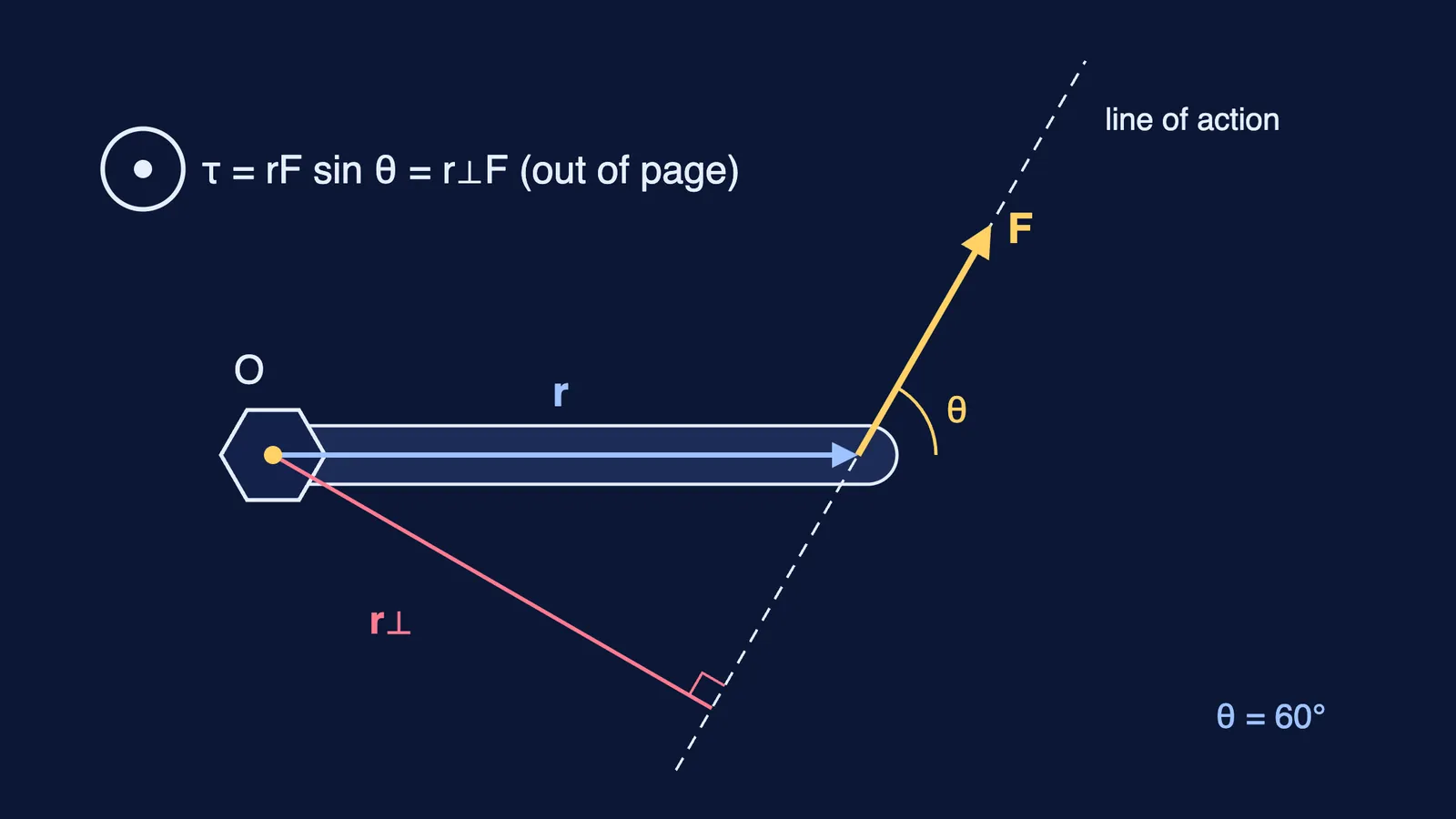
Torque (moment of force, τ): the turning effect of a force about an origin, τ = r × F, of size rF sin θ; SI unit newton metre (N m). Its direction is given by the right-hand rule: an anticlockwise turn in the page means torque out of the page. Example: a door turns most easily when pushed square-on at its outer edge. Don't confuse with: work, which has the same dimensions but is a scalar.
Line of action: the line along which a force acts. If it passes through the origin, the torque about it is zero.
Perpendicular distance (r⊥): the shortest distance from the origin to the line of action, r sin θ, so τ = r⊥F.
Angular momentum (l or L): the moment of linear momentum, l = r × p; SI unit kg m²/s. For a body turning about a fixed symmetry axis, L = Iω.
Conservation of angular momentum: when the total external torque is zero, L stays constant. Example: on a swivel chair, pulling your arms in speeds up your spin.
Equilibrium and levers
Translational equilibrium: the vector sum of external forces is zero.
Rotational equilibrium: the vector sum of external torques is zero.
Mechanical equilibrium: both conditions hold at once. A body can satisfy one without the other.
Couple: equal and opposite forces with different lines of action; zero net force, non-zero torque. Example: your fingers turning a bottle lid.
Fulcrum, load arm and effort arm: a lever's pivot, and the distances of the load and the effort from it.
Principle of moments: for a balanced lever, load arm × load = effort arm × effort. Example: a heavier child sits nearer a see-saw's pivot.
Mechanical advantage: load divided by effort (no unit); above 1 when the effort arm is longer than the load arm.
Centre of gravity (CG): the point about which the total gravitational torque on a body is zero. Don't confuse with: centre of mass; the two coincide in uniform gravity but can differ for a body so large that g varies across it.
Moment of inertia and rotational energy
Moment of inertia (I): the sum of each particle's mass times the square of its distance from the axis, I = Σmr²; SI unit kg m². It is the rotational counterpart of mass and depends on the axis chosen. Example: a thin ring about its central axis has I = MR²; a solid sphere about a diameter has 2MR²/5.
Radius of gyration (k): the distance from the axis at which the body's whole mass, placed as one point, would have the same I, so I = Mk²; SI unit m. Example: a thin rod about a perpendicular axis through its midpoint has k = L/√12.
Rotational kinetic energy: K = ½Iω²; SI unit joule (J).
Flywheel: a disc with a large moment of inertia in engines that resists sudden speed changes.
How to learn these terms
Build a two-column card pairing linear and rotational quantities: displacement with θ, velocity with ω, mass with I, force with τ (NCERT Table 6.2).
Redraw the spanner diagram above from memory, labelling r⊥.
Learn the confusable pairs together: centre of mass and gravity, torque and work, origin and axis.
Test yourself with application questions in our rotational motion case study questions for CBSE Class 11, and check symbols in our grouped rotational motion formulas. If an idea will not stick, look it up in the Fermi Concept Library, where each concept has its own lesson.