On this page
Below are the formulas of System of Particles and Rotational Motion, Chapter 6 of the NCERT Class 11 Physics Part I textbook (2026-27 reprint), grouped with SI units, conditions, an example and a pitfall. For a study plan, see our System of Particles and Rotational Motion Class 11 guide.
The CBSE Class XI Physics syllabus for 2026-27 lists moment of inertia values for simple shapes with "no derivation". The axis theorems and the rolling-motion section are not in the 2026-27 chapter (rolling appears only as an introductory example).
Centre of mass: what are the formulas?
Two particles on a line: X = (m1x1 + m2x2)/(m1 + m2) (m), masses in kg.
n particles: R = Σmiri/M (m), M = Σmi (kg), ri the position of particle i.
Continuous body: X = (1/M)∫x dm (m), likewise Y and Z.
Uniform thin rod of length L: centre of mass at L/2 from either end (m).
Centre-of-mass velocity: V = P/M (m/s), P = total momentum (kg m/s).
Motion of the centre of mass: MA = F_ext (N), A in m/s²; internal forces cancel.
If F_ext = 0, P = MV is constant (kg m/s).
Worked example: 2 kg at x = 0 and 3 kg at x = 1.5 m give X = (2 × 0 + 3 × 1.5)/5 = 0.9 m.
Watch for: measure every position, and X, from one origin.
Angular velocity and rotational kinematics
Cross product: |a × b| = ab sin θ (product of their units), direction by the right-hand rule.
Angular velocity: ω = dθ/dt (rad/s). Angular acceleration: α = dω/dt (rad/s²).
Linear velocity: v = ω × r, so v = ωr⊥ (m/s), r⊥ = distance from the axis (m).
Constant α, fixed axis (θ in rad, t in s):
ω = ω0 + αt (rad/s)
θ = θ0 + ω0t + ½αt² (rad)
ω² = ω0² + 2α(θ − θ0) (rad²/s²)
Worked example: a wheel at 10 rad/s accelerates at 2 rad/s² for 5 s. ω = 10 + 2 × 5 = 20 rad/s, and θ − θ0 = 10 × 5 + ½ × 2 × 5² = 75 rad (11.9 revolutions).
Watch for: rpm. Convert first: ω = 2π × (rev/min)/60.
Torque and angular momentum: how are they defined?
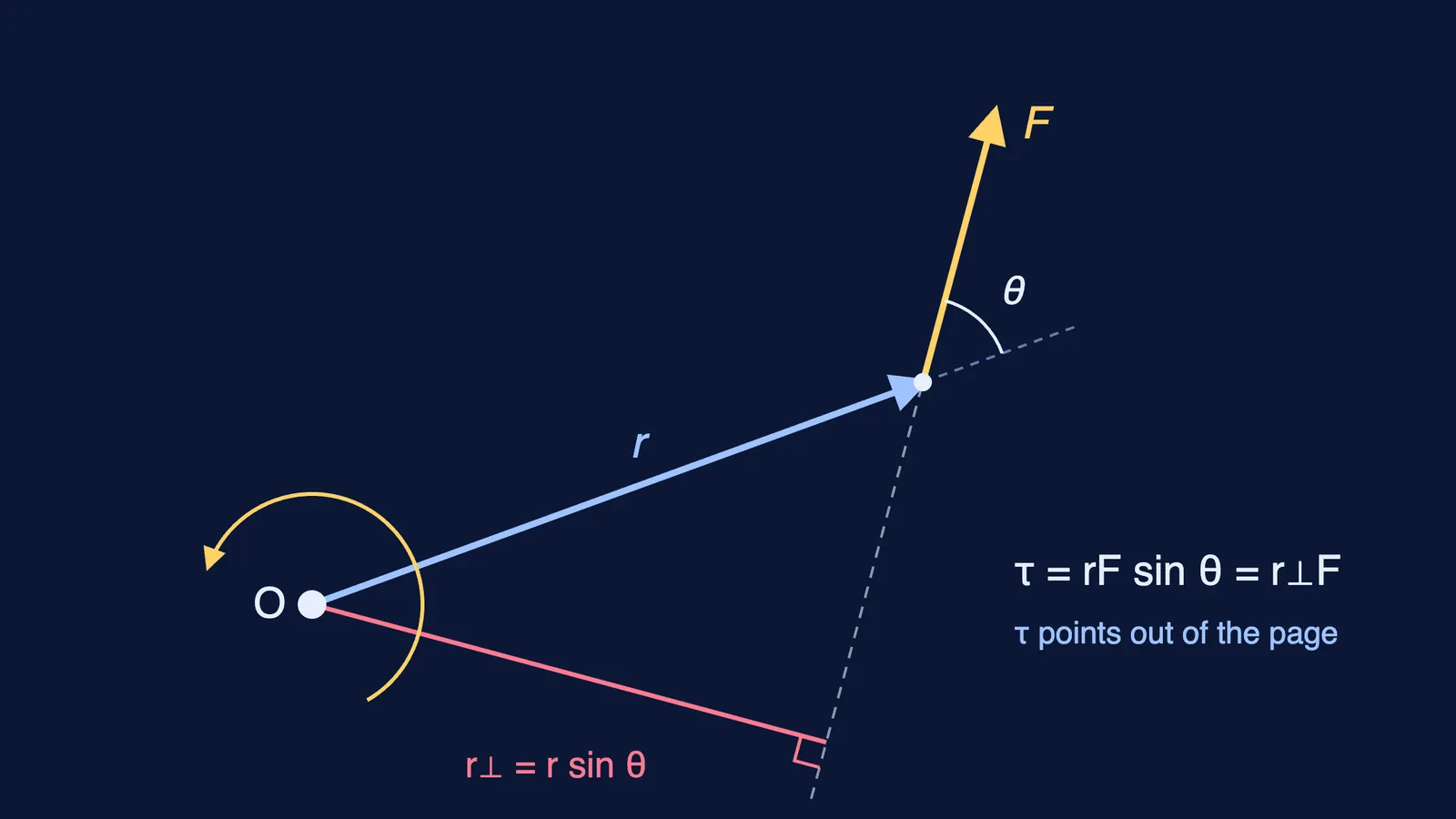
Torque about an origin: τ = r × F (N m), r in m, F in N.
Magnitude: τ = rF sin θ = r⊥F (N m), θ the angle between r and F; r⊥ = r sin θ is the lever arm (m).
Angular momentum of a particle: l = r × p, l = rp sin θ (kg m²/s), and dl/dt = τ.
System: L = Σri × pi and dL/dt = τ_ext (N m), assuming the third law and internal forces along the joining lines.
If τ_ext = 0, L is constant (kg m²/s).
Worked example: 40 N on the end of a 0.30 m spanner, at 30° to the handle: τ = 0.30 × 40 × sin 30° = 6.0 N m, lever arm 0.15 m.
Watch for: θ is the angle between r and F, not F and a surface.
Equilibrium of a rigid body
Equilibrium: ΣF = 0 (N) and Στ = Σri × Fi = 0 (N m).
Couple (F at B, −F at A): moment AB × F (N m), the same about any origin.
Principle of moments: d1F1 = d2F2 (N m), load arm × load = effort arm × effort.
Mechanical advantage: M.A. = F1/F2 = d2/d1 (no unit).
Centre of gravity: where the total gravitational torque is zero. If g is uniform, Σmiri = 0 (kg m) with ri measured from it, so it matches the centre of mass.
Worked example: a 600 N load 0.4 m from the fulcrum, effort 1.2 m away. Effort = 600 × 0.4/1.2 = 200 N; M.A. = 1.2/0.4 = 3.
Watch for: a couple has zero net force but non-zero torque, so ΣF = 0 alone is not equilibrium.
Moment of inertia and rotation about a fixed axis: which formulas apply?
Moment of inertia: I = Σmiri² (kg m²), ri the perpendicular distance from the axis (m).
Radius of gyration: I = Mk², so k = √(I/M) (m).
Values (no derivation), in kg m²:
Thin ring, perpendicular axis through centre: MR²
Thin ring, diameter: MR²/2
Thin rod of length L, perpendicular axis at midpoint: ML²/12, so k = L/√12
Circular disc, perpendicular axis through centre: MR²/2
Circular disc, diameter: MR²/4, so k = R/2
Hollow cylinder, own axis: MR²
Solid cylinder, own axis: MR²/2
Solid sphere, diameter: 2MR²/5
Rotational kinetic energy: K = ½Iω² (J).
Work and power: dW = τ dθ (J), P = τω (W).
Second law for rotation: τ = Iα (N m), for constant I about a fixed axis.
Angular momentum about the axis: Lz = Iω (kg m²/s); L = Iω if the axis is a symmetry axis.
Iω = constant (kg m²/s) if the external torque about the axis is zero.
Worked example: a 4 kg disc, radius 0.25 m, starts from rest under a 0.5 N m torque about its axis. I = ½ × 4 × 0.25² = 0.125 kg m², so α = 0.5/0.125 = 4 rad/s². After 3 s, ω = 12 rad/s and K = ½ × 0.125 × 12² = 9 J, matching the work τθ = 0.5 × 18 = 9 J.
Watch for: the axis. A disc about a diameter has half its I about the central perpendicular axis.
How to revise this formula sheet
Pair formulas with linear twins: F = Ma with τ = Iα, p = Mv with L = Iω, P = Fv with P = τω.
Write the axis beside each moment of inertia, never just "disc".
Check units: N m = kg m² × rad/s² (the radian is dimensionless).
Rework the steps with our rotational motion Class 11 derivations, then try the rotational motion case study questions for Class 11.
If the lever arm is hard to picture, the Fermi Simulation Lab has interactive simulations for ideas that are easier to see than to read.