

On this page
Three original cases, easiest first, each with four questions and worked answers. For theory and solved numericals, see our CBSE guide to System of Particles and Rotational Motion for Class 11.
What do these case-study questions cover?
Class 11 papers are set by schools, so treat these as case-based practice. Every case stays inside Chapter 6 of the CBSE Physics curriculum for 2026-27: centre of mass, torque, equilibrium of rigid bodies, moment of inertia (values, no derivation), equations of rotational motion and conservation of angular momentum. Moments of inertia come from Table 6.1 of the rationalised NCERT Physics Part I, Chapter 6 (Reprint 2026-27). Take g = 9.8 m/s².
Case 1: Two baskets on a shoulder pole
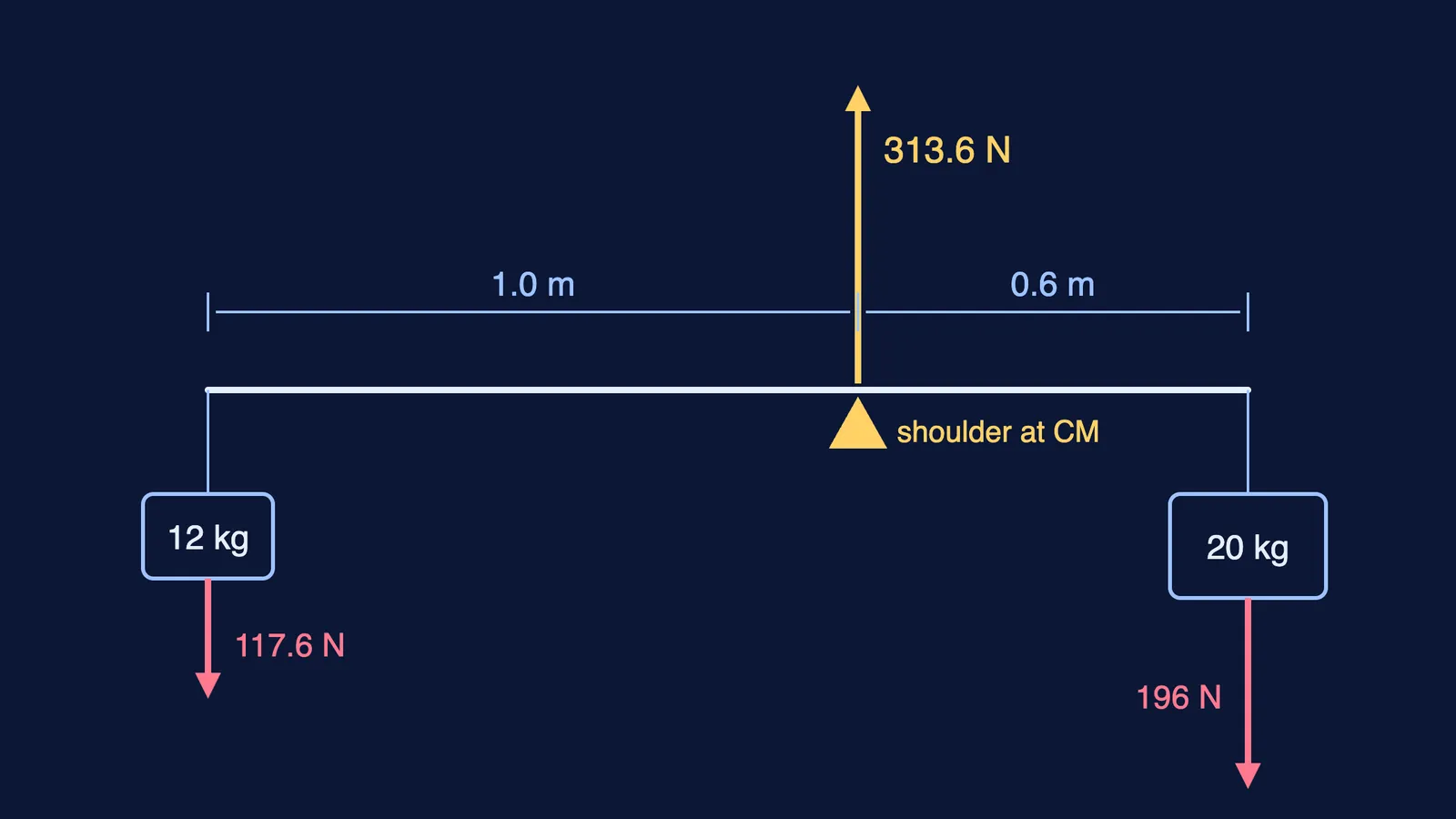
Ramesh sells vegetables at a weekly market near Nashik. He carries two baskets on a light bamboo pole 1.6 m long resting on his shoulder: a 12 kg basket of tomatoes hangs from one end and a 20 kg basket of onions from the other. Treat the pole as massless and the baskets as point loads. At the right point on his shoulder, the pole stays level without his hands. One day he rests the pole at its midpoint instead and holds the lighter end to keep it level.
(i) The centre of mass of the two baskets lies: (a) at the midpoint of the pole (b) closer to the 12 kg basket (c) closer to the 20 kg basket (d) outside the pole
(ii) How far from the 12 kg basket must the shoulder be for the pole to balance by itself?
(iii) What upward force does his shoulder exert when the pole balances by itself?
(iv) With the shoulder at the midpoint, what vertical force must his hand apply at the 12 kg end, and what force does the shoulder now carry?
Answers.
(i) (c). The centre of mass sits nearer the heavier mass.
(ii) x = (12 × 0 + 20 × 1.6)/32 = 1.0 m from the 12 kg basket (0.6 m from the other).
(iii) For translational equilibrium, N = (12 + 20) × 9.8 = 313.6 N.
(iv) About the shoulder, the net torque of the loads is (20 − 12) × 9.8 × 0.8 = 62.72 N m. The hand, 0.8 m away, must push down with 62.72/0.8 = 78.4 N. The shoulder now carries 313.6 + 78.4 = 392 N.
Case 2: Spinning up an electric potter's wheel
A pottery studio in Khurja buys an electric potter's wheel. Its wheel head is a uniform solid metal disc of mass 30 kg and radius 0.30 m, rotating about a vertical axis through its centre. The motor takes it from rest to 12 rad/s in 4.0 s, with constant torque. Ignore bearing friction.
(i) The moment of inertia of the wheel head about its axis is: (a) 2.70 kg m² (b) 1.35 kg m² (c) 0.675 kg m² (d) 0.090 kg m²
(ii) Find the angular acceleration and the torque supplied by the motor.
(iii) Through how many revolutions does the wheel turn during the 4.0 s start-up?
(iv) Find the motor's power at 4.0 s and its average power over the start-up, and explain the difference.
Answers.
(i) (b). For a disc about its central perpendicular axis, I = MR²/2 = 30 × 0.09/2 = 1.35 kg m².
(ii) α = 12/4.0 = 3.0 rad/s². τ = Iα = 1.35 × 3.0 = 4.05 N m.
(iii) θ = ½αt² = ½ × 3.0 × 16 = 24 rad, and 24/2π ≈ 3.8 revolutions.
(iv) At 4.0 s, P = τω = 4.05 × 12 = 48.6 W. The wheel gains K = ½Iω² = ½ × 1.35 × 144 = 97.2 J in 4.0 s, so average power = 24.3 W. With constant torque, power grows with ω, so the final value is twice the average.
Case 3: Children on a playground roundabout
A park roundabout in Chandigarh is a uniform disc of mass 120 kg and radius 1.5 m on a frictionless vertical axle. Meera (30 kg) stands at the rim while it turns freely at 1.0 rad/s. She walks slowly to the centre. Later, with Meera at the centre, her friend Kabir (20 kg) runs at 3.0 m/s along a tangent to the rim, in the direction of rotation, grabs the rim and holds on. Treat both children as point masses.
(i) As Meera walks to the centre, which quantity stays constant? (a) angular velocity (b) rotational kinetic energy (c) angular momentum about the axle (d) moment of inertia
(ii) Find the total moment of inertia about the axle when Meera stands at the rim.
(iii) Find the angular speed when Meera reaches the centre.
(iv) Find the angular speed after Kabir grabs the rim. Is kinetic energy conserved when he grabs on?
Answers.
(i) (c). No external torque acts about the axle, so Iω is constant.
(ii) Platform: ½ × 120 × 1.5² = 135 kg m². Meera: 30 × 1.5² = 67.5 kg m². Total 202.5 kg m².
(iii) 202.5 × 1.0 = 135 × ω, so ω = 1.5 rad/s.
(iv) Angular momentum before: 135 × 1.5 + 20 × 3.0 × 1.5 = 202.5 + 90 = 292.5 kg m²/s. New I = 135 + 20 × 1.5² = 180 kg m², so ω = 292.5/180 = 1.625 ≈ 1.6 rad/s. Kinetic energy falls from 241.9 J to 237.7 J: about 4.2 J is lost, as in any sticking collision.
How do you solve rotational motion case-study questions?
Mark the axis first; torque, moment of inertia and angular momentum all depend on it.
For balance problems, take torques about the support; its unknown force then drops out.
Learn the Table 6.1 values with their axes: a disc is MR²/2 about its central perpendicular axis but MR²/4 about a diameter.
Before using Iω = constant, say in one line why the external torque about the axis is zero.
Check units: N m for torque, kg m² for moment of inertia.
Next, read our guide to answering case-based questions and try the assertion-reason questions on rotational motion. If a spinning system is hard to picture, the Fermi Simulation Lab has interactive simulations for the ideas that are easier to see than to read.


