On this page
These 10 original questions test what numericals skip: whether a statement is true, and whether one true statement causes another.
What do the answer keys mean?
Assertion-reason items:
(A) Both A and R are true and R is the correct explanation of A.
(B) Both A and R are true but R is NOT the correct explanation of A.
(C) A is true but R is false.
(D) A is false but R is true.
Statement I / Statement II items:
(A) Both statements are correct.
(B) Both statements are incorrect.
(C) Statement I is correct, Statement II is incorrect.
(D) Statement I is incorrect, Statement II is correct.
Every item stays inside Unit 5 of the NMC syllabus for NEET (UG)-2026 and is checked against Chapter 6 of the NCERT Class 11 Physics textbook, Reprint 2026-27. Our Rotational Motion for NEET preparation guide covers the theory; our assertion-reason strategy explains the method.
Assertion-reason questions on rotational motion
Q1 (easy). Assertion (A): A force whose line of action passes through the axis of rotation produces no torque about that axis. Reason (R): The magnitude of torque equals the force multiplied by the perpendicular distance of its line of action from the axis.
Answer: (A). Both true: zero perpendicular distance gives zero torque, directly from R.
Trap: choosing (B) because R looks like just a formula.
Q2 (easy). Assertion (A): In a rigid body rotating about a fixed axis, every particle has the same linear speed. Reason (R): In a rigid body rotating about a fixed axis, every particle has the same angular velocity.
Answer: (D). R is true, but v = ωr, so a particle twice as far from the axis moves twice as fast. A is false.
Trap: carrying "same ω" over to linear speed.
Q3 (medium). Assertion (A): About the central axis perpendicular to its plane, a thin ring has a larger moment of inertia than a uniform disc of the same mass and radius. Reason (R): All the ring's mass sits at the rim, one radius from the axis, while much of the disc's mass lies closer to it.
Answer: (A). NCERT's Table 6.1 gives MR² for the ring and MR²/2 for the disc. Mass farther from the axis adds more, which is what R says.
Trap: thinking equal mass and radius means equal moment of inertia.
Q4 (medium). Assertion (A): An engine's flywheel resists sudden increases or decreases in the speed of the vehicle. Reason (R): The moment of inertia of a body depends on the position and orientation of the axis of rotation.
Answer: (B). Both true. The flywheel smooths speed changes because its moment of inertia is large, as NCERT explains. R is true in general but does not explain the flywheel.
Trap: picking (A) because both statements mention moment of inertia.
Q5 (hard). Assertion (A): A skater spinning freely speeds up when she pulls her arms in. Reason (R): Her rotational kinetic energy stays constant, because no external torque acts.
Answer: (C). A is true: with no external torque Iω is constant, so smaller I means larger ω. R is false: kinetic energy is L²/2I, so halving I doubles it. Her muscles supply the extra energy.
Trap: assuming energy is conserved whenever angular momentum is.
Q6 (hard). Assertion (A): A particle moving with constant velocity along a straight line has constant angular momentum about any fixed point. Reason (R): A particle moving in a straight line has zero angular momentum about every point.
Answer: (C). A is true: the magnitude of r × p is mv times the perpendicular distance from the point to the line, which never changes; the direction is fixed too. R is false: that angular momentum is zero only about points on the line itself.
Trap: thinking a straight path means no angular momentum.
Statement I / Statement II questions
Q7 (medium). Statement I: The moment of inertia of a thin uniform rod about an axis through its midpoint, perpendicular to the rod, is ML²/12. Statement II: The radius of gyration of the same rod about the same axis is L/(2√3).
Answer: (A). Statement I matches Table 6.1. From I = Mk², k² = L²/12, so k = L/√12 = L/(2√3).
Trap: writing k = L/12 by forgetting the square root.
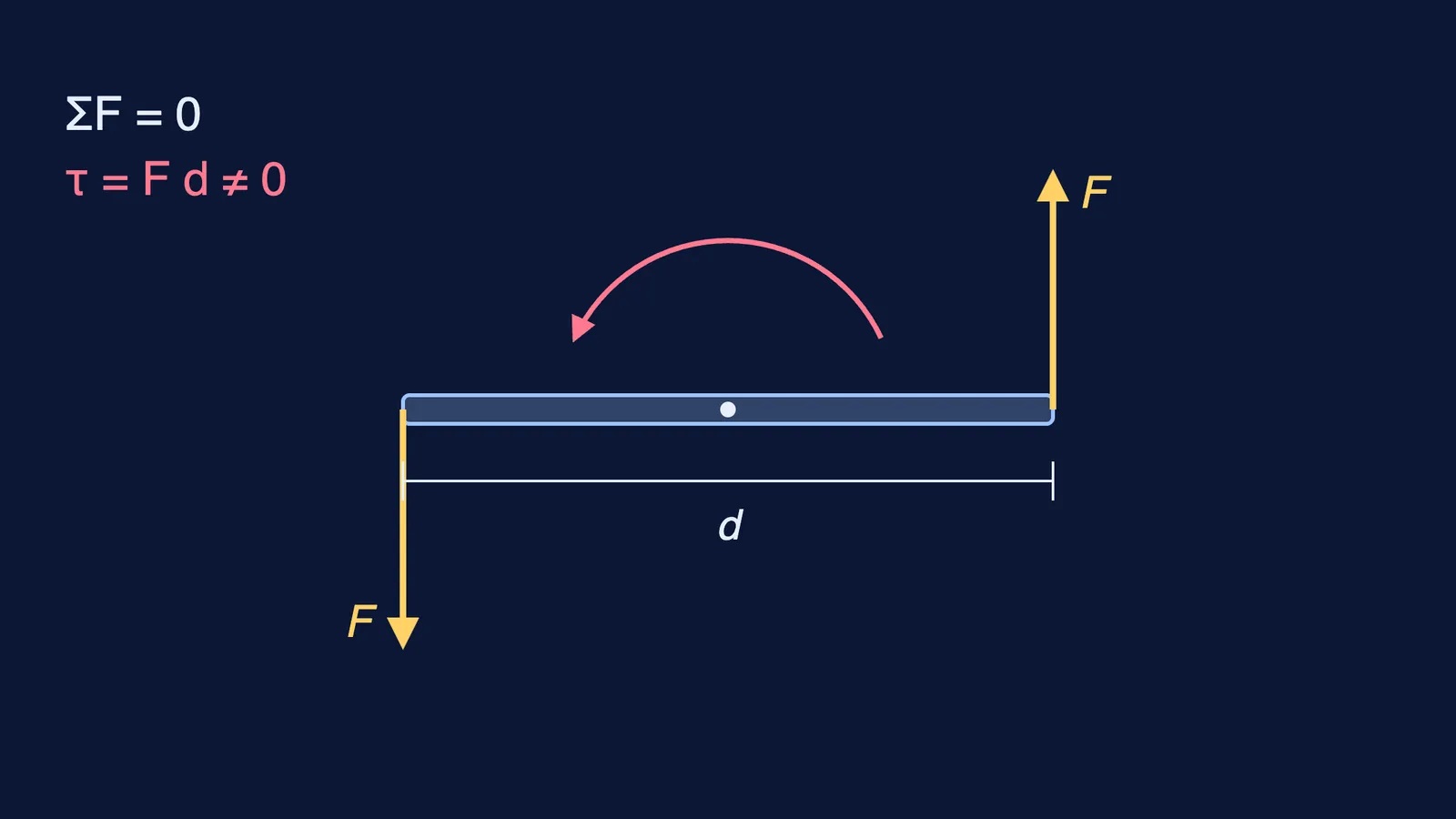
Q8 (medium). Statement I: If the net external force on a rigid body is zero, it is in translational equilibrium. Statement II: If the net external force on a rigid body is zero, the net torque on it must also be zero.
Answer: (C). Statement I is correct. Statement II fails for a couple: equal, opposite forces on different lines of action add to zero but give a torque of F times their separation, as in the diagram above.
Trap: assuming one equilibrium condition gives you the other.
Q9 (hard). Statement I: When a projectile explodes in mid-air (no air resistance), its centre of mass leaves its parabolic path. Statement II: Internal forces cannot change the motion of the centre of mass of a system.
Answer: (D). The explosion forces are internal, so only gravity steers the centre of mass. It stays on the same parabola, as NCERT's Fig. 6.12 shows.
Trap: watching the fragments, not the centre of mass.
Q10 (hard). Statement I: The angular momentum of a system is conserved whenever the net external force on it is zero. Statement II: If the net external torque about a point is zero, the linear momentum of the system must be conserved.
Answer: (B). Both are wrong. A couple gives zero net force but non-zero torque, so angular momentum changes. A single force through the point gives zero torque about it yet changes linear momentum.
Trap: swapping the laws. Zero force conserves linear momentum; zero torque conserves angular momentum.
How should you use this set?
Mark a key for all 10 before checking any.
For each miss, note which check failed: A, R or the link.
Rewrite every false statement as a true one.
Redo misses in two days, then try our Rotational Motion NEET practice questions with solutions.
If Q5 or Q8 felt abstract, the Fermi Simulation Lab has interactive simulations for the ideas that are easier to see than to read.