
On this page
Chapter 6 of the NCERT Class 11 Physics Part I textbook, 2026-27 reprint, System of Particles and Rotational Motion, derives five results from Newton's laws. Each is set out below: setup, numbered steps, result and the usual slip. For the chapter's scope and a revision plan, read our System of Particles and Rotational Motion Class 11 guide.
The CBSE Class XI Physics syllabus for 2026-27 lists moment of inertia values for simple shapes with "no derivation", so those are left out here.
Motion of the centre of mass: why does MA = F_ext?
Setup: n particles with constant masses m1, m2, … mn at position vectors r1, r2, … rn; total mass M = Σmi; R is the position of the centre of mass.
Start from the definition: MR = m1r1 + m2r2 + … + mnrn.
Differentiate once, keeping the masses constant: MV = m1v1 + … + mnvn, where V = dR/dt.
Differentiate again: MA = m1a1 + … + mnan, where A = dV/dt.
Newton's second law for each particle gives miai = Fi, the total force on particle i.
Each Fi is external force plus internal force. Internal forces come in equal and opposite third-law pairs, so they cancel in the sum.
Result: MA = F_ext. The right side of step 2 is the total momentum, so P = MV and dP/dt = F_ext; when F_ext = 0, P stays constant.
Where students slip: leaving internal forces in step 5.
Centre of mass of a uniform rod: why is it at the middle?
Setup: a thin uniform rod of length L and mass M, origin at its geometric centre, x-axis along the rod.
For a continuous body, X = (1/M)∫x dm.
The rod is uniform, so every element dm at x has a matching element dm at −x.
Each such pair adds x dm + (−x) dm = 0 to the integral.
So ∫x dm = 0 and X = 0. The same reflection argument gives Y = 0 and Z = 0.
Result: the centre of mass of a uniform rod is at its geometric centre, L/2 from either end.
Where students slip: using symmetry for a rod whose mass is not spread evenly.
Torque and angular momentum: how do you get dL/dt = τ_ext?
Setup: one particle of mass m at position r with momentum p = mv about origin O, then a system of n particles.
Angular momentum is l = r × p. The product rule gives dl/dt = (dr/dt) × p + r × (dp/dt).
dr/dt = v, and v is parallel to p = mv, so v × mv = 0.
dp/dt = F, so dl/dt = r × F = τ.
For the system, L = Σli, so dL/dt = Στi; split each torque into external and internal parts.
Assume the third law and that the force between two particles acts along the line joining them. Then each pair's torques cancel, and τ_int = 0.
Result: dL/dt = τ_ext. If the total external torque is zero, L is constant: conservation of angular momentum.
Where students slip: crediting the cancellation to the third law alone; the forces must also act along the line joining the pair.
Kinetic energy of rotation: K = ½Iω²
Setup: a rigid body rotating about a fixed axis with angular speed ω; particle i has mass mi at perpendicular distance ri from the axis.
Each particle moves in a circle, so its speed is vi = riω.
Add the kinetic energies: K = Σ ½mivi² = Σ ½miri²ω².
Every particle has the same ω, so take it out of the sum: K = ½ω²(Σmiri²).
Define the moment of inertia I = Σmiri².
Result: K = ½Iω², where I = Σmiri² is measured in kg m².
Where students slip: treating I as a fixed property of the body. It changes when the axis changes, because the ri change.
Torque and angular acceleration: how is τ = Iα derived?
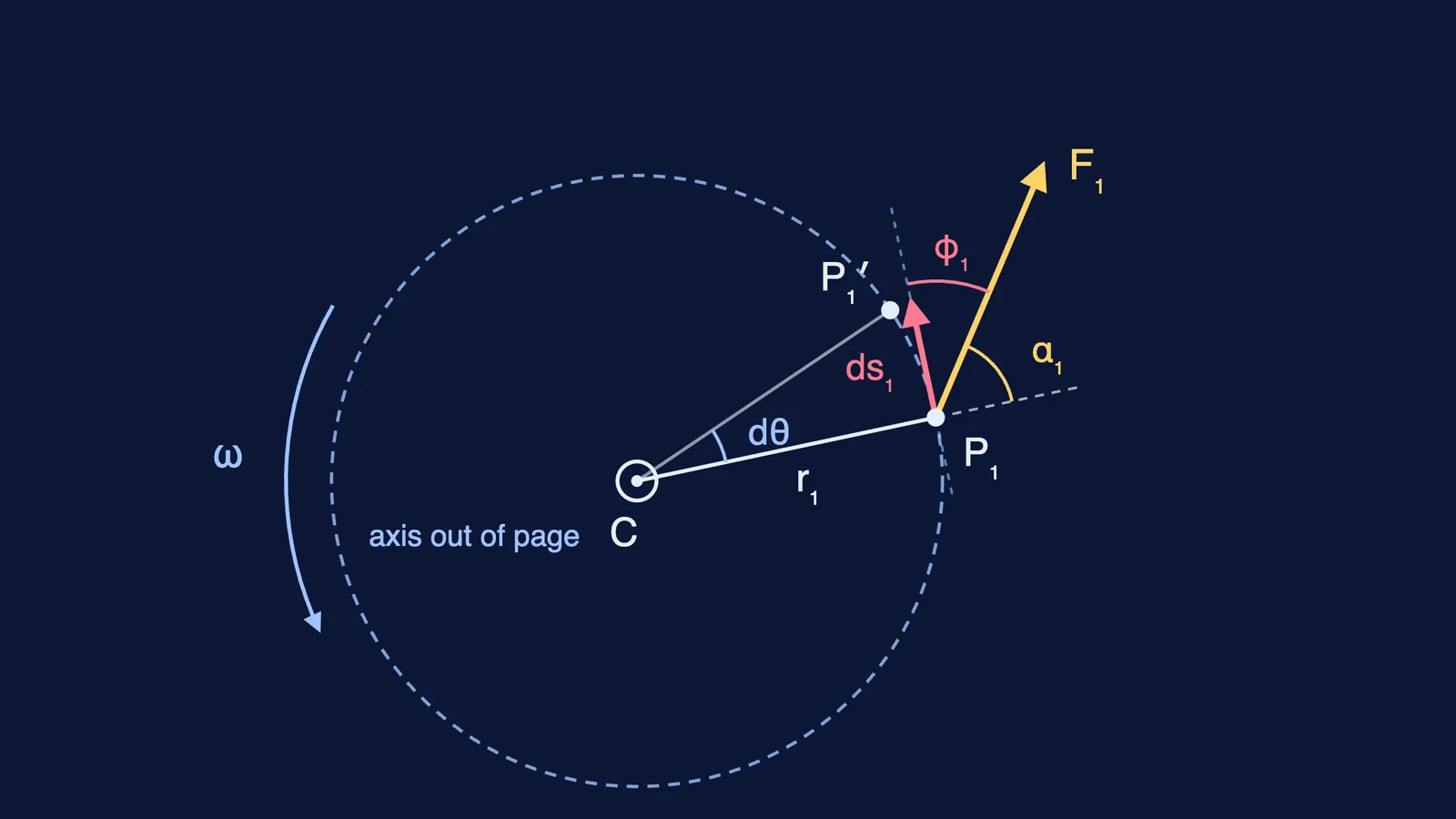
Setup (the figure above): a rigid body rotating about a fixed axis through C. A force F1, in the plane perpendicular to the axis, acts on a particle at P1, a distance r1 from C. α1 is the angle between F1 and the radius CP1; φ1 is the angle between F1 and the tangent, so φ1 + α1 = 90°.
In a small rotation dθ, P1 moves ds1 = r1dθ along the tangent.
Work done by F1: dW1 = F1ds1 cos φ1 = F1r1 sin α1 dθ.
r1F1 sin α1 is the torque τ1 about the axis, so dW1 = τ1dθ. Adding all the forces, dW = τdθ.
Divide by dt: the power is P = τω.
Nothing inside a rigid body moves relative to anything else, so no work is lost internally and this power goes entirely into kinetic energy: d(½Iω²)/dt = Iω(dω/dt) = Iωα, with I constant.
Equate the two rates: τω = Iωα.
Result: τ = Iα, Newton's second law for rotation about a fixed axis.
NCERT reaches the same result a second way in Section 6.12, by differentiating Lz = Iω and using dL/dt = τ.
Where students slip: writing cos α1 in step 2. The cosine belongs to the angle with the tangent; with the radius it becomes a sine.
How to practise derivations in this chapter
Draw the figure first and mark whether you are measuring from an origin or from the axis.
Say each assumption at the step that uses it: constant masses, a uniform rod, forces along the joining line, constant I.
Pair each result with its linear twin (MA = F_ext with τ = Iα, P = MV with L = Iω); our linear and rotational analogues side by side lists them.
End with a units check: N m = kg m² × rad s⁻², since radians carry no dimension.
Write each one from a blank page, compare with NCERT step by step, then use the results on our rotational motion case study questions for Class 11.
If the angles in the τ = Iα derivation are hard to picture, the Fermi Simulation Lab has interactive simulations for the ideas that are easier to see than to read.