On this page
Regional Aspirations is chapter 7 of Politics in India since Independence. This guide follows the NCERT chapter (Reprint 2026-27) region by region.
How many marks is Regional Aspirations worth in 2026-27?
The CBSE Political Science curriculum for 2026-27 gives Regional Aspirations 6 marks out of the 40 for Part B. Its listed topics are Region and the Nation, Jammu and Kashmir, Punjab and the North-East. Its annexure adds reference material, including a note on Jammu and Kashmir.
The topic list omits the Dravidian movement and Sikkim, but the 2026-27 sample paper asks about both, so revise the whole chapter.
What does NCERT mean by the Indian approach?
NCERT says India chose a democratic approach to diversity: regions and linguistic groups keep their own culture, and the nation does not mean the negation of the region. Democracy does not treat regional aspirations as anti-national. Many demands of the 1980s ended in negotiated accords within the constitutional framework.
What happened in Jammu and Kashmir?
NCERT describes three regions, Jammu, Kashmir and Ladakh, and this sequence:
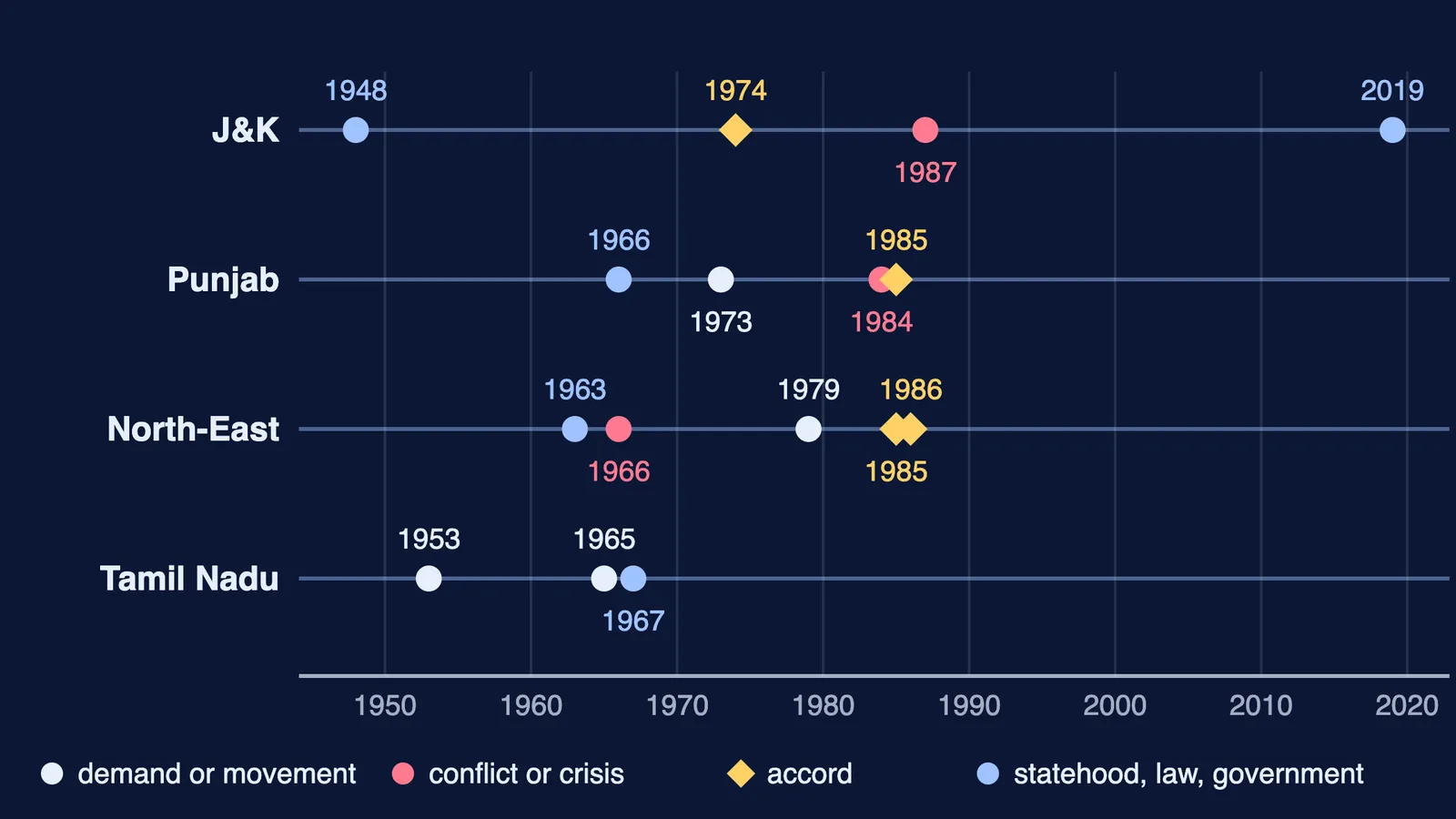
1947: in October, after tribal infiltrators sent from Pakistan entered, the Maharaja signed the Instrument of Accession and India sent troops.
1948: a UN resolution of 21 April proposed a three-step process that made no progress; Sheikh Abdullah became Prime Minister of the state in March, and India agreed to provisional autonomy under Article 370.
1953 to 1974: Sheikh Abdullah was dismissed in 1953; a 1974 agreement with Indira Gandhi made him Chief Minister.
1987: NCERT says the election result was widely believed not to reflect popular choice, and a crisis followed; by 1989 a militant movement backed by Pakistan had grown; NCERT also notes the displacement of Kashmiri Pandits.
1996 to 2018: Assembly elections were held again in 1996; President's rule followed in June 2018 after the BJP left the PDP-led government.
August 2019: NCERT records that Article 370 was abrogated and that, under the Jammu and Kashmir Reorganisation Act 2019, the State became two Union Territories, Jammu and Kashmir, and Ladakh.
NCERT records two opposite views of Article 370: one, held outside the State, that it blocked full integration; the other, held mostly in Kashmir, that its autonomy was not enough.
What were Punjab's demands, and what did the Punjab Accord say?
Punjab got a Punjabi-speaking State in 1966, after a movement led by the Akali Dal. In 1973 the Anandpur Sahib Resolution asked for regional autonomy and a redefined centre-state relationship; NCERT calls it a plea for strengthening federalism that had limited appeal. Leadership later passed to militant groups.
In June 1984 Operation Blue Star removed militants from the Golden Temple but damaged the shrine. After Indira Gandhi's assassination on 31 October 1984, NCERT records, over two thousand Sikhs died in Delhi in the violence that followed.
The Rajiv Gandhi-Longowal Accord of July 1985 agreed to transfer Chandigarh to Punjab, set up a commission on the Punjab-Haryana border and a tribunal on Ravi-Beas water, and withdraw the Armed Forces Special Powers Act in Punjab. NCERT notes 24 per cent turnout in 1992 and peace by the mid-1990s.
What did the North-East and Tamil Nadu demand?
NCERT sorts North-East politics into three issues:
Autonomy: tribal leaders sought a State separate from Assam. Nagaland became a State in 1963, Meghalaya, Manipur and Tripura in 1972, and Mizoram and Arunachal Pradesh in 1987.
Secession: the Mizo National Front under Laldenga began an armed campaign in 1966; the 1986 Rajiv Gandhi-Laldenga accord brought full statehood, and the MNF gave up secession. NCERT notes that Nagaland still awaits a final resolution.
Outsiders: the AASU-led Assam Movement (1979-1985) ended with the 1985 Assam Accord on identifying and deporting foreigners who came during and after the Bangladesh war.
Sikkim, a protectorate, became the 22nd State in 1975 after an Assembly request and a referendum. In Tamil Nadu, the DMK entered politics through three agitations in 1953-54 and won power in 1967; NCERT calls it a good example of regionalism and nationalism fitting together.
How do you answer board questions on Regional Aspirations?
The sample paper has a 2-mark question (Q17) on the DMK's early objectives and a passage on Sikkim's merger (Q25, 1+1+1+1=4 marks). Its marking scheme lists three DMK objectives and accepts any two. Build one grid, a row per case:
Region and years, such as Mizoram, 1966-1986.
Demand: autonomy, secession, outsiders, or language.
Response: statehood, accord, or constitutional change.
Lesson: negotiation, power sharing, or flexible federalism.
Practice questions (our own):
(1 mark) Which accord of 1986 led to full statehood for Mizoram?
(2 marks) Give two reasons the Mizo accord of 1986 is seen as a turning point for Mizoram.
(4 marks) Compare demands for autonomy and secessionist movements in the North-East, with one example each.
(6 marks) Using two cases, explain NCERT's lesson that negotiation works better than suppression.
Revise the background in our Challenges of nation building Class 12 guide, then Recent Developments in Indian Politics, and see how to write Political Science board answers.
If you are unsure where to start, Fermi's AI tutor can work out what you already know and build a plan for the session.