On this page
Recent Developments in Indian Politics is the last chapter of Politics in India since Independence. This guide turns the current NCERT chapter (Reprint 2026-27) into a dated timeline for board answers.
How many marks is Recent Developments in Indian Politics worth?
The CBSE Political Science curriculum for 2026-27 gives the chapter 8 marks out of the 40 for Part B. Its topics run from the context of the 1990s and the era of coalition to Mandal, Ayodhya, Lok Sabha elections from 2004 to 2019 and growing consensus. CBSE notes that its annexure of additional reference material will not be assessed in the board exam.
Why is 1989 called a turning point?
NCERT names five developments at the end of the 1980s:
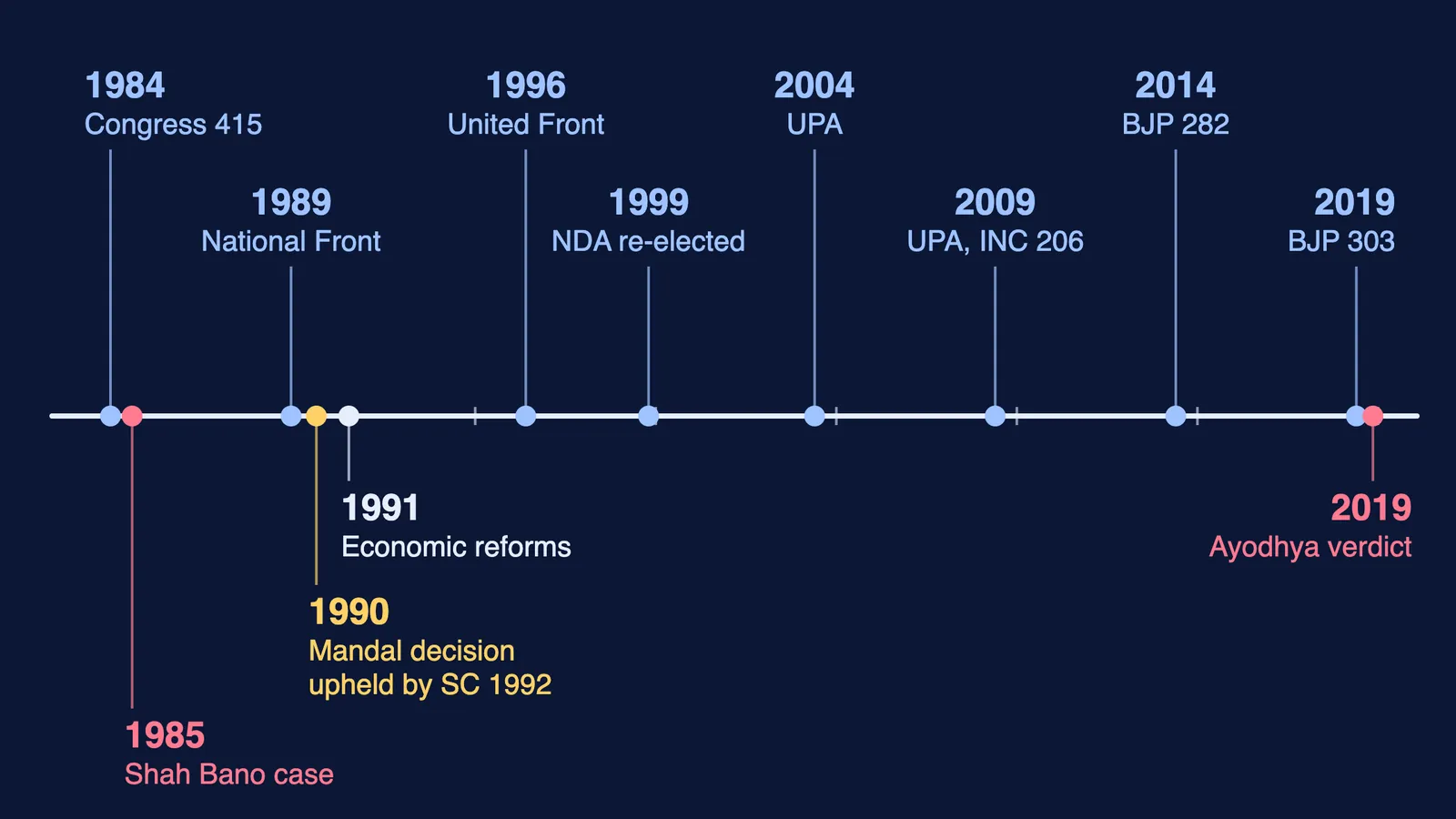
End of the Congress system. Congress fell from 415 Lok Sabha seats in 1984 to 197 in 1989. It stayed an important party but lost its central place.
The Mandal issue. In 1990 the National Front government decided to implement the Mandal Commission's recommendation on reserving central government jobs for OBCs.
New economic policy. The structural adjustment programme, started under Rajiv Gandhi, became very visible in 1991.
The Ayodhya dispute started influencing national politics and, in NCERT's account, changed the discourse on secularism and democracy.
Rajiv Gandhi's assassination in May 1991 changed Congress leadership; P. V. Narasimha Rao became Prime Minister.
What happened in the era of coalitions?
According to NCERT, no single party won a clear majority in any Lok Sabha election from 1989 to 2009; in 2014 and 2019 the BJP won one on its own. Learn the sequence:
1989: the National Front (Janata Dal and regional parties) formed the government, supported by both the BJP and the Left Front, neither of which joined it.
1996: the United Front took office with Congress support, while the BJP stayed out. NCERT calls these equations unstable.
1998 and 1999: the BJP led coalition governments under Atal Behari Vajpayee; the 1999 government completed its full term.
2004 and 2009: the Congress-led UPA governed, with Dr Manmohan Singh as Prime Minister. Congress seats rose from 145 to 206.
2014: the BJP won 282 seats, which NCERT describes as the first single-party majority in 30 years, and still formed the NDA government with partners. In 2019 it won 303.
How did Mandal change the politics of OBCs?
The Mandal Commission, officially the Second Backward Classes Commission, was appointed in 1978 under B. P. Mandal and reported in 1980. Its recommendation was a 27 per cent reservation for backward classes in government jobs and in educational institutions. The August 1990 decision led to protests and to the Indira Sawhney case; in November 1992 the Supreme Court upheld the decision (NCERT). NCERT also traces the rise of the Bahujan Samaj Party under Kanshi Ram, with its 1989 and 1991 breakthrough in Uttar Pradesh.
How does NCERT present Ayodhya and the new consensus?
NCERT names two developments around 1986 that became central to the BJP's politics. In the Shah Bano case (1985) the Supreme Court ruled for a divorced Muslim woman seeking maintenance, and the Muslim Women (Protection of Rights on Divorce) Act, 1986 then nullified that judgement. On Ayodhya, NCERT records the 1949 sealing of the structure, the 1986 district court order opening it, and its demolition in 1992. On 9 November 2019 a constitutional bench of the Supreme Court gave a 5-0 verdict: the site went to a trust for a Ram temple, and the government was directed to allot the Sunni Central Waqf Board a suitable site to build a mosque (NCERT). NCERT presents the verdict as an example of a dispute resolved through due process of law.
The chapter closes with four elements of a growing consensus among most parties: support for the new economic policies, acceptance of the claims of backward castes, acceptance of State-level parties in national government, and pragmatic alliances over ideology.
How do you write board answers on this chapter?
The 2026-27 sample paper asks a 1-mark matching question on consensus, the new economic policy, coalitions and the United Front, and a 6-mark question on coalition politics since 1989 that asks for examples. Its marking scheme expects any three points to be explained. Use this frame:
Claim (1 line): state the change.
Three points: each with one date or figure from the timeline.
Close (1 line): link back to the question.
Practice questions written for this guide:
(1 mark) Which government took the 1990 decision on OBC reservations in central government jobs?
(2 marks) Give two reasons why 1989 is seen as the end of the Congress system.
(4 marks) How did the Mandal Commission's recommendations and the 1990 decision change the politics of the OBCs?
(6 marks) Explain the four elements of the growing consensus, with one example each.
Time yourself with the 20-minute board answer-writing drill, and revise the book's first chapter with our Challenges of nation building Class 12 guide.
If you are unsure where to start, Fermi's AI tutor can work out what you already know and build a plan for the session.