

On this page
How do examiners mark political science board papers?
In the senior secondary board examination, examiners assess students on an 80-mark theory paper across 30 compulsory questions, as specified on the CBSE Academic Portal. A frequent mistake among humanities students is treating political science like a literary essay where word volume determines the score. In reality, board evaluation is criterion-driven and rapid.
Examiners grade scripts against an official marking scheme divided into predetermined value points. In a systematic review of 75 studies on scoring rubrics in *Educational Research Review*, researchers Anders Jönsson and Gunilla Svingby found that explicit, analytic rubrics enhance scoring reliability by holding evaluators to objective markers (Jönsson & Svingby, 2007). An evaluator reading dozens of scripts daily scans specifically for syllabus keywords and numbered points. Understanding how examiners apply CBSE marking schemes enables you to present answers in the precise layout examiners are instructed to reward.
How should you structure 2-mark, 4-mark and 6-mark answers?
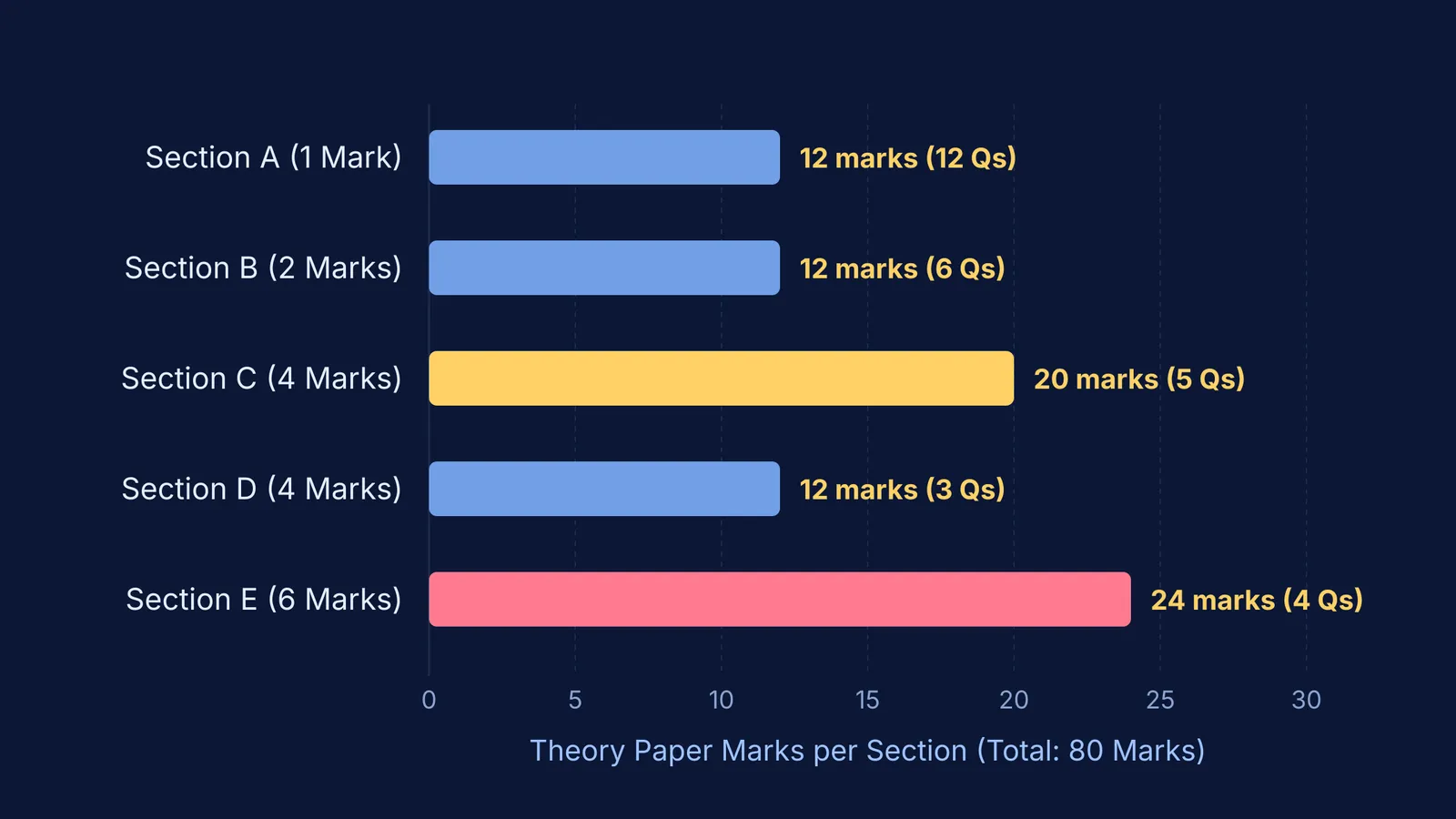
Board question papers follow specifications on the CBSE Academic Portal, enforcing strict word counts and mark allocations across three main descriptive tiers:
Section B (2 marks, questions 13 to 18): Word limit is 50 to 60 words. State the core concept or definition in your first sentence, and give the constitutional article or historical example in the second, providing two distinct 1-mark value points.
Section C (4 marks, questions 19 to 23): Word limit is 100 to 120 words. Provide four distinct value points formatted as numbered items, each starting with a bold concept heading followed by a two-sentence explanation.
Section E (6 marks, questions 27 to 30): Word limit is 170 to 180 words. Provide a two-sentence introductory definition, three detailed points with subheadings carrying 2 marks each (or six distinct value points), and a concise conclusion.
Educational research supports this structured approach. In a meta-analysis in the *Journal of Educational Psychology*, researchers Steve Graham and Dolores Perin found that setting specific product goals produced a weighted effect size of 0.70, while teaching explicit writing strategies achieved an effect size of 0.82 (Graham & Perin, 2007). Point targets keep answers concise and aligned with the marking scheme.
Why are NCERT key terms and concrete examples essential?
Political science answers require domain-specific vocabulary. Prescribed textbooks on the NCERT Textbooks Portal—*Contemporary World Politics* and *Politics in India Since Independence*—contain exact analytical terms that marking rubrics reproduce word for word.
You should deliberately practice retrieving and including core syllabus concepts:
Global politics: Shock Therapy, Democratic Upsurge, Common but Differentiated Responsibilities, the ASEAN Way, and Structural Adjustment.
Indian politics: Congress System, Syndicate, Privy Purse abolition, Judicial Activism, Coalition Era, and Mandal Commission recommendations.
Anchor every claim to a concrete fact: an amendment number, treaty, year, or named body. Stating that "nations agreed to protect nature" earns partial credit; citing the "1992 Rio Summit and the principle of Common but Differentiated Responsibilities" earns full marks. While Fermi's AI tutor works out what a student knows and builds a plan for the session in STEM subjects, mastering political science requires you to construct your own deliberate syllabus glossary to ensure rapid, precise conceptual recall.
How should you tackle map, cartoon and passage questions?
Section D features three 4-mark questions (questions 24 to 26) testing source evaluation. With competency-based questions making up 50% of board assessments on the CBSE Academic Portal, using proven CBSE competency-based question strategies is critical.
Apply these rules for Section D:
Map questions: Do not simply label the map. CBSE instructions require a four-column table in your answer sheet: Serial Number, Clue Used, Alphabet on Map, and Name of the State or Country. Omitting the table risks losing marks.
Cartoon analysis: Identify the political leaders and symbols, state the historical dispute or election portrayed, and explain the underlying political critique.
Passage questions: Never copy full lines from the extract. Use the excerpt for context, but formulate your answers using textbook definitions and conceptual reasoning.
What does a high-scoring structured answer look like?
Consider an examiner grading a 4-mark question on the economic consequences of globalisation from the syllabus on the CBSE Academic Portal. An unstructured paragraph forces the examiner to hunt for credit.
A high-scoring answer uses four transparent value points:
Capital and trade mobility: Globalisation expands international flows of commodities, technology, and capital by reducing state tariffs and trade barriers.
State deregulation: It reduces government subsidies and social safety nets, prompting market privatisation and deregulation across national economies.
Unequal distribution: While benefiting skilled professionals and multinational firms, it often causes economic vulnerability for unorganised workers and small-scale farmers.
Institutional resistance: Developing countries and civil society groups coordinate resistance through forums like the World Social Forum (WSF) to advocate for equitable economic rules.
Each point features a clear thematic heading and official terminology, directly earning its designated mark. Leave five minutes at the end for reviewing your answers in the final minutes to underline key terms and verify question numbers.


